By Mumbai Rises to Save Democracy
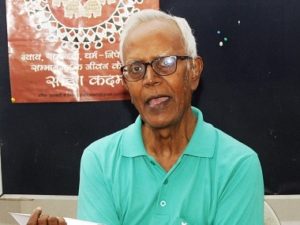
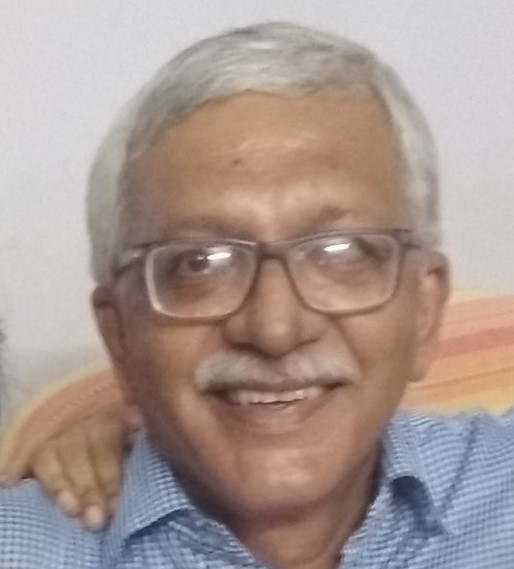
Characterised by a loose cotton half sleeve shirt, loose trousers, spectacles, a jhola and a hearty laughter, Vernon Gonsalves comes across as an effervescent wise man. Gonsalves gets along well with everyone from the age of six to sixty. His demeanour reflects an inner happiness. He started a band in college, but gave it up to be a part of people’s movements. His songs still hold the flavour of 70s rock.
Vernon’s pen is as sharp as his vision for an equitable, just society without distinctions of class, caste, race, with principles of gender equality and justice at its core. He is an acute political observer and makes nuanced arguments about complex sociopolitical-economic issues. Vernon has shown a keenness to understand the latest undercurrents in progressive politics.
He was born to a Mangalorean Catholic couple and grew up in a chawl in a modest locality in Byculla in Mumbai. Vernon was always good with academics and won a gold medal in Commerce from Mumbai University. Subsequently, he left his corporate job in Siemens to work with trade unions, workers, slum dwellers and the working class in Mumbai. During this period, he taught in prominent colleges in Mumbai including Ruparel College, HR College of Commerce and Economics, and Akbar Peerbhoy College of Commerce and Economics. Very few know that, in college he wanted to be a musician. Rumours say that he had also started a band but could not find meaning in it.
Around 1983, he moved to Chandrapur near Nagpur to work with unorganised sector workers including the coal-mine workers in the area. In 1984, he married fellow activist Susan Abraham. It was a union of two unique and fiercely independent minds. They worked in Chandrapur for a decade. After their son Sagar was born in 1994, they returned to Mumbai.
On 19 August 2007, the Maharashtra ATS arrested Vernon from his residence in Andheri, Mumbai. His arrest was falsely shown as from the residence of his co-accused S. Shridhar in Govandi. They were charged with being “top-level” Naxalites having explosives in their possession. For some months prior to this, Vernon had been working for the rights of tribal communities in the Maharashtra district of Chandrapur. 20 cases were filed against him. He spent nearly six years in jail while his trial dragged on as an undertrial. He was acquitted in 18 cases, convicted in one against which his appeal is pending in the Nagpur HC while the application for discharge in the last case in Gujarat is pending before the High Court.
During his years as an undertrial in jail, Vernon spent most of his time writing. He is now working on a collection of prison writings. He edited a set of short stories written while imprisoned, one of which, “Jailbird Jabbar” was written in a typical staccato Bambaiya patois style. He also translated stories by Annabhau Sathe from Marathi to English for Aleph Publication’s “A Clutch of Short Stories.” After his release he wrote articles on prevailing law, rights of Dalit and tribal communities, the condition of prisons in India, land grabbing by the nexus of Corporates and the Government, misuse of the criminal justice system by the governments against marginalised communities, and scrapping of UAPA. One of his last published articles titled “Harsher Punishments and Retributive Criminal Justice” is a landmark commentary on the trends of crime control vis-a-vis justice system in the country.
Vernon’s son Sagar sums what everyone close to him feels about him:
“Among the many things that I admire greatly about my father is his commitment to his beliefs and ideals.To stand up for what is right and help those whose rights are denied – he has always done that and will continue to do so. This did not deter him the last time and will not do it now as well. He has an unbreakable spirit and will always stay true to what he believes in.”
WHO IS VERNON GONSALVES?
By India Civil Watch
Vernon Gonsalves is trade unionist, activist, an academic (former professor of business management in a college in Mumbai) and a writer, who writes extensively on Dalit and adivasi rights, the conditions of prisons in India and the routine violation of rights of prisoners. Along with Arun Ferriera, he has authored a number of popular articles on the condition of Indian jails, the abuse of authority by Indian police, and draconian laws such as the Unlawful Activities (Prevention) Act (UAPA), a piece of ‘anti-terror’ legislation with a wide ambit and vague concepts, which allows its misuse against academics, lawyers and human rights defenders. Equally importantly, their writings expose the hypocrisy of democracy in India. …
Read More Read More