The Bombay High Court on Friday asked the Indian National Congress, the People’s Union for Civil Liberties (PUCL) and the All India Trade Union Congress (AITUC) to furnish details of their registration, constitution and office-bearers before it proceeds to hear their petitions challenging the constitutional validity of the Maharashtra Special Public Security Act (MSPSA).
… The State’s affidavit cited various instances particularly, the caste-based riots infamously known as the Bhima-Koregaon Violence which broke out across Maharashtra on January 01, 2018. It stated that the arrest of the ‘central committee’ members of the Communist Party of India (Maoist) (CPI-M) in Elgar Parishad, brought national focus on ‘Urban Activities’ of ‘Urban Maoists.’ Read more
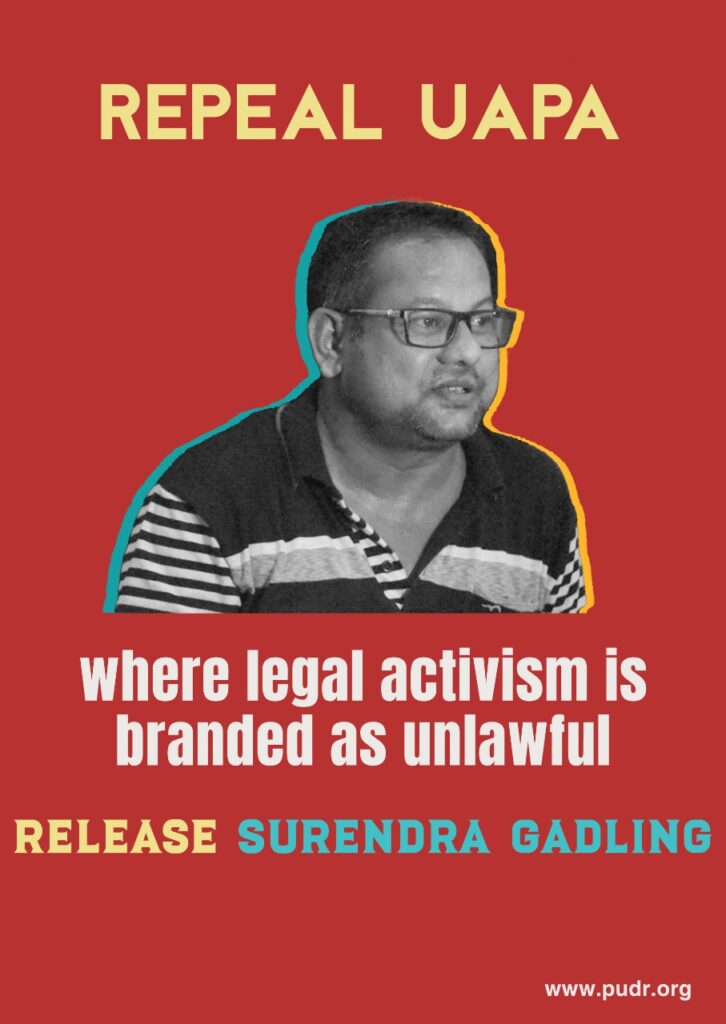
Surjagarh Arson Case: Supreme Court To Hear UAPA Accused Surendra Gadling’s Bail Plea On November 4
15/10/2026
Law Beat / by Sukriti Mishra
Senior Advocate Kapil Sibal on October 15, 2026 mentioned Surendra Gadling’s bail plea before a Supreme Court Bench including Justice Vikram Nath, which listed the matter for hearing on November 4
The Supreme Court on Thursday fixed Surendra Gadling’s plea for bail for hearing on November 4, after Senior Advocate Kapil Sibal urged the Court to fix a date, telling the Court that Gadling “has been inside for 7 years” and that the matter “is not being heard”.
Gadling’s plea was listed before a Bench of Justices Vikram Nath and Sandeep Mehta. Read more
Supreme Court Lists Surendra Gadling’s Bail Plea In Surjagarh Arson Case For November 4
15/10/2026
LawChakra / by LawChakra Desk
Years in custody and a plea that never seemed to reach the head of the cause list: the Supreme Court has now fixed November 4 to hear Surendra Gadling’s bail plea in the 2016 Surjagarh mine arson case, after Senior Advocate Kapil Sibal mentioned it.
Activist-lawyer Surendra Gadling, who remains in custody in the 2016 Surjagarh mine arson case in Gadchiroli, Maharashtra, will have his bail plea heard on November 4, the Supreme Court decided on Thursday, although he has already secured bail in the Bhima Koregaon case [Surendra Pundalik Gadling v. State of Maharashtra]. Read more
‘Maharashtra centre of Maoist urban network’: State defends Special Public Security Act in court
07/10/2026
The Indian Express / by Omkar Gokhale
Defending the law against Congress, CPI and AITUC pleas, the state says other Maoist-hit states already have similar laws that have withstood judicial scrutiny
Maharashtra, “because of its highest urban population has become center of Maoist urban network,” the state government has told the Bombay High Court, defending the Maharashtra Special Public Security (MSPS) Act. … Citing Elgaar Parishad and other cases, the affidavit claimed Maharashtra has the highest number of frontal organisations in the country, 64. It said Andhra Pradesh, Telangana, Chhattisgarh, Odisha and Jharkhand had banned such groups under similar laws that “withstood judicial scrutiny”, so Maharashtra was empowered to enact one for “local security environments”. Read more
Maharashtra Has Become ‘Centre’ Of Maoist Urban Network: State Defends Special Public Security Act Before Bombay High Court
07/10/2026
Live Law / by Narsi Benwal
The Maharashtra Government while defending its decision to enact the Maharashtra Special Public Security Act (MSPSA), on Tuesday (October 6) told the Bombay High Court that because of its highest urban population, the State has become a ‘centre’ for Maoist urban network and thus in absence of legal framework to ban such ‘left wing extremist’ organisations, it has come up with this law as done by states like Telangana, Andra Pradesh, Madhya Pradesh and Chhattisgarh. Read more
The Elgar Parishad case has been transferred from Mumbai’s designated NIA court in Sessions Court No. 25 to newly notified Court No. 26. The move comes as discharge hearings were nearing completion, with several applications pending for over two years. The transfer could require arguments to be repeated, potentially delaying proceedings.
Days after the NIA court refused to cancel the bail of activists Sudha Bharadwaj, poet Varavara Rao, Vernon Gonsalves and Arun Ferreira, booked in connection with their alleged involvement in the Elgar Parishad violence case, the case has been transferred to another court. Read more
Supreme Court to hear bail plea of Bhima Koregaon accused Surendra Gadling on October 14
01/09/2026
The Hindu / by The Hindu Bureau
The present bail plea arises from the 2016 Surjagarh arson case, in which several vehicles transporting iron ore from Surjagarh mines in Maharashtra’s Gadchiroli district were allegedly set ablaze by persons associated with the banned Communist Party of India (Maoist)
The Supreme Court said on Tuesday (September 1, 2026) that it would her on October 14 a bail plea filed by advocate and activist Surendra Gadling in connection with the 2016 Surjagarh iron ore mine arson case. Read more
Supreme Court to hear Surendra Gadling’s bail plea on Oct 14
01/09/2026
The Print / by pti
The Supreme Court on Tuesday said it would hear on October 14 a plea filed by advocate Surendra Gadling seeking bail in the 2016 Surjagarh iron ore mine arson case.
Gadling has challenged in the apex court a January 2023 order of the Nagpur bench of the Bombay High Court which refused to grant him bail in the case.
The plea came up for hearing before a bench of justices Vikram Nath, Augustine George Masih and Sandeep Mehta.
Senior advocate Kapil Sibal, appearing for Gadling, said the petitioner is also an accused in the Elgar Parishad-Maoist links case, and he is already granted bail in that case. Read more
by Bar & Bench / @barandbench (Aug 29):
A special Mumbai court today has rejected applications filed by NIA seeking cancellation of bail of four accused in the 2018 Bhima Koregaon case.
The special judge held that mere presence at a gathering with co-accused does not automatically amount to a breach of bail conditions without concrete evidence of illegal activities.
Bail! VV Rao, Feb 2021
Vernon & Arun walk out of jail. Aug 5, 2023.
Sudha Bharadwaj, Dec 2021
Bhima Koregaon Case: NIA Court Refuses To Cancel Bail Of Sudha Bharadwaj & 3 Others For Attending Press Club Event
30/08/2026
Live Law / by Narsi Benwal
A Special Court on Saturday (August 29) refused to cancel the bail granted to four rights activists booked in the Bhima Koregaon-Elgar Parishad case. The Special Court has, however, ‘cautioned’ the accused persons against breaching the conditions imposed on them while granting them bail.
Special Judge Chakor Baviskar dismissed the application filed by the National Investigation Agency (NIA) seeking to cancel the bail granted to Varavara Rao, Sudha Bharadwaj, Arun Ferreira and Vernon Gonsalves.
The four accused were granted bail at various points of time by either the High Court or the Supreme Court. Read more
Bhima Koregaon case: Mumbai court rejects NIA plea to cancel bail for four activists
30/08/2026
Scroll.in / by Scroll Staff
The agency claimed that Varavara Rao, Sudha Bharadwaj, Arun Ferreira and Vernon Gonsalves violated their bail conditions by attending a gathering in January.
A Mumbai court has rejected the National Investigation Agency’s application to cancel the bail granted to four activists in the Bhima Koregaon case, reported Bar and Bench on Sunday.
The investigating agency had sought that the bail granted to activists Varavara Rao, Sudha Bharadwaj, Arun Ferreira and Vernon Gonsalves be cancelled on the grounds that they had attended a gathering at the Mumbai Press Club in January along with other persons accused in the case. Read more
Court Rejects NIA’s Plea to Put Elgar Parishad Accused Back in Jail
30/08/2026
The Wire / by The Wire Staff
There is no evidence that four accused persons in the case gathered earlier this year with a view to commit similar crimes, the court ruled.
A Mumbai court has rejected the National Investigation Agency (NIA)’s plea to put four individuals accused in the Elgar Parishad case back in jail on the grounds that they violated their bail conditions.
Special judge Chakor Baviskar on Saturday (August 29) ruled in four orders dealing with Varavara Rao, Arun Ferreira, Sudha Bharadwaj and Vernon Gonsalves that there is no evidence they gathered at a function in Mumbai earlier this year looking to commit crimes similar to what they are accused of committing. Read more
No bail violation in ordinary human interaction, court says, rejecting NIA plea against four Elgaar Parishad accused
30/08/2026
Maktoob Media / by Maktoob
A special court on Saturday refused to cancel the bail of four human rights defenders accused in the Elgaar Parishad case, holding that the NIA had failed to produce evidence that their presence at a January gathering at the Mumbai Press Club amounted to a violation of their bail conditions.
… NIA judge Chakor Baviskar remarked that co-accused routinely meet inside and outside courtrooms during hearings and converse about their cases and personal well-being.
“By that alone, they cannot be said to be committing any breach…Merely because the venue of the meeting/gathering of the accused changed, they cannot be said to have committed breach of the bail condition,” the order stated. Read more
NIA court rejects pleas to cancel bail of 4 Elgar Parishad case accused
30/08/2026
Hindustan Times / by Vikrant Jha
A National Investigation Agency (NIA) court on Saturday rejected the NIA’s pleas to cancel the bail of four Elgar Parishad-Bhima Koregaon case accused — Telugu poet-activist P Varavara Rao, lawyer-activist Sudha Bharadwaj, and activists Vernon Gonsalves and Arun Ferreira, for participating in an event at the Mumbai Press Club earlier this year
The court said there was no evidence to show that the gathering they attended was meant to propagate CPI (Maoist) ideology or advance the “Urban Naxal” movement. Read more
The Special NIA Court in Mumbai rejected the agency’s plea to cancel bail granted to four Elgar Parishad accused, saying their mere presence at a Press Club gathering did not establish a violation of bail conditions or Maoist-linked activity.
A Special NIA Court in Mumbai on Saturday rejected the National Investigation Agency’s (NIA) applications seeking cancellation of bail granted to activists P Varavara Rao, Vernon Gonsalves, Sudha Bharadwaj and Arun Ferreira in the Elgar Parishad case, holding that the agency had failed to produce sufficient evidence to establish a violation of their bail conditions. Read more
Court refuses to cancel bail of 4 accused over Press Club gathering
29/08/2026
The Indian Express / by Sadaf Modak
NIA failed to produce evidence that Sudha Bharadwaj, Varavara Rao, Vernon Gonsalves and Arun Ferreira met to further ‘Urban Naxal’ activities, court says
A special court on Saturday refused to cancel the bail of four accused in the Elgaar Parishad case, holding that the NIA had failed to produce evidence that their presence at a January gathering at the Mumbai Press Club amounted to a violation of their bail conditions. Read more
The TISS student’s arrest after commemorating the death anniversary of G.N. Saibaba raises fears that the machinery used to criminalise dissent, now armed with the label of “dimagi naxal”, could be ensnaring a new generation of students.
Abhirup Paul is a name that has little recall value. Note down his name, because he’s likely to be the next Surendra Gadling or the next Umar Khalid or the next Sharjeel Imam—the three men who have been languishing for years in prison and were unable to celebrate yet another Independence Day outside its forbidding walls. Like them, Paul also couldn’t celebrate, a protent that the fate of the three could also become his. Read more
Credits: Drawing by Arun Ferreira / The Polis Project
The New Indian Express / by Kaleeswaram Raj
Asaram Bapu’s access to a full-time caregiver in jail highlights the stark disparities in India’s prison system, where many inmates struggle for medical care, dignity and even basic necessities
… Swamy’s and Saibaba’s predicaments are often cited, but many others have suffered in prison. In a 2024 paper, Bhavya Dore and Sukhada Tatke exposed the incredibly inhuman treatment, including denial of medical care, extended to political prisoners booked under the draconian Unlawful Activities (Prevention) Act, going beyond the Swamy-Saibaba tragedies. It says the prison authorities denied even a mosquito net to people accused in the Bhima Koregaon case, including Anand Teltumbde, Vernon Gonsalves, Gautam Navlakha and Sagar Gorkhe. Law teacher and activist Sudha Baradwaj and English teacher Shoma Sen were lodged along the Phansi yard in Yerwada jail, says the paper. Read more
Modi’s ‘Dimagi Naxal’ Remark Is an Attempt to Frame the Next Wave of Youth Dissent as Anti-National
22/08/2026
The Wire / by Anand Teltumbde
A government that has just witnessed a leaderless, meme-driven youth movement force it to yield has an obvious institutional incentive to narrow the boundaries of legitimate protest – and to have the vocabulary for doing so ready in advance.
…
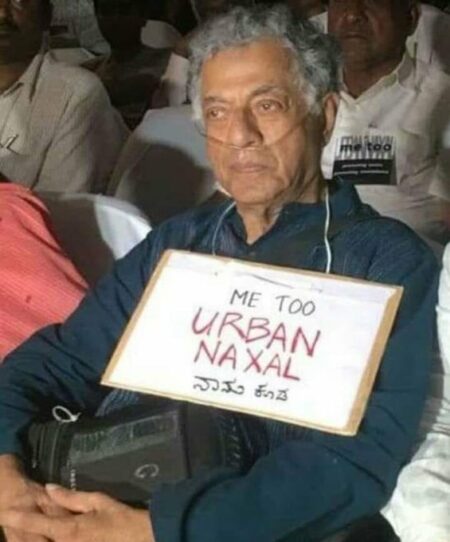
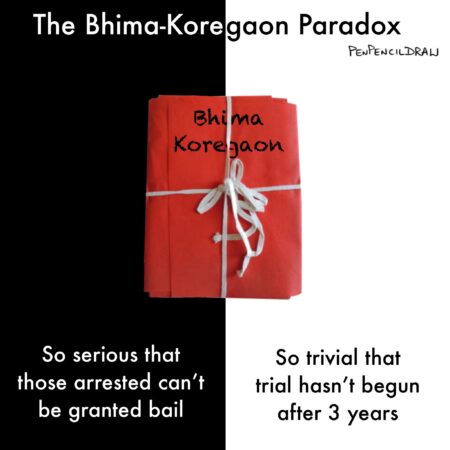
The phrase “dimagi Naxal” echoes the politically charged label “urban Naxal,” a term Modi and leaders of his Bharatiya Janata Party (BJP) have used for years for activists, academics and other critics of the government. It became the operative logic behind the 2018 Bhima Koregaon arrests, in which poets, lawyers, professors and human-rights defenders were arrested under the draconian Unlawful Activities (Prevention) Act (UAPA) on the theory that they had a link to a banned Maoist conspiracy.
One of these 16 arrestees, Father Stan Swamy, 84 years old and suffering from Parkinson’s disease, died in judicial custody in 2021 without ever being convicted and Surendra Gadling, a human rights lawyer from Nagpur is still in jail in his ninth year. Read more
A Speech Sans Substance!
22/08/2026
Peoples Democracy / by M A Baby
On March 31, 2026, Union Home Minister Amit Shah declared that India has become free from Naxalism. In his Independence Day speech from the Red Fort on August 15, Prime Minister Narendra Modi proclaimed its return.
Quite a few things happened in the intervening four months. But three developments stand out – the wave of workers’ protests that briefly spread across the northern part of the country in April and May; the historic student-youth movement that forced the resignation of Union Education Minister Dharmendra Pradhan; and the Bankipur bye-election, which resulted in a mammoth defeat for the BJP in a seat it had dominated for over three decades and had only recently been vacated by its National President. These developments have no doubt forced the BJP onto the back foot.
Modi invoking the threat of “dimagi naxals” in his address must be seen in this context. A rattled leader bereft of ideas tends to fall back on rhetoric and tactics that have proven useful in the past. The “dimagi Naxal” jibe is thus a revival of the “tukde-tukde gang”, “urban Naxal”, “andolan jeevi” and similar labels used earlier. Read more
From ‘Tukde-Tukde Gang’ to ‘Dimagi Naxals’: When Labels Replace Answers
20/08/2026
Counterview.net / by Mohd Ziyaullah Khan
How the politics of insulting dissenters evolved — and why India’s Gen Z may be less willing to accept it. There is something revealing about the political vocabulary of the Narendra Modi era
When students protested, they were called the “Tukde-Tukde Gang.” When intellectuals, activists and academics challenged the government, some were branded “Urban Naxals.” Writers and artists who returned state awards became the “Award Wapsi Gang.” Farmers protesting the government’s policies were described using terms such as “Khalistanis,” “Maoists” and “anti-national.” Prime Minister Narendra Modi also coined “Andolanjeevi” for people he portrayed as professional protesters.
Now comes another expression: “Dimagi Naxals” — ideological or intellectual Naxals. Read more
Prime Minister’s ‘Dimagi Naxal’ Formulation Echoes the British Playbook Against Dissent
19/08/2026
The Leaflet / by S.N. Sahu
By branding dissenters as “Dimagi Naxals,” the Prime Minister revives the same colonial logic once used to silence Gandhi and threatens the constitutional freedoms India’s youth are fighting to defend.
Prime Minister Modi in his address to the nation from the ramparts of Red Fort on the occasion of 80th Independence Day stated that his government has succeeded in eliminating the armed Naxals in the jungles., While doing so he warned about “Dimagi Naxals” (intellectual Naxals) waiting for opportunities to unleash violence, unrest and create turmoil in society. And so, he underlined the necessity of identifying and isolating them. Read more
‘Dimagi Naxal’: When Mind Becomes Site of Suspicion
17/08/2026
NewsClick / by Shirin Akhter
After 79 years of Independence, a democracy should not be asking its citizens to fear the independent mind.
…
Naxalism has a specific political history. Its name derives from the 1967 uprising in Naxalbari in West Bengal and the Maoist political movements that subsequently emerged. For decades, the Naxalite was associated primarily with armed revolutionary politics.
Then came the term, “Urban Naxal”.
The expression acquired wider political currency particularly around 2018, when activists, lawyers and intellectuals were arrested in connection with the Bhima Koregaon case. The political category began travelling beyond those accused of participation in armed insurgency. Read more
Opposition says PM Modi’s ‘dimagi Naxals’ remark shows he is ‘rattled’
16/08/2026
Scroll.in / by Scroll Staff
Prime Minister Narendra Modi describing his opponents as “dimagi Naxals”, or persons with “Naxal mentality”, was a “sure sign of his desperation”, said the Congress on Saturday.
“It is a separate matter that he ends up doing whatever these so-called ‘urban Naxals’ or now ‘dimaagi Naxals’ are demanding or advocating,” said party leader Jairam Ramesh.
The term “urban Naxals” was first used by Union ministers and leaders of the Bharatiya Janata Party after several activists and academics were arrested in the Elgar Parishad case in 2018. Since then, the term has often been used to describe some dissidents of the Narendra Modi government. Read more
After 3 Supreme Court Judges Recuse, Surendra Gadling Requests CJI Kant To List Bail Plea In Surajgarh Arson Case
27/07/2026
Law Beat / by Aishwarya Iyer
Last week, the Supreme Court said the matter would be listed before a different combination after noting that Justice Shree Chandrashekhar was unable to hear the case.
The Supreme Court today heard a mentioning made on behalf of Surendra Gadling concerning listing of his bail plea in connection with the 2016 Surajgarh arson case.
Senior Advocate Kapil Sibal told a CJI Surya Kant led bench, “Another judge has recused..it may be listed..”. Read more
Surendra Gadling Bail Plea: Kapil Sibal Asks Supreme Court To List Matter Before Another Bench After Third Judge’s Recusal
27/07/2026
Live Law / by Gursimran Kaur Bakshi
Senior Advocate Kapil Sibal on Monday requested the Supreme Court to assign lawyer-activist Surendra Gadling’s bail plea in the 2016 Gadchiroli arson case to a different bench, after Justice Shree Chandrashekhar recently recused from hearing the matter. Read more
3rd SC judge recuses himself from hearing lawyer Surendra Gadling’s bail plea
21/07/2026
Hindustan Times / by Abraham Thomas
Supreme Court judge Shree Chandrashekhar on Tuesday recused himself from hearing lawyer Surendra Gadling’s bail plea in a 2016 arson case, becoming the third judge to do so in the case over the past year.
Justice PK Mishra announced the recusal when the National Investigation Agency (NIA) sought an adjournment before the matter came up for hearing before a bench comprising him and Justice Chandrashekhar. Justice Mishra said the matter had to be adjourned anyway, as Justice Chandrashekhar conveyed his inability to hear it. “This will have to go before another bench as my brother [Justice Chandrashekhar] has some difficulty.” Read more
Third Supreme Court Judge Recuses From Hearing Surendra Gadling’s Bail Plea In 2016 Gadchiroli Arson Case
21/07/2026
Live Law / by Gursimran Kaur Bakshi
The Supreme Court today (July 21) ordered that the bail plea of lawyer-activist Surendra Gadling in the 2016 Gadchiroli arson case should be heard by a bench not comprising Justice Shree Chandrashekhar.
The matter was listed before a bench comprising Justice Prashant Kumar Mishra and Justice Shree Chandrashekhar. At the outset, an advocate on behalf of Additional Solicitor General SV Raju (for the National Investigation Agency) sought a passover, while Senior Advocate Kapil Sibal appeared for the petitioner. However, Justice Mishra said the matter will go before another coordinate bench since Justice Chandrashekhar has some difficulty. Read more
Justice Shree Chandrashekhar recuses from hearing bail plea of Bhima Koregaon accused Surendra Gadling
21/07/2026
The Hindu / by The Hindu Bureau
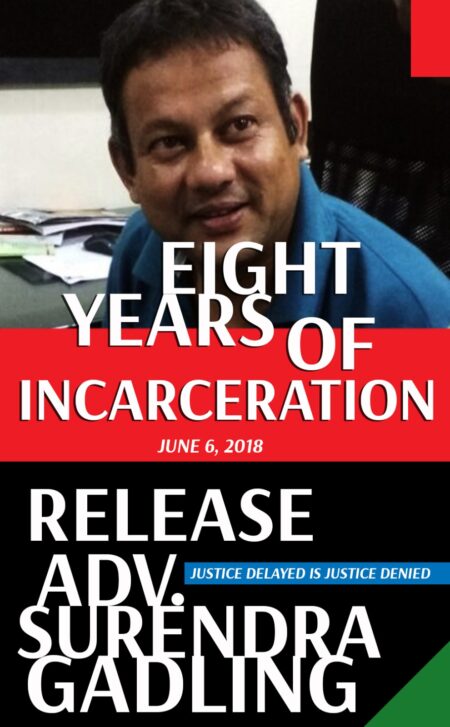
This marks the third recusal by a Supreme Court judge from hearing activist Mr. Gadling’s bail plea without assigning any reason; the bail plea arises from the 2016 Surjagarh arson case; Mr. Gadling has been in Taloja Central Prison since June 2018 following his arrest in the Elgar Parishad-Maoist links case
Supreme Court judge Justice Shree Chandrashekhar on Tuesday (July 21, 2026) recused himself from hearing a bail petition filed by advocate and activist Surendra Gadling in connection with the 2016 Surjagarh iron ore mine arson case. It is the third such recusal by a Supreme Court judge in the past year, with no reasons assigned on any of the occasions. Read more