Two judgments, no single standard: Why terror law UAPA’s bail threshold isn’t a straight line
21/05/2026
The Print / by Sahaj Sankaran
SC’s contradiction over bail in terror cases has revived questions over whether the stringent Watali test or the liberty-focused Najeeb ruling should guide UAPA jurisprudence.
When a two-judge Supreme Court bench Monday criticised a co-ordinate bench’s decision denying bail in January to Sharjeel Imam and Umar Khalid, both accused under the Unlawful Activities (Prevention) Act (UAPA) in the Delhi riots case, the criticism raised a much broader issue: how should courts decide on bail under the anti-terror law?
… In the the 2022 Jyoti Jagtap vs NIA case, the court did not consider Najeeb at all, implicitly arguing that Najeeb had no applicability even though the defendant had been in prison for two years by that point. It took another three years for Jagtap, arrested for her alleged ties to the organisers of the 2017 Elgar Parishad event, to secure bail. Read more
Not defending civil society judiciary’s biggest failure Advocate Indira Jaising
19/05/2026
The Week / by pti
The judiciary’s inability to protect civil society from persecution is its “biggest failure”, writes senior advocate Indira Jaising in her new book “The Constitution Is My Home”, alleging that political opponents, activists and human rights defenders are being systematically targeted through criminal law.
… Referring to the prosecution of late Delhi University professor G N Saibaba under the Unlawful Activities (Prevention) Act (UAPA), she criticised judicial observations that shifted the focus of criminal law from “overt acts to beliefs and ideas”.
She also criticised the use of the UAPA and the sedition provision under Section 124A of the Indian Penal Code against activists and human rights defenders in cases linked to the 2020 Delhi riots and the Bhima Koregaon violence. Read more
▪ Indira Jaising interview: Senior advocate sounds alarm on democracy & dissent in modern India en | 19:16min | 2026
Interview by: Kanu Sarda
Camera: Sanjay Ahlawat
Editor: Syam Krishnan
In this exclusive interview with THE WEEK, Indira Jaising discusses her new memoir, The Constitution Is My Home, and shares her thoughts on the biggest constitutional and judicial challenges facing India today. From the Bhima Koregaon case and judicial accountability to women in the Supreme Court and the criminalisation of dissent, Jaising offers a candid and deeply personal reflection on law, democracy and power. Watch video
India’s Anti-Terror Law and the Punishment of the Unconvicted
19/05/2026
Countercurrents.org / by Utkarsh Mishra
The statistics released by the government paint a troubling picture. From 2019 to 2023, India arrested 10,440 individuals using its strictest anti-terror law, but only 335 were convicted. This number didn’t come from a human rights organisation; it was shared by the Union Home Ministry itself during a session in Parliament in December 2025. The National Crime Records Bureau put together these figures, and it amounts to a mere 3.2% conviction rate. Read more
Voices From Prison: Mahesh Raut | A Broken Prison System Is In Dire Need Of Critical Care
22/01/2026
Outlook / by Mahesh Raut
Mahesh Raut, the youngest accused in the Bhima Koregaon case, was granted interim bail on medical grounds. Many prisoners have no hope.
What constitutes freedom? What does it constitute for the person who is confined or for the one who comes out of jail, only to get entangled in another web of chains; some similar, but for others, different from what they experienced behind bars. In a prison, your identity is reduced to just a number. You are dehumanised at the whims of authorities and burdened by numerous hurdles and difficulties to secure bail. Many are not able to come out of prison even after securing bail due to financial constraints. All these factors take a toll on the physical and mental health of prisoners. Read more
Lives Lost: How Prolonged Incarceration Failed Pandu Narote, Kanchan Nanaware, Stan Swamy
22/01/2026
Outlook / by Priyanka Tupe
Pandu Pora Narote, Kanchan Nanaware and Stan Swamy never lived to learn their innocence or guilt after years of incarceration under the UAPA. Narote was acquitted by the Bombay High Court only after his death. It was too little, too late. Nanaware and Swamy also died as undertrials. For their families and lawyers, justice exists only on paper, not in life.
Pandu Pora Narote, 33, a tribal youth from Maharashtra’s Gadchiroli district, was arrested in August 2013 on allegations of links with the banned CPI (Maoist) and its frontal organisation, the Revolutionary Democratic Front. The case later widened to include former Delhi University professor G.N. Saibaba and several others. Read more
Voices From Prison: Of Lives Stolen For Dissent
20/01/2026
Outlook / by Outlook News Desk
Outlook’s February 1 issue, Thou Shalt Not Dissent, shines a light on the lives of political prisoners who were slapped with anti-terrorism charges and continue to face long trials and curbing of rights.
…
In Outlook’s February 1 issue, Thou Shalt Not Dissent, first-person accounts of political activists who were slapped with anti-terrorism charges under different political regimes, explore life behind bars, the trauma, sights and sounds of a world bereft of freedom, normalcy and reason. Weaved with the accounts are stories of individuals who carry the burden of incarceration like a tumour on the face, afraid to cover it, so it doesn’t chafe, and hesitant to let it free, so it does not translate into their only identity. Read more
Voices From Prison: ‘In Jail, I Measured Time From One Court Date to Another’
21/01/2026
Outlook / by Shoma Sen
Women’s rights activist and professor Shoma Sen, who was arrested in 2018 for her alleged involvement in the Bhima Koregaon riots, writes how in prisons, time comes to a standstill, literally
Though it is true that I did time, it appears more as if time did me. One cloudy evening, on June 21, 2018, when I was being taken to the Yerawada jail in Pune, I knew that watches were not allowed in jail, yet I had clung on to my basic Titan watch. I had to submit it at the gate. It was returned to me, looking like a museum relic, almost six years later. Time, trapped in a brown sarkari envelope, sealed in a metal box. Time that had stopped ticking. Read more
Me Coming Out Alive Is A Miracle: Hany Babu, Bhima-Koregaon Accused, On Life Behind Bars
21/01/2026
Outlook / by Hany Babu M.T.
More than five years after his arrest under the UAPA in the Bhima Koregaon case, former Delhi University professor Hany Babu was granted bail in December 2025. He shares his experience of prison life.
Mornings start very early in jail, but they never come with an air of freedom. It has only been three to four weeks since I came out; the bail arrived quite late for me. Five years is a long time compared to my co-accused. Throughout these five years, hope never left my sight, even when I contracted Covid. But there were indeed times when a little despair did creep in. Read more
Correctional Facility Or The World Of Endless Repetition, Solitude and Boredom?
21/01/2026
Outlook / by Rona Wilson
The prison system in India, persistently mediated and nourished by its colonial and retributive sensibilities, cannot be wished away by just changing the names of the prisons as correctional facilities, writes Rona Wilson, accused in the Elgar Parishad-Maoist links case.
I had trouble in my barrack with some of the inmates smoking heavily beside me and some among them playing ludo till the wee hours. As the game intensifies with gambling, so does smoking and use of tobacco. I requested the officer-in-charge of my circle to intervene. Read more
Voices From Prison: Life After Jail Is Tough, But Surveillance, Harassment Continue, Says Sudha Bharadwaj
20/01/2026
Outlook / by Sudha Bharadwaj
I am enormously relieved that the separation from my only daughter, Maaysha, has ended. We can speak to each other every day.
A couple of weeks ago, cops in civil dress—or so they claimed to be—arrived in the society where I live in a friend’s accommodation on rent. The police have my mobile number, which, no doubt, they monitor regularly. Besides, I report to the local police station every 14 days, and I regularly attend court dates, at least once every 15 days, if not more frequently. Despite this, the police did not bother to call me. Read more
Voices From Prison: In The Isolation of the Anda Ward, We Dared To Sing, Writes Gautam Navlakha
20/01/2026
Outlook / by Gautam Navlakha
I realised that the more intense the sense of despair, the harder hope kicks in.
‘Those who speak of humanity in this system
Are thrown into prison to acquaint them
With the vocabulary of ‘criminology’’’ — Varavara Rao, Schools and Prisons
Hope and despair are basic human emotions and I believe that all human beings, now and then, swing between these two ends of the spectrum in life. I experienced these emotions acutely during my time in prison and captivity. Read more
Voices From Prison: Alienating A Poet From A Language He Deeply Loves Is Painful, Writes Varavara Rao’s Daughter
20/01/2026
Outlook / by P Vanava
The poet and activist was jailed in connection with caste violence that erupted in 2018 in Bhima Koregaon. He was 78 then. Though he was released on medical grounds in 2022, he is still confined to Mumbai. In this first-person account, his daughter Pavana writes about how multiple incarcerations could not break her father’s strength and soul
…
This wasn’t his first arrest; he has been arrested many times in the past, since the Emergency in 1975, for his political activism. I was a newborn baby (a month old), when appa was arrested. Read more
Voices From Prison: Bail Is Little Solace As I Lost My Life Anyway, Says Anand Teltumbde
19/01/2026
Outlook / by Anand Teltumbde
We became victims of two things—unjust investigation and a media trial that was used as a weapon. The Media Trial was Deeply Painful.
The tragic dimension of jail has been exhaustively mined. What remains scandalously underexplored is its comic genius. Prison is a factory of absurdity, running at full capacity every day, and I made it a habit to collect its specimens—especially during the so-called free hours, when the cells were opened each morning. This ritual began with the ceremonial clanking of batons, as guards slid them menacingly across steel bars, producing a sound—less like an alarm than a declaration of sovereignty. Read more
Voices From Prison: What Happened In Bhima Koregaon Could Happen To You
20/01/2026
Outlook / by Alpa Shah
The Bhima Koregaon case is not only about those who were imprisoned. It is also about the fate of democracy itself
There are things in life that somehow wrap themselves around us. Things we never would have dreamed of doing—ideas that once seemed dangerous, crazy, or simply foolish. They arrive quietly, almost by accident, and before we know it, they surround us, occupy our thoughts, and slowly take over. Until one day, there is no turning back, and we can’t imagine thinking about anything else. Read more
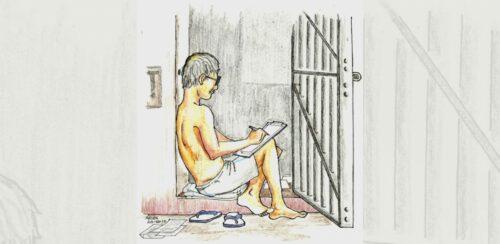
▪ THE BK-16 PRISON DIARIES SERIES (THE POLIS PROJECT / JUNE 2024)
Credits: Drawing by Arun Ferreira / The Polis Project
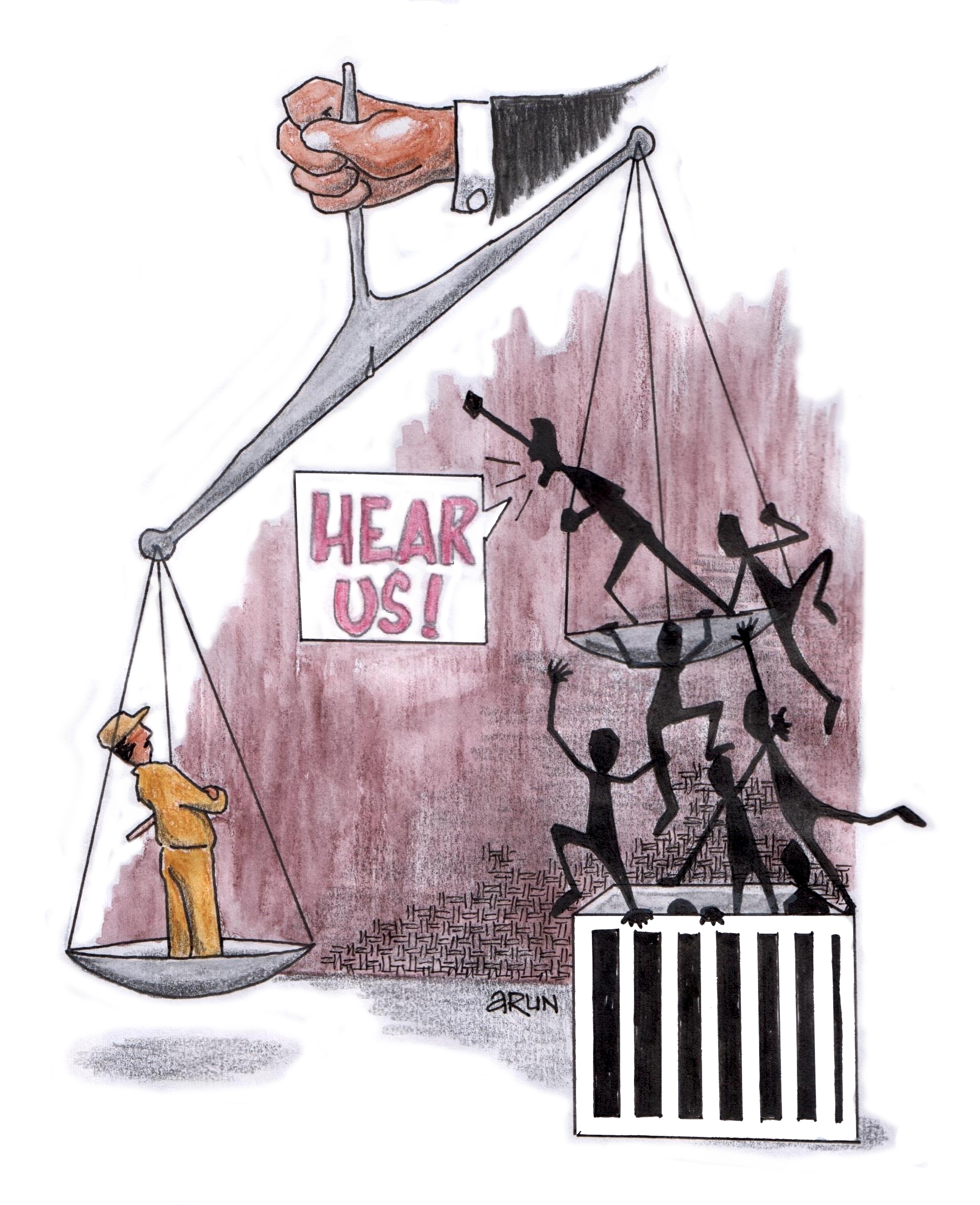
Credits: Drawing by Arun Ferreira / The Polis Project
Credits: Drawing by Arun Ferreira / The Polis Project
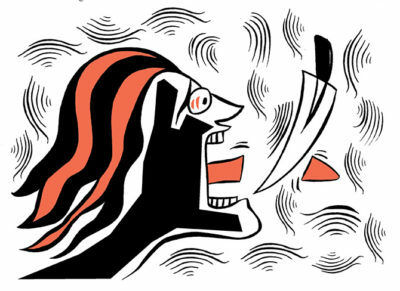
Credits: Drawing by Arun Ferreira / The Polis Project
Credits: Drawing by Arun Ferreira / The Polis Project
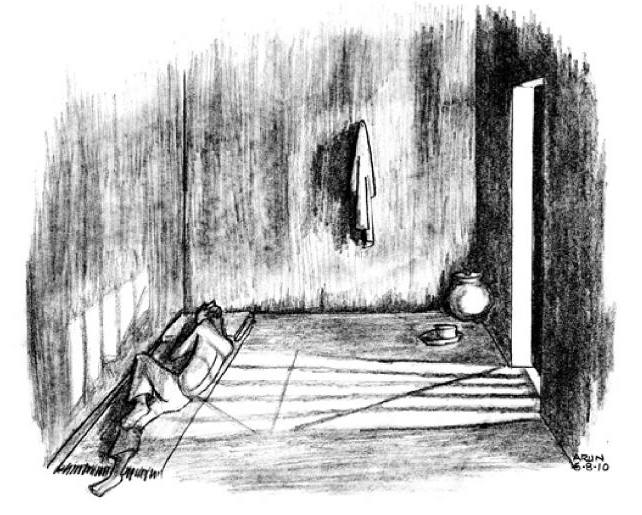
To mark six years of the arbitrary arrests and imprisonment of political dissidents in the Bhima Koregaon case, The Polis Project is publishing a series of writings by the BK-16, and their families, friends and partners. By describing various aspects of the past six years, the series offers a glimpse into the BK-16’s lives inside prison, as well as the struggles of their loved ones outside. Each piece in the series is complemented by Arun Ferreira’s striking and evocative artwork.
▪ How Long Can the Moon Be Caged? Voices of Indian Political Prisoners
How Long Can the Moon Be Caged? includes visual testimonies and prison writings from those falsely accused of inciting the Bhima Koregaon violence, by student leaders opposing the new discriminatory citizenship law passed in 2020, and by activists from the Pinjra Tod’s movement. In bringing together these voices, the book celebrates the courage, humanity and moral integrity of those jailed for standing in solidarity with marginalised and oppressed communities.
Authors: Suchitra Vijayan and Francesca Recchia
Publishing Date: Aug 2023
Publisher: Pluto Press
Pages: 247 Read more / order
Delhi University Vice Chancellor’s speech criticising ‘urban naxals’ draws ire
PUCL condemns regressive and defamatory views of DU Vice Chancellor Prof. Yogesh Singh: At odds with Constitutional values
09/10/2025
Countercurrents.org / by People’s Union For Civil Liberties
People’s Union for Civil Liberties (PUCL) India, is shocked at the troubling views expressed by Dr Yogesh Singh, professor and Vice Chancellor Delhi University on 28th September, 2025 in a speech titled “Naxal Mukt Bharat: Ending Red Terror Under Modi’s Leadership, Why Campuses are Targets?’
…
In the over 20 minute speech, replete with unsubstantiated and defamatory statements about alleged “urban naxals” on campus, Prof Singh named Delhi university’s professors and student activists charged and imprisoned under the draconian Unlawful Activities (Prevention) Act, 1967, including members of the feminist student group Pinjar Tod (Devangana Kalita and Natasha Narwal), charged in the Delhi riots case and Prof Hany Babu and professors Dr Shoma Sen and Dr Anand Teltumbde (mispronounced by Prof Singh as Teltumbedke), charged in the Bhima Koregaon case. Read more
Delhi University V-C’s speech criticising ‘urban naxals’, Pinjra Tod movement draws ire
08/10/2025
The Indian Express / by Express News Service
Delhi University Vice-Chancellor Yogesh Singh’s speech alleging the presence of “Urban Naxals” in universities and criticising movements like ‘Pinjra Tod’ has triggered protests from students and faculty.
… Referring to the 2018 Bhima Koregaon case, Singh named DU professor Hany Babu and academics Rona Wilson and Anand Teltumbde, saying, “And these are not isolated cases.” Read more
Are Indian universities turning into suffocating spaces where constant censorship and surveillance is leaving no room for protests or dissenting voices?
… Academics and intellectuals, having anything to say that is remotely critical of the current regime, are wilfully thrown under the bus by their own institutions. Worse, institutions now lead the mob hounding individuals who exercise their right to free expression—a fundamental right enshrined in the constitution. Read more
Elgar Parishad case accused at event that attacked Maharashtra Public Security Bill
Elgar Parishad case accused at event that attacked Maharashtra Public Security Bill, cops to seek bail review
22/05/2025
Times of India / by Soumitra Bose
The Elgar Parishad case accused, who are out on bail, had thronged the Veera Sathidar memorial event at Vidarbha Hindi Sahitya Sammelan on May 13, top security sources told TOI.
Though the event was organised as a memorial for the acclaimed filmmaker, security agency sources stated it turned into a platform for attacking the Maharashtra govt’s efforts to table the proposed Maharashtra Public Security Bill to rein in frontal organisations of alleged urban Maoists.
… Activists like Sudhir Dhawale and former Nagpur University professor Soma Sen, who are out on bail in the Elgar Parishad case, participated in the event Read more
Actor’s wife, 2 others booked for reciting Pak poet’s poem
21/05/2025
Rediff.com / by pti, edited by Hemant Waje
The recitation of Pakistani poet Faiz Ahmad Faiz’s Hum Dekhenge poem at an event in Nagpur has led police to slap charges of endangering India’s unity and integrity, and promoting enmity against three persons, including late actor-activist Veera Sathidar’s wife Pushpa.
… Police said they are also looking into the activities and background of the Samata Kala Manch, whose head, Sudhir Dhawale, is currently out on bail in connection with another case related to alleged inflammatory speeches made during the Elgar Parishad event in Pune in 2017. Read more
Singing Faiz’s ‘Hum Dekhenge’ is ‘Sedition’: Nagpur Police Book Organisers of Vira Sathidar Memorial
19/05/2025
The Wire / by Sukanyana Shantha
Singing the revolutionary poetry of Faiz Ahmed Faiz, once celebrated as a voice of resistance, now attracts sedition charges in India.
At an event organised last week in memory of actor and activist Vira Sathidar, a group of young cultural activists sang the lyrics of Faiz’s famous Hum Dekhenge.
… In October 2020, when the NIA filed a supplementary chargesheet in the Elgar Parishad case, Sathidar’s name appeared among the so-called “urban Naxals,” a term loosely used by the Devendra Fadnavis-led government to target dissenters. Now, with the Maharashtra Special Public Security Bill, the state government seeks to formalise the term “urban Naxal” within the legal framework. Read more
‘The Message Is Loud & Clear.’ Author Of New Book On 11 Indian ‘Prisoners Of Conscience’ & The Costs Of Defiance
07/03/2025
Article 14 / by Zeyad Masroor Khan
Political prisoners are among the most discriminated against of India’s prisoners, says Neeta Kolhatkar, author of ‘The Feared’, a book that explores the lives of 11 such prisoners and their families. They talked to her about their experiences while incarcerated and—for those on bail—after. Kolhatkar tells us how she got access to India’s ‘prisoners of conscience’, and why she thinks they were arrested; how they struggle for basic facilities, including medical tests; the impact on their physical and mental health, on their spouses and children; and their survival strategies.
“I will not come out alive if I am jailed again.”
That is what Binayak Sen, 75, says in “The Feared”, a new book by Mumbai-based journalist Neeta Kolhatkar, chronicling the experiences of 11 Indian political prisoner. A medical doctor arrested in 2007 while working in the Adivasi lands of Chhattisgarh, Sen was convicted of sedition in 2010 before being granted bail in 2011. Read more
The Feared: A wake-up call to the gross human rights violations inflicted on thousands of undertrials
05/06/2025
Sabrang India / by Harsh Thakor
The Feared is a collection of interviews conducted by Neeta Kolhatkar with 11 political prisoners and, in some cases, their loved ones. Through these conversations, she vividly portrays their everyday lives within multiple prisons across India. This landmark work is a path breaking contribution to resurrecting the spirit of dissent and resistance at a time when proto-fascism is reaching unprecedented heights.
The book serves as a wake-up call to the gross human rights violations inflicted on thousands of undertrials. Kolhatkar’s detailed discussions – some spanning multiple meetings – reveal personal anecdotes from the prisoners’ time behind bars. She brings to light not only their experiences but also the deplorable prison conditions, including issues related to space, hygiene, medical care, and food. Read more
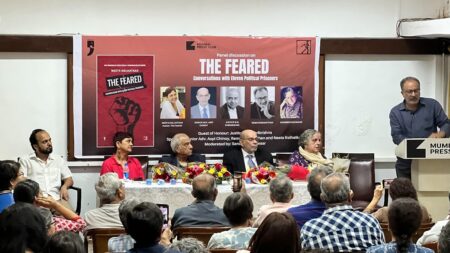
‘If I’m A Hindu, It Does Not Mean I’ll Put Non-Hindu Behind Bars,’ Says Retired Justice BN Srikrishna At Book Launch
27/02/2025
Free Press Journal / FPJ News Service
If I’m a Hindu, it does not mean that I hate a person who’s a non-Hindu or put him behind the bars for their religion or political ideology, said retired justice BN Srikrishna, who headed the Srikrishna Commission to investigate the Bombay Riots of 1992-93.
… The book includes conversations with political prisoners including Sudha Bharadwaj, Nilofer Malik and Sameer Khan, Koel Sen, Prashant Rahi and Shikha Rahi, Sanjay Raut, Kishorechandra Wangkhem, Anand Teltumbde and Rama Ambedkar, Binayak Sen, Kobad Gandhy, Muralidharan K and P Hemlatha. Read more
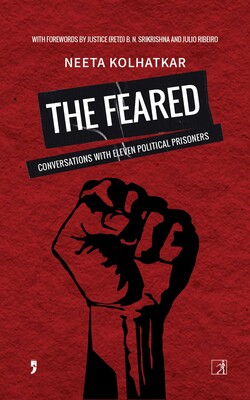
Also read: ▪ The Feared – Conversations with Eleven Political Prisoners
Author: Neeta Kolhatkar
Publishing Date: Dec 2024
Publisher: S&S India
Pages: 272 Read more /order
During the course of extensive research, Kolhatkar spoke to political prisoners and their family members.
Journalist and political analyst Neeta Kolhatkar has written about the life and struggles of the political prisoners in India. The prisoners include Dr Binayak Sen, paediatrician, public health specialist and social activist, and Prof Anand Teltumbde, eminent scholar, Dalit activist and management teacher. Read more
The Feared
Conversations with Eleven Political Prisoners
simonandschuster.co.in / by Neeta Kolhatkar
During long discussions, sometimes taking place over multiple meetings, Kolhatkar unearths personal anecdotes from the time her interviewees were incarcerated, bringing into focus the human face of prison inmates, while also detailing the wretched conditions relating to space, hygiene, medical attention, and food that they experienced. Apart from being an urgent call to action for prison reforms, The Feared is thus also an account of hope and strength, narrating unique stories of survival and solidarity, and the unexpected bonds and relationships formed in prison.
Author: Neeta Kolhatkar
Publisher: S&S India (December 20, 2024)
Length: 272 pages Read more
English professor Shoma Sen and singer and activist Jyoti Jagtap, both accused in the Bhima-Koregaon case, discuss the issues they experienced in prison, such as overcrowding, inadequate healthcare, and poor living conditions. They describe the lack of access to education, systemic inequalities, and the challenges faced by marginalised women and LGBTQ+ individuals in India’s prison system. Both women spoke of the importance of sisterhood and resilience and expressed hope for change. Read more
Also listen / read: ▪ Episode 18 of CJP’s Podcast Series RightsCast en/hindi | 13:18min | 2023 By Citizens for Justice and Peace (cjp)
How does the Indian Prison system strip the women inmates of their basic rights and dignity? In a patriarchal society, within a prison system that’s designed to focus on male inmates, how do female prisoners navigate their incarceration?
Listen to this in-depth podcast on the conditions of women inmates in India’s prisons where human rights activists, Adivasi leaders, student activists, lawyers and citizens-in-resistance share stories of horror and explore the plight of women in prison. Listen to the podcast
▪ Video: Healthcare and Mental Health inside Prison | Sudha Bharadwaj | QUAID KE PARE By Citizens for Justice and Peace hindi | 5:51min Watch video
In a significant judgment, the Supreme Court has held that a bail condition enabling police to monitor the movement of an accused out on bail through mobile phones is illegal and violative of Article 21 of the Constitution.
…
It remains to be seen whether this judgment of the Supreme Court will provide relief to the Bhima Koregaon-Elgar Parishad accused Shoma Sen, Vernon Gonsalves and Arun Ferreira, upon whom the judiciary has imposed similar bail conditions or whether this will be another case of a progressive Order in one case which is not followed by a similar Order in another case. Read more
To mark six years of the arbitrary arrests and imprisonment of political dissidents in the Bhima Koregaon case, The Polis Project is publishing a series of writings by the BK-16, and their families, friends and partners. By describing various aspects of the past six years, the series offers a glimpse into the BK-16’s lives inside prison, as well as the struggles of their loved ones outside. Each piece in the series is complemented by Arun Ferreira’s striking and evocative artwork.
Credits: Drawing by Arun Ferreira / The Polis Project
BK-16 PRISON DIARIES: STORIES OF LOVE, MURDER AND CHILD MARRIAGE FROM SHOMA SEN’S YEARS IN PRISONS
16/06/2024
The Polis Project / by Shoma Sen
While we were in jail, Himanta Biswa Sarma, the chief minister of Assam, initiated a campaign (read: crackdown) against child marriage. Instead of formulating programmes to educate the community and facilitate social reforms, he used law enforcement to viciously subjugate the poor, minorities and rural residents, to superimpose modernism through fear and repression.
A large number of women living in prison had been married off between the ages of 12 and 14, and were being held for different crimes, from theft and murder to trafficking drugs and children. Read more