The Bombay High Court on Friday asked the Indian National Congress, the People’s Union for Civil Liberties (PUCL) and the All India Trade Union Congress (AITUC) to furnish details of their registration, constitution and office-bearers before it proceeds to hear their petitions challenging the constitutional validity of the Maharashtra Special Public Security Act (MSPSA).
… The State’s affidavit cited various instances particularly, the caste-based riots infamously known as the Bhima-Koregaon Violence which broke out across Maharashtra on January 01, 2018. It stated that the arrest of the ‘central committee’ members of the Communist Party of India (Maoist) (CPI-M) in Elgar Parishad, brought national focus on ‘Urban Activities’ of ‘Urban Maoists.’ Read more
They voiced their concerns over alleged voter deletions, police action against dissenters and the independence of constitutional institutions, seeking the intervention of the Supreme Court.
… Advocate and legal activist Narasimhamurthy condemned alleged police atrocity against lawyers, students and journalists. … He also cited the imprisonment of activists, including GN Saibaba and Father Stan Swamy, and detentions in the Bhima Koregaon case as examples of the treatment of dissenting voices. Read more
Modi opens war on the people, and the Supreme Court looks on
10/10/2026
Frontline / by Anand Teltumbde
The government has used force to stop protests against Gyanesh Kumar and the SIR. The Supreme Court’s delays and refusal of interim relief have allowed the process to continue, prompting criticism that its caution favors the executive.
On October 10, Delhi was sealed before the protest began. Dozens of Metro stations were closed or restricted, trains cancelled, and mobile internet suspended in central Delhi. Jantar Mantar was ringed with barricades, cameras, water cannons, and security forces; buses waited to carry detainees away. …
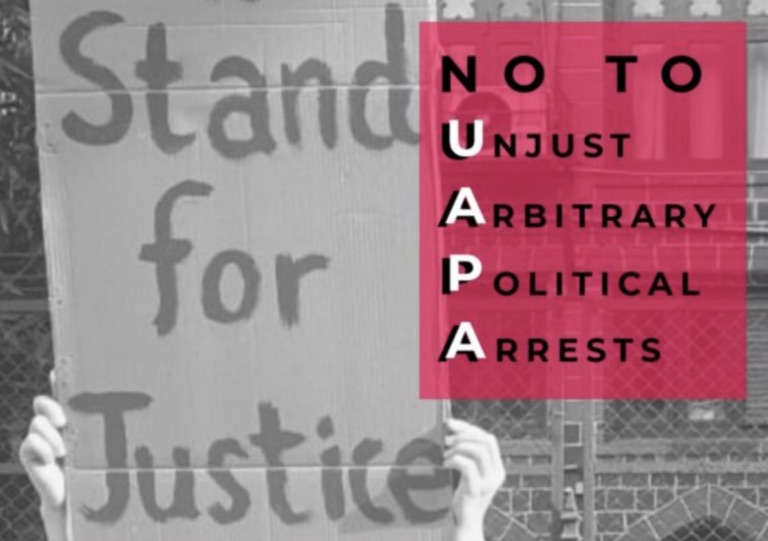
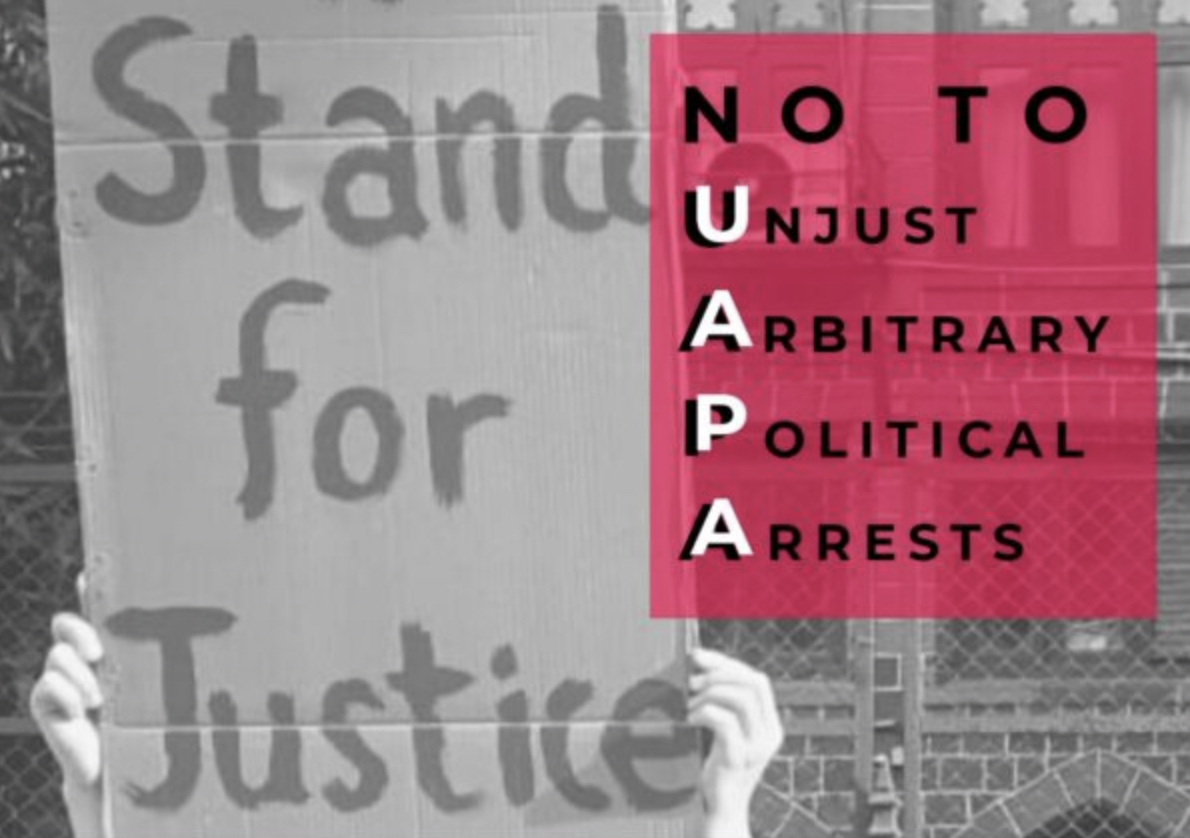
In the Bhima-Koregaon case, civil-rights activists, lawyers, and scholars were arrested under the Unlawful Activities (Prevention) Act and held for years without trial. During the protests against the Citizenship Amendment Act (CAA), Muslim activists, including Umar Khalid, were prosecuted under the same law. Prolonged detention before trial makes process itself a punishment. It was meant to terrorise people into silence. Women wrestlers who protested alleged sexual abuse by a BJP MP were met with police force rather than an urgent reckoning with their allegations. Read more
Front Line Defenders / by Front Line Defenders & others
We, the undersigned, are regional and international human rights nongovernmental organizations as well as individuals expressing concerns over the developments at the National Human Rights Commission of India (NHRCI).
…
Over the past decade, the NHRCI has not intervened when Indian authorities have targeted students, activists, lawyers, journalists, and critics of the government under the abusive, counterterrorism law, the Unlawful Activities Prevention Act (UAPA). This includes 16 prominent activists who promoted the rights of persons from India’s most marginalized communities, accusing them of inciting violence that occurred during a Dalit meeting in January 2018 in Bhima Koregaon in Maharashtra state. The trial is yet to begin but 15 activists arrested in the case spent years in jail before they were granted bail, while 84-year-old Stan Swamy, a prominent tribal rights activist, died in custody, which a UN expert termed as “a stain on India’s human rights record.” According to reports by the US-based forensic firm Arsenal Consulting, malware was used to surveil and plant evidence on the computers of at least three accused in this case. Read more
‘A National Hero’: Jailed Activist Umar Khalid Wins International Award For Human Rights Defenders
09/10/2026
The Wire / by The Wire Staff
A special ceremony was held at the Trinity College in Dublin, to honour all the recipients. Khalid was represented by his father, Syed Qasim Rasool Ilyas.
Activist Umar Khalid who has been jailed since the last six years has won the 2026 Front Line Defenders Award for Human Rights Defenders at Risk.
“Umar Khalid is the 2026 Asia winner of the Front Line Defenders Award. To those who try to silence his work, he is seen as an “enemy of the state’’ and an “anti-national”, but to others, he is a national hero, a voice of the people, and a human rights defender. Read more
‘Maharashtra centre of Maoist urban network’: State defends Special Public Security Act in court
07/10/2026
The Indian Express / by Omkar Gokhale
Defending the law against Congress, CPI and AITUC pleas, the state says other Maoist-hit states already have similar laws that have withstood judicial scrutiny
Maharashtra, “because of its highest urban population has become center of Maoist urban network,” the state government has told the Bombay High Court, defending the Maharashtra Special Public Security (MSPS) Act. … Citing Elgaar Parishad and other cases, the affidavit claimed Maharashtra has the highest number of frontal organisations in the country, 64. It said Andhra Pradesh, Telangana, Chhattisgarh, Odisha and Jharkhand had banned such groups under similar laws that “withstood judicial scrutiny”, so Maharashtra was empowered to enact one for “local security environments”. Read more
Maharashtra Has Become ‘Centre’ Of Maoist Urban Network: State Defends Special Public Security Act Before Bombay High Court
07/10/2026
Live Law / by Narsi Benwal
The Maharashtra Government while defending its decision to enact the Maharashtra Special Public Security Act (MSPSA), on Tuesday (October 6) told the Bombay High Court that because of its highest urban population, the State has become a ‘centre’ for Maoist urban network and thus in absence of legal framework to ban such ‘left wing extremist’ organisations, it has come up with this law as done by states like Telangana, Andra Pradesh, Madhya Pradesh and Chhattisgarh. Read more
To mark Prisoners’ Day honestly is to notice this asymmetry, not just to honor the dead of 1929. It is to ask why a nation can revere its historical political prisoners while refusing that name to those living through an almost identical experience today
On 13th September 1929, Jatin Das died in Lahore Central Jail after sixty-three days without food. He had not committed a violent act. His crime, in the eyes of the colonial state, was conviction, the belief that India should govern itself. His body, wasting through week after week of hunger strike, became the only language of protest still available to a man the state had already decided to silence through confinement rather than trial. His death is why September 13th is observed as Prisoners’ Day.
… Sharjeel Imam has been in Jail without trial since 2020. Umar Khalid’s case has moved at a similar pace. The Bhima Koregaon accused, several of them elderly, some in visibly deteriorating health, have spent years as undertrials on charges that have yet to be substantively tested in court. Read more
Set up in 2023 to bring trials closer to remote Maoist affected villages, the court now has 31 pending UAPA cases, most more than five years old; witnesses travel for hours through forested areas while accused are often produced from distant jails through videoconferencing
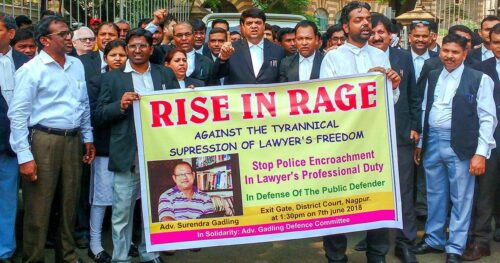
… The need for a dedicated court had also come into focus before the Supreme Court earlier this year during the bail proceedings of lawyer Surendra Gadling, who has represented several UAPA accused and was arrested in the 2018 Elgaar Parishad case. Gadling had told the Supreme Court that his 2016 Surjagarh arson case remained pending without a court or prosecutor in Aheri. Read more
Umar Khalid’s six years in Tihar expose how prolonged pretrial detention under UAPA has become a means of punishing dissent, with Muslims, Dalits and Adivasis bearing a disproportionate burden.
On September 13, 2026, Umar Khalid completed six years in Tihar Jail. Not one prosecution witness has been examined.
There is a particular kind of silence that settles over a case like Umar’s. This is the silence of a system that has learned to punish without verdict, to sentence without trial, and most importantly, to convert the process itself into the penalty.
… The Bhima-Koregaon case offers a parallel indictment of the same machinery. It has been eight years since the alleged incident. Even the trial has not begun. Read more
Who Will Police the Indian Police?
13/09/2026
The Wire / by Anand Teltumbde
Police reform will remain cosmetic unless policing is made strictly accountable to the law rather than to political power.
Police are the face of the state to ordinary Indians. And that face is often one of raw terror. People encounter the state through the policeman at the street corner, the police station, the barricade or the interrogation room. As veteran journalist Kuldip Nayar once observed, the ordinary person’s first encounter with the police often begins with abuse and the danda. Read more
Serving the Powerful, Failing the Powerless
13/09/2026
Peoples Democracy / by MA Baby
Justice Deepak Gupta, a former judge of the Supreme Court, marked the eightieth anniversary of Independence by asking in print what few in his position have dared to ask; how free are we, the citizens of India?
… The Bhima Koregaon prosecution is in its ninth year. Father Stan Swamy died in custody in July 2021. Surendra Gadling got bail in May 2026 after nearly eight years, only to stay in jail on a second case. Every surviving accused has now been granted bail; not one has faced trial, because charges have still not been framed, and forensic findings that the incriminating files were planted by malware have never been judicially examined. The process is the punishment, and the court’s refusal to intervene is what keeps the process alive. Read more
“The process has become the punishment”: Former SC judge Justice Deepak Gupta flags Umar Khalid’s incarceration, judicial majoritarianis
11/09/2026
Maktoob / by Maktoob
Former Supreme Court judge Justice Deepak Gupta criticised prolonged incarceration, judicial majoritarianism and courts’ failure to protect individual liberty, saying “the process has become the punishment” while citing the cases of Umar Khalid, Elgar Parishad and Sonam Wangchuk.
Former Supreme Court judge Justice Deepak Gupta criticised the judiciary’s failure to protect individual liberty, citing rights activist Umar Khalid’s prolonged incarceration and the Elgar Parishad case, and said “the process has become the punishment” as people are labelled “anti-nationals” and their lives ruined. Read more
The true meaning of freedom
06/09/2026
The Tribune / by Justice Deepak Gupta
No country can claim to be free unless it has an independent and fearless judiciary
After the marching has come to a halt, the drumrolls have fallen silent and the euphoria of India’s 80th Independence Day celebrations has lessened, I ponder, how free are we, the citizens of India?
… The accused in the Elgar Parishad case were kept behind bars for years; one died in jail. The allegations against them are said to be very serious. If so, why has the prosecution not shown the same seriousness to start the trial? Eight years have passed since the incident took place. The trial is yet to begin. Read more
Bail is the Rule, Jail is the Exception: The Promise of the Constitution and the Reality of State Repression
30/08/2026
Countercurrents / by Asish Gupta
Former Maoist leader Azad alias Dana Keshav Rao, had a total of 49 cases pending against him in Odisha and Andhra Pradesh after being arrested by the police in 2011. He spent more than 15 years and 2 months in prison as an undertrial prisoner. … Finally, in August 2026, he was acquitted in all 49 cases and released from prison. A lack of sufficient evidence was one of the key grounds for his acquittal.
…
Surendra Gadling’s situation underscores a broader dilemma. Even after securing bail in the Bhima-Koregaon case, he could not be released immediately because he faced a separate case related to the 2016 Surjagarh arson, in which his bail application was pending before the Supreme Court. Thus, while a person was granted bail in one case on the ground of prolonged undertrial detention, the doors of the prison remained closed due to another case.
This illustrates a structural loophole in the Indian bail system. Read more
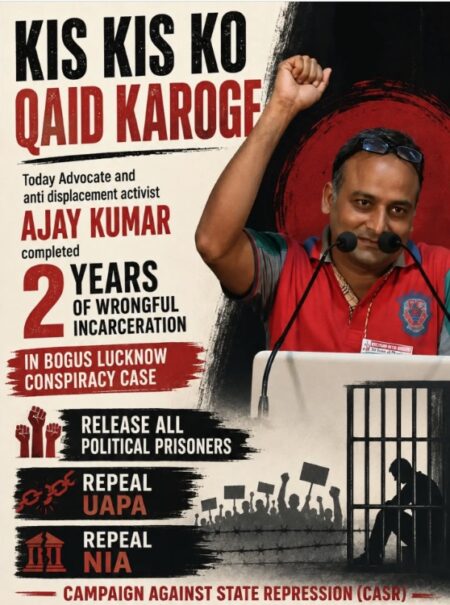
Who is Ajay Kumar? Why Has He Been Behind Bars for the Last Two Years?
30/08/2026
Campaign Against State Repression / by Campaign Against State Repression (CASR)
An activist, writer, lawyer, and intellectual, Ajay Kumar has dedicated nearly three decades of his life to the struggles of the toiling masses for liberation from oppression and exploitation.
… Ajay was actively involved in the Forum Against the War on People, which opposed attacks by state forces and the corporate-sponsored militia Salwa Judum on Adivasi communities in central India under Operation Green Hunt. He was also a founding member of the Vistapan Virodhi Jan Vikas Andolan (VVJVA), a coalition of more than 50 organisations from across the country working against the forcible displacement of peasants, particularly Adivasis, for corporate land acquisition and extractive projects.
VVJVA has campaigned against the forced displacement of peasant and Adivasi communities for the construction of big dams, industrial projects, mines, Special Economic Zones, highways, National Parks, and Smart City projects, among others.
… As a member of the Indian Association of Peoples Lawyers (IAPL), he has worked for the release of political prisoners, including those incarcerated in the Bhima Koregaon case. Read full statement
Click to enlarge
Civil Liberties Groups Seek Release of Political Prisoners
29/08/2026
Deccan Chronicle / by DC Correspondent
The Civil Liberties Committee (CLC) along with CPI and other activists demanded the release of political prisoners detained under UAPA cases.
“It is necessary that we strongly demand that the Telangana government release political prisoners. Governments of other states, including Andhra Pradesh, as well as the Centre, must release political prisoners,” Supreme Court advocate D. Suresh, CLC general secretary, said at a protest at Dharna Chowk on Saturday.
… Suresh said around 1,200 people in Chhattisgarh, 1,000 in Jharkhand and many others in Odisha, UP, Bengal, Kerala, Maharashtra and Delhi were jailed on allegations of being Maoists. He cited the case of lawyer Surendra Gadling who he said was “falsely implicated in the Bhima Koregaon case and has been unjustly languishing in jail for eight years without bail.” Read more
The TISS student’s arrest after commemorating the death anniversary of G.N. Saibaba raises fears that the machinery used to criminalise dissent, now armed with the label of “dimagi naxal”, could be ensnaring a new generation of students.
Abhirup Paul is a name that has little recall value. Note down his name, because he’s likely to be the next Surendra Gadling or the next Umar Khalid or the next Sharjeel Imam—the three men who have been languishing for years in prison and were unable to celebrate yet another Independence Day outside its forbidding walls. Like them, Paul also couldn’t celebrate, a protent that the fate of the three could also become his. Read more
78-year-old man named Mohammed Naeem was acquitted and cleared of all charges by a special National Investigation Agency (NIA) Court in Lucknow after a 33-year-old sedition case due to a lack of evidence. He was accused of outraging religious feelings and making imputations prejudicial to national integration. The case stemmed from an incident on Republic Day, January 26, 1993, in Gorakhpur, Uttar Pradesh.
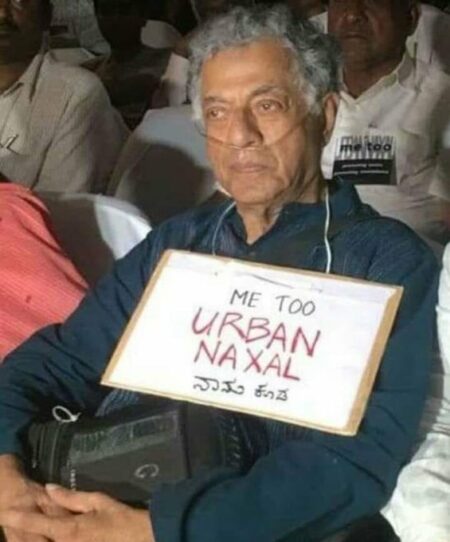
… The Bhima Koregaon case remains one of India’s most controversial legal proceedings. The takeover and handling of the case by the National Investigation Agency (NIA) reflect a politically motivated misuse of federal investigative powers to suppress dissent. The investigation conflates peaceful human rights advocacy and tribal rights work with militant activities, labelling intellectuals and lawyers as “urban naxals”. Read more