As Maharashtra Govt Brings Bill Against ‘Urban Naxalism’, Activists Fear Criminalisation of Dissent
13/07/2025
The Wire / by Sukanya Shantha
None of the provisions under the newly introduced bill is not already covered under the existing UAPA or the Bhartiya Nyaya Sanhita (BNS) or the Maharashtra Control of Organised Crime Act (MCOCA).
Despite existing laws that comprehensively address the threat of terrorism in the country, the Bharatiya Janata Party (BJP)-led Maharashtra government last week introduced yet another bill – the Maharashtra Special Public Security Bill – claiming it will tackle the “urban footprint of Naxalism” in the state. Read more
Maharashtra Public Security Bill: Vague and dangerous for civil liberties
11/07/2025
The Indian Express / by Rohin Bhatt
Instead of the word ‘abetting’, which is commonly used in criminal law, the new law uses the word ‘encouraging’. What amounts to abetting a crime is settled jurisprudence. But the word ‘encouraging’ is alien to criminal law
“When I use a word,” says Humpty Dumpty in Lewis Carol’s Through the Looking Glass, “it means just what I choose it to mean — neither more nor less.” However, when words are used in a piece of legislation, they cannot mean what the party in power wants them to. Read more
Maharashtra Assembly passes bill to curb ‘left-wing extremism‘
10/07/2025
Scroll.in / by Scroll Staff
Opposition leaders expressed concern about its broad language, particularly the definition of the term ‘urban Naxal’.
… The term “urban Naxals” was first used by Union ministers and leaders of the Bharatiya Janata Party after several activists and academics were arrested in the Elgar Parishad case in 2018. Since then, the term has often been used to describe some dissidents of the Narendra Modi government. Read more
Are Indian universities turning into suffocating spaces where constant censorship and surveillance is leaving no room for protests or dissenting voices?
… Academics and intellectuals, having anything to say that is remotely critical of the current regime, are wilfully thrown under the bus by their own institutions. Worse, institutions now lead the mob hounding individuals who exercise their right to free expression—a fundamental right enshrined in the constitution. Read more
Democracy-in-waiting: Voices Of An Imprisoned Conscience
The continuing imprisonment of some of the country’s brightest minds will persist as an indelible taint on the history of a nation state that prides itself as a democracy.
… The same dissent that was criminalised by the British to suppress the anti-colonial struggle nearly a century ago, continues to be treated as a threat even today. Umar Khalid, an ex-student activist from JNU, has been in Tihar jail, New Delhi, since September 2020, on charges of partaking in a “conspiracy” that led to the communal violence in Northeast Delhi in February that year.
… Hundreds of kilometres from Delhi, human rights defenders started being arrested in 2018 by the Pune police under the same UAPA. This time, the allegations had involved inciting the violence at Koregaon Bhima in January 2018 and having alleged links with Maoist outfits. Read more
Progressive Students’ Association – JNU / @Psa_jnu
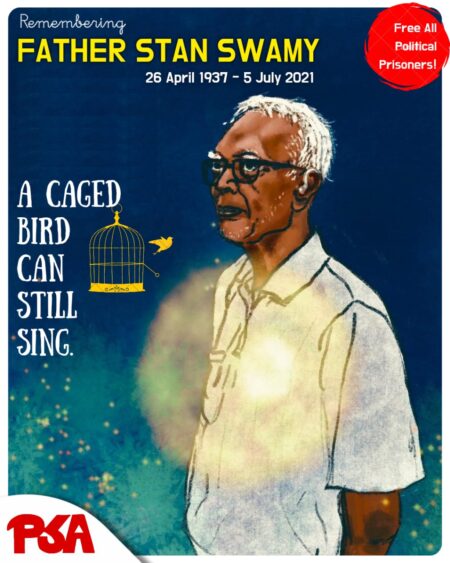
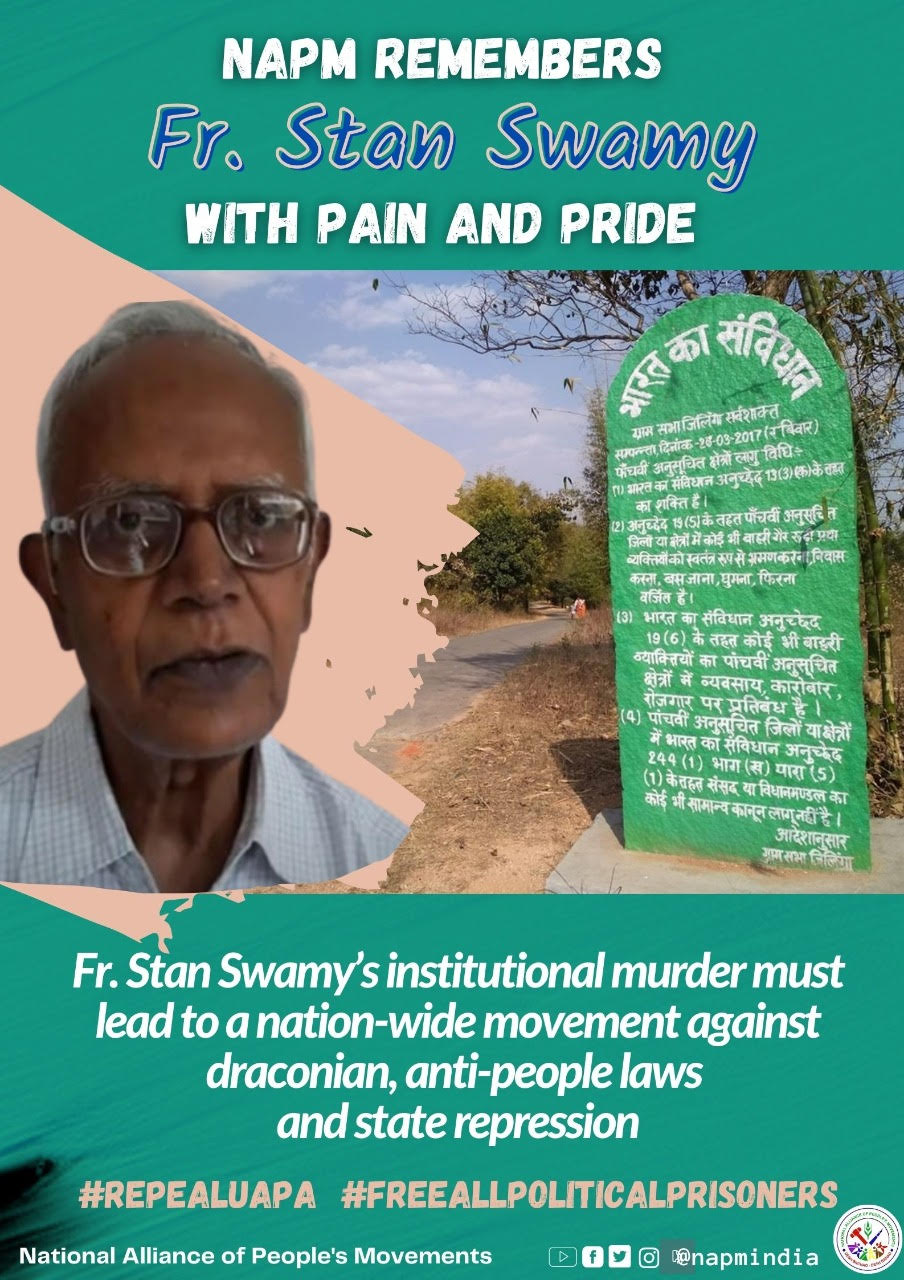
4 Years since the institutional murder of Fr. Stan Swamy!
By Progressive Students’ Association – JNU / @Psa_jnu (Jul 5, 2025):
“Why truth has become so bitter, dissent so intolerable, justice so out of reach? Because truth has become very bitter to those in power and position, dissent, so unpalatable to the ruling elite, justice, so out of
reach to the powerless, marginalised, deprived people. Yet, truth must be spoken, right to dissent must be upheld, and justice must reach the doorsteps of the poor. I am not a silent spectator.”
▪ Free BK 15!
▪ Free All Political Prisoners!
▪ Repeal UAPA.
Four years on, India commemorates the death of a priest of the people, Fr Stan Swamy
05/07/2025
cjp / by Cedric Prakash SJ
On his fourth death anniversary, Jesuit activist Stan Swamy is remembered in for his integrity, sacrifice, and the institutional injustice he endured
When Fr Stan Swamy died on July 5, 2021, the world of truth and justice was shocked and saddened. Those who belonged to this group were convinced, that his death was not a natural one, but a pre-mediated institutional murder. Yes, he was killed – because the powerful and other vested interests had no doubt that he was a real nuisance to their nefarious deeds. So he needed to be done away with. Theirs was a meticulously crafted plan: to interrogate and harass him, to incarcerate him in Taloja jail under an extremely draconian law, the ‘Unlawful Activities Prevention Act (UAPA), to continuously intimidate him through the National Investigation Agency (NIA) even whilst he was imprisoned, to deny him (an ailing 84-year-old frail, sickly Jesuit) a much –needed straw-sipper, proper food and adequate Medicare; all this and more! Read more
Video: A Documentary Film on Stan Swamy – A Caged Bird Can Still Sing
hindi / en | 21:40 | 2025
By Karwan e Mohabbat
This short documentary revisits the life and work of Father Stan Swamy, the Jesuit priest and tribal rights activist who spent decades standing with Adivasi communities in Jharkhand. Arrested under draconian anti-terror laws and denied timely medical care, Stan died in custody on 5 July 2021.
Through conversations with his friends and colleagues, and using Stan’s own archival footage and recordings, we reflect on his unwavering commitment to justice and begin to understand why he was targeted by the state. This is both a tribute and a reminder of the forces that criminalise dissent and silence those who speak for the most marginalised. Watch video
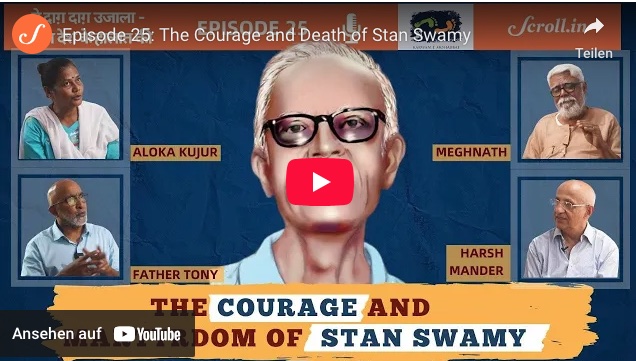
Video: The courage and death of Stan Swamy
hindi | 55:44 | 2025
Scroll.in / by Karwan e Mohabbat
In this episode of our discussion series, author and peace worker Harsh Mander is in conversation with filmmaker Meghnath, activist Aloka Kujur, and Father Tony, director of Bagaicha, the institute founded by Father Stan Swamy in Ranchi. The conversation reflects on the life, work, and legacy of Stan Swamy – a Jesuit priest, Adivasi rights activist, and a central figure in the fight for justice for India’s marginalized communities. The panel discusses his decades-long work with Adivasis and undertrials, his commitment to human rights, and the events that led to his arrest under the UAPA. They talk about his time in jail, the denial of basic medical care, and his death in custody. Watch video
Repeal UAPA, withdraw cases: DMK, allies remember Stan Swamy on death anniversary
05/07/2025
Times Of India / by TNN
Senior DMK leaders and their allies on Saturday squarely blamed the Modi govt for the death of 84-year-old tribal rights activist Stan Swamy in a Jharkhand prison in 2021, calling it an injustice that cannot be undone. Read more
Father Stan’s legacy: The dream of justice for the Adivasis continues in Ranchi
07/07/2025
Herald Malaysia / by Alessandra De Poli
Four years after the death of the Jesuit who dedicated his life to defending the land rights of India’s indigenous peoples, the Bagaicha centre, which he founded in the State of Jharkhand, continues to fight for the poor. Despite threats and continuous mining, Jesuits and activists continue their mission to accompany tribal communities in claiming their rights, in the name of Father Stan Swamy, a symbol of justice for new generations too. Read more
Leaders of INDIA bloc parties remember tribal rights activist Stan Swamy, slams UAPA
07/07/2025
The Telegraph / by M.R. Venkatesh
Unveiling a bust of Fr Stan at St Peter’s Higher Secondary School in Viragalur village near Tiruchirappalli, DMK MP K. Kanimozhi remembered how the octogenarian who had fought for the rights of tribals all his life was denied a straw and a sipper in jail
Leaders of INDIA bloc parties have called upon the Centre to repeal the draconian Unlawful Activities Prevention Act (UAPA), which they alleged was being used as a tool to crush dissent, as they paid homage to tribal rights activist Stan Swamy at his native village in Tamil Nadu on his fourth death anniversary on Saturday. Read more
‘Pilgrim of hope’ Fr Stan Swamy remembered on anniversary
07/07/2025
The Tablet / by Rita Joseph
Kanimozhi Karunanidhi said Fr Stan had been targeted for defending the rights of tribal peoples to forests, water and mineral-rich lands that the government wanted to exploit.
Memorial meetings across India commemorated the tribal rights activist Fr Stan Swamy SJ on the fourth anniversary of his death on Saturday. Read more
Activists call for legal protection, remembering Indian priest’s death
08/07/2025
UCA News / by UCA News reporter
84-year-old Jesuit Stan Swamy died in custody after being denied bail on medical grounds
A call to protect Indian activists from state repression was made on the death anniversary of Father Stan Swamy, an 84-year-old Jesuit priest and tribal rights activist who died as an undertrial five years ago.Political leaders from the ruling alliance in the southern Indian state of Tamil Nadu, Swamy’s home state, endorsed the call by Jesuits and rights activists for legal measures to protect activists working for the socially and financially disadvantaged. Read more
Father Stan Swamy was killed for standing up for the rights of Adivasis
10/07/2025
Countercurrents.org / by Dr Suresh Khairnar
Father Stan Swamy had never visited Bhima Koregaon in his life, in which he was arrested by the NIA in October 2020. And there is no reason for him to have any connection with Elgar Parishad. Because that Parishad was formed by more than two hundred social organizations of Maharashtra to celebrate the 200th anniversary of Bhima Koregaon Shaurya Diwas (on 1 January 2018). In which I myself was a member in the capacity of President from Rashtra Seva Dal. And after celebrating Bhima Koregaon Shaurya Diwas on 1 January 2018, that Parishad has no existence after that. It was formed purely for the program to celebrate the 200th anniversary of Bhima Koregaon Shaurya Diwas in 2018. Read more
The deterioration of the 84-year-old in Taloja Jail was evident. Jail medical staff watched it happen, recalls a fellow prisoner.
Ferreira was incarcerated along with Swamy in the prison hospital. He has been now released on bail on conditions, one of which disallows him from commenting about the case in the media.
“This is not a natural death, but the institutional murder of a gentle soul,” reads the statement by the family members of the people accused in the Elgar Parishad case that was released immediately after Father Stan Swamy’s death on July 5, 2021.
Some may consider these words a bit too harsh given Stan’s age (he was 84) and health (he had Parkison’s disease). However observing and experiencing the callous treatment meted out to Stan at Taloja Prison, I am inclined to endorse their view. Read more
Daring, Fearless and Kind, Father Stan Swamy Remains a Beacon of Resistance
The Wire / by Hany Babu, Jyoti Jagtap, Mahesh Raut, Ramesh Murlidhar Gaichor, Sagar Gorkhe, Surendra Gadling
On the fourth anniversary of Father Stan’s death due to alleged medical negligence in prison, his co-defendants in jail have vowed to lead a hunger strike.
On July 5, 2021, Father Stan Swamy left us, succumbing to failing health aggravated by the deliberate denial of medical care by a repressive state as part of its devious strategy in the Bhima Koregaon-Elgar Parishad case. Four years have passed since this institutional murder of Father Stan. We seethe in indignation on the very memory of this day, when the real, violent, blood-thirsty face of the state unravelled to one and all. Read more
‘Tell the judge he has done no crime’: The struggles of Hany Babu’s family
On July 28, Delhi University professor 57-year-old Hany Babu will complete five years of incarceration.
When the National Investigation Agency came for Babu in 2020, India was battling the Covid-19 virus, which is known to fester and multiply in densely packed spaces, such as prison cells.
The Delhi University professor, arrested in the Bhima Koregaon case, has been in jail for five years with no trial in sight. Read more
Symptoms cited to meet ailing father ‘common for almost every senior citizen’: Mumbai court denies interim bail for Ramesh Gaichor
03/07/2025
The India Express / by Sadaf Modak
Ramesh Gaichor has been in jail since 2020 over alleged Maoist affiliation in the Elgaar Parishad case and sought interim bail for two weeks to meets his father.
A special court in Mumbai Tueday denied interim bail for two weeks sought by an accused in the Elgaar Parishad case, citing that symptoms suffered by his father are “quite common for almost every senior citizen”. Read more
A special NIA court in Mumbai on Tuesday denied interim bail to Ramesh Murlidhar Gaichor, one of the accused in the Bhima Koregaon-Elgar Parishad case [Ramesh Murlidhar Gaichor v National Investigation Agency]
Gaichor had sought a two-week temporary release to visit his ailing father. Read more
▪ WE ARE CHILDREN OF AMBEDKAR: Shahir Ramesh and Sagar hindi/english subtitles | 07:26min | 2020
Shahir Sagar Gorkhe and Shahir Ramesh Gaichor, prominent members of Bhima Koregaon Shauryadin Prerna Abhiyan and Kabir Kala Manch, found themselves at the receiving end of the BJP government’s actions when they were arrested by the National Investigation Agency (NIA) on 7th September 2020.
Both Shahir Sagar Gorkhe and Shahir Ramesh Gaichor have asserted that the NIA forced them to provide false testimony against those already arrested. They were coerced into writing confessional statements seeking forgiveness and implicating other individuals in the case. However, their steadfast refusal to comply with these unjust demands has put them at risk of being arrested by the NIA.
In a recorded video statement, Sagar emphasized their commitment to following the constitution and their allegiance to Dr. Ambedkar, stating, “We aren’t progenies of Savarkar but are children of Dr. Ambedkar. Confessing to things we have never done is out of the question.”
Mahesh Raut, a TISS alumnus and rights activist working for Adivasis and marginalised communities, was arrested in June 2018 in the Bhima-Koregaon Maoist conspiracy case and has since been incarcerated in jail
Taloja Central Prison, located in Kharghar, Navi Mumbai, Maharashtra, houses primarily male undertrial prisoners under the jurisdiction of various courts in the Mumbai Metropolitan Region (eg., Mumbai, Thane, Kalyan, Panvel and Belapur Courts). Like many prisons across India, Taloja is severely overcrowded, accommodating thrice its sanctioned capacity. As an undertrial prisoner at Taloja, confined in Yard 03 (referred to as ‘Baba Barrack’), which includes separate barracks for male prisoners aged 18 to 23, my curiosity was stirred by the rising number of young inmates here and the socio-economic realities leading to their incarceration. Read more
It prompts us all to ask: What kind of society do we want to become?
Father Stan Swamy’s death in custody raises profound questions about India’s commitment to humanity under Prime Minister Narendra Modi’s government.
The 84-year-old Jesuit priest and tribal rights activist died on July 5, 2021, while imprisoned under harsh anti-terror laws, triggering outrage and sorrow across the nation. Read more