How Not To Defend Umar Khalid / Shadows of Judicial Indiscipline / From Protest to Persecution
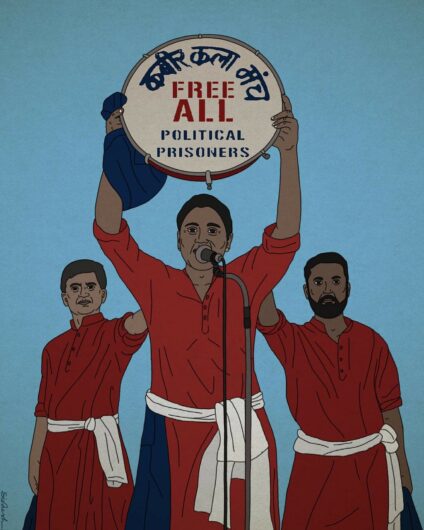
An Injustice Strengthened by Political Silence
18/01/2026
Peoples Democracy / by Brinda Karat
The Supreme Court’s refusal to grant bail to Umar Khalid and Sharjeel Imam, while accepting the bail pleas of five other accused in the same case, is not merely a judicial order affecting two individuals. It marks a deeply troubling moment for constitutional democracy in India.
…
Silence transforms injustice, more so when it has a communal colour, into routine governance. When there is hesitation to challenge unjust court orders, to oppose political persecution carried out through lawless laws like UAPA, whether in the Delhi violence cases, the Bhima Koregaon prosecutions or the NewsClick case, the ruling regime faces no real political cost for its repression, all under the pretext of “national security.” In such a political climate, even the custodial death of a Stan Swamy — caused by the sheer cruelty of denying bail and even basic facilities despite his serious health conditions — becomes normalised.
Read more
How Not To Defend Umar Khalid
16/01/2026
The Wire / by Ajay Gudvarthy
The problem with Umar for the current regime is his refusal to be constrained within a Muslim body and identity. Very much similar to a Dalit like Anand Teltumbde who is not Dalit enough because he speaks of right to education and corporate Hindutva.
Umar Khalid is arrested not because he is a Muslim. He is under detention because he does not wear his Muslim identity on his sleeves. He remains incarcerated not because he protested against the Citizenship Amendment Act (CAA) but because he was agitated about what is happening to the tribals in central India and was resisting the damage being done to the economy that was emaciating the working poor.
Read more
Shadows of Judicial Indiscipline: On the Supreme Court’s bail denial to Umar Khalid and Sharjeel Imam
07/01/2026
The Leaflet / by Indira Jaising
In both the Bhima Koregaon and Delhi riots cases, a wrongful invoking of UAPA and obdurate refusal to follow precedent on delay in trial, raise legitimate questions on the independence of the judiciary.
At the heart of the controversy relating to the denial of bail to Sharjeel Imam and Umar Khalid is a simple question: what is the crime that they have committed? What if they have committed no crime at all under the Unlawful Activities (Prevention) Act, 1967? Would bail still have been denied to them?
Read more
From Protest to Persecution: The Supreme Court’s defining Moment in Delhi Riot Case
07/01/2026
PUDR / by PUDR
On 5 January 2026, the Supreme Court delivered its first substantive order in the so-called ‘Delhi riots conspiracy case’ of FIR 59/2020 under UAPA, to grant bail to five (Gulfisha Fatima, Shifa ur Rehman, Meeran Haider, Md Saleem Khan and Shadab Ahmad) and reject the bail of two (Umar Khalid and Sharjeel Imam).
… the Supreme Court walks back on its own precedent in Vernon Gonsalves, which held that in determining the existence of a prima facie case to deny bail under UAPA, courts are empowered to look into the probative value or patent inadmissibility of prosecutorial materials. In the order of 5 January 2026, the Supreme Court states: “the inquiry is one of statutory plausibility, not evidentiary sufficiency”.
Read full statement
When a Government Targets Its Citizens
07/01/2026
Countercurrents.org / by Hiren Gohain
Does anyone remember the Bhima Koregaon incident now? Certain well-known people active and well-regarded for their work in academic areas as well as in social action to bring justice to victims of state repression and social discrimination as well as human rights violations,had been detained following midnight arrests on hair-raising charges of conspiring to assassinate the Prime Minister and destroy the state. It had shaken the fragile world of the media, though not the workaday world.
Read more
Justice Delayed, Selectively Denied
05/01/2026
Youth Ki Awaaz / by Geetika Kaur
The denial of bail to Umar Khalid this week is not an isolated legal decision. It sits within a larger and deeply disturbing pattern in India’s criminal justice system, one where activists, students, lawyers, and environmentalists languish in jail for years without conviction, while those convicted of rape, murder, or mass violence repeatedly find the doors of prison opening for them.
… Stan Swamy died in custody after repeated denial of bail despite his age and illness. Sudha Bharadwaj spent years in jail before being granted bail, not because she was acquitted, but because prolonged incarceration without trial became legally indefensible. Gautam Navlakha remained under incarceration and house arrest for years on allegations that rested largely on contested digital evidence.
Read more
The spectacle of justice in the Delhi riots case is cover for polarisation and violence
06/01/2026
Scroll.in / by Akash Bhattacharya
In the six years since, a series of incidents in the national capital have intensified this schism while Umar Khalid and Sharjeel Imam remain incarcerated.
The capital of India, Delhi is no stranger to political violence. But the Delhi riots of 2020 set a new benchmark. The violence not only ended lives and livelihoods, it also transformed the city’s social and political landscape for the worse.
Read more
Also read:
▪ How The Supreme Court’s Bail Order Against Umar, Sharjeel Enables Govt Efforts To Silence Muslim Voices (article 14 / Jan 2026)
▪ After Five Years in Jail, Bail Still Barred for Two: Supreme Court denies bail to Umar Khalid and Sharjeel Imam in Delhi riots case (Sabrangindia / Jan 2026)
▪ Umar Khalid, Sharjeel Imam, and The Moral Arc of the Universe (The Wire / Jan 2026)
▪ In UAPA Bail Hearing, Defence Not To Be Considered; Only See If Prosecution Has Shown Prima Facie Case : Supreme Court (Live Law / Jan 2026)
Read judgment
▪ Delhi Riots UAPA Case : Supreme Court’s Bail Conditions Bar Accused From Sharing Posts Digitally & Attending Gatherings (Live Law / Jan 2026)
▪ Why SC denied bail to Umar Khalid, Sharjeel Imam but awarded it to five other anti-CAA activists (Scroll.in / Jan 2026)
▪ Recovering the Basics: The Supreme Court’s Bail Order in Vernon Gonsalves’ Case (Constitutional Law and Philosophy / Jul 2023)
▪ Amit Shah’s ‘Bhima Koregaon Model’ Used For Anti-CAA Protests (NDTV / May 2020)