Eleven years after Narendra Modi’s rise in 2014, with promises of “Achhe Din” and a transformed India, the nation stands at a crossroads. Expectations of a global powerhouse and inclusive democracy have been replaced by broken promises, manipulated data, and a Government obsessed with optics over outcomes.
…
Civil liberties have declined since 2014. Freedom House rated India “Partly Free,” and V-Dem calls it an “electoral autocracy.” The 2025 World Press Freedom Index ranks India 151st of 180, citing journalist harassment. The ED registered 193 cases against political leaders from 2015 to 2025, with 95 per cent of CBI probes targeting opposition figures. The NIA’s questionable evidence in Bhima Koregaon, coupled with low UAPA (3 per cent) and PMLA (0.4 per cent) conviction rates, shows detention over justice. Read more
Congress has a UAPAwakening: Law parent cries ‘dangerous misuse’
12/06/2025
The Telegraph / by Pheroze L. Vincent
Khera mentioned the Bhima Koregaon case, the Delhi riots conspiracy, and the action on web portal NewsClick and other instances of journalists and activists facing arrest under the UAPA
The Congress on Wednesday skewered the anti-terror Unlawful Activities (Prevention) Act, alleging that the Narendra Modi government had weaponised it to stifle dissent and deny justice, but in the process starkly bared the irony that the party had itself passed the law and inserted the provisions that it now finds “draconian” and vulnerable to “dangerous misuse”. Read more
Modi govt using laws like UAPA to stifle dissent: Congress
11/06/2025
Deccan Herald / by PTI
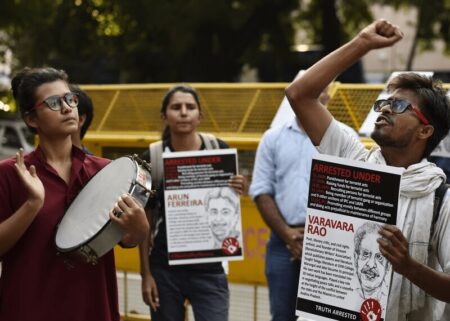
Anand Teltumbde, Nodeep Kaur, and Mahesh Raut were arrested under UAPA in the Bhima Koregaon case
The Congress on Wednesday accused the Modi government of stifling dissent and said the “dangerous misuse” of laws like the UAPA to threaten free expression is part of the BJP’s broader attack on the Constitution.
“Under the Modi government, law has increasingly been used to stifle dissent and delay justice. Between 2014 and 2022, 8,719 UAPA cases yielded only a 2.55% conviction rate, exposing its misuse to target critics, students, journalists, and activists,” Congress’ media and publicity department head Pawan Khera said in a post on X. Read more
The Opposition’s Silence Has Let the BJP Diminish India’s Political Discourse
06/06/2025
The Wire / by Sarayu Pani
Today, the opposition faces a choice – they can either continue to allow the boundaries of political engagement in the country to be decided by the ruling party or they can ground their opposition in democratic principles.
… A vast majority of these instances have not been rhetorically resisted by the political opposition to the BJP. In 2019, for example, the Congress voted in favour of amendments that dangerously broadened the scope of the draconian Unlawful Activities Prevention Act in the Rajya Sabha. Few opposition political parties have stood in clear solidarity with the detainees of either the Bhima Koregaon case or the Delhi riots conspiracy case. Read more
Is the government campaign aimed at ‘finishing off’ the extremists, or are the larger goals to open up central India’s mineral and natural resources for exploitation? Or both?
… Over the years, Maoists, NGOs and even priests like Stan Swamy have mobilized these tribal communities to resist corporate expansion. The state forces, on the other hand, have intervened to crush the protests. Read more
Elgar Parishad case accused at event that attacked Maharashtra Public Security Bill, cops to seek bail review
22/05/2025
Times of India / by Soumitra Bose
The Elgar Parishad case accused, who are out on bail, had thronged the Veera Sathidar memorial event at Vidarbha Hindi Sahitya Sammelan on May 13, top security sources told TOI.
Though the event was organised as a memorial for the acclaimed filmmaker, security agency sources stated it turned into a platform for attacking the Maharashtra govt’s efforts to table the proposed Maharashtra Public Security Bill to rein in frontal organisations of alleged urban Maoists.
… Activists like Sudhir Dhawale and former Nagpur University professor Soma Sen, who are out on bail in the Elgar Parishad case, participated in the event Read more
Actor’s wife, 2 others booked for reciting Pak poet’s poem
21/05/2025
Rediff.com / by pti, edited by Hemant Waje
The recitation of Pakistani poet Faiz Ahmad Faiz’s Hum Dekhenge poem at an event in Nagpur has led police to slap charges of endangering India’s unity and integrity, and promoting enmity against three persons, including late actor-activist Veera Sathidar’s wife Pushpa.
… Police said they are also looking into the activities and background of the Samata Kala Manch, whose head, Sudhir Dhawale, is currently out on bail in connection with another case related to alleged inflammatory speeches made during the Elgar Parishad event in Pune in 2017. Read more
Singing Faiz’s ‘Hum Dekhenge’ is ‘Sedition’: Nagpur Police Book Organisers of Vira Sathidar Memorial
19/05/2025
The Wire / by Sukanyana Shantha
Singing the revolutionary poetry of Faiz Ahmed Faiz, once celebrated as a voice of resistance, now attracts sedition charges in India.
At an event organised last week in memory of actor and activist Vira Sathidar, a group of young cultural activists sang the lyrics of Faiz’s famous Hum Dekhenge.
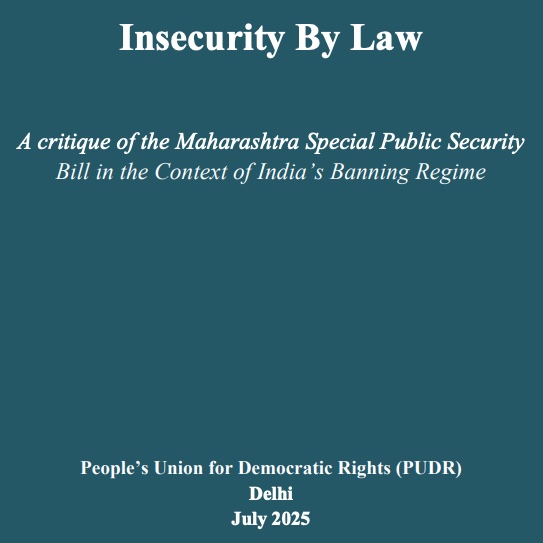
… In October 2020, when the NIA filed a supplementary chargesheet in the Elgar Parishad case, Sathidar’s name appeared among the so-called “urban Naxals,” a term loosely used by the Devendra Fadnavis-led government to target dissenters. Now, with the Maharashtra Special Public Security Bill, the state government seeks to formalise the term “urban Naxal” within the legal framework. Read more
Prashant Jalinder Kamble, an expert with computers, was arrested in Pune
The Maharashtra Anti-Terrorism Squad (ATS) nabbed a Pune resident, who was reported “missing” 15 years ago, for allegedly being an active member of the banned Communist Party of India (Maoist).
… A graduate from a college in Pune, he was allegedly associated with the city-based cultural outfit Kabir Kala Manch (KKM), which according to the police is a “frontal organisation of Maoists”. Read more
The rationality that the Telugu society cultivated 50 years ago—rejecting state oppression and embracing humanistic values—now seems to have been turned upside down.
When an ordinary citizen commits murder, it is a punishable offense. But if the government itself, through the home minister, announcing deadlines for killing people, is that not a crime? And when so-called intellectuals clap and cheer for these murders, is that not a crime too? Read more
Swamy, who was suffering from Parkinson’s disease, had filed bail pleas citing medical grounds which were rejected multiple times. While incarcerated, his health deteriorated and he died on July 5, 2021.
A day after TMC MP Saket Gokhale alleged that the National Investigation Agency (NIA) “denied even a straw” to Father Stan Swamy while he was in jail, former NIA Director General Y C Modi in a statement on Thursday dismissed the allegation and said that the central agency had no role in denying Stan Swamy a sipper. Read more
The Erosion Of Judicial Independence: Is India’s Judiciary An Extension Of Hindutva?
11/03/2025
Eurasiareview / by Debashis Chakrabarti
Once the last bastion against executive overreach, India’s judiciary today stands accused of capitulating to the ideological project of Hindutva—an ethno-nationalist vision that seeks to establish India as a Hindu-first nation.
… While BJP-affiliated individuals find themselves exonerated, critics of the regime face relentless judicial harassment. Activists, journalists, and intellectuals have been imprisoned under draconian laws like the Unlawful Activities (Prevention) Act (UAPA) and sedition charges, with little to no judicial relief. The arrests of intellectuals like Anand Teltumbde, Sudha Bharadwaj, and Umar Khalid reflect how the judiciary has become a willing accomplice in the state’s crackdown on dissent. Read more
Eternal adjournments, impractical riders mar precious Constitutional values
10/03/2025
DT Next / by Justice K Chandru Retd
The case of Umar Khalid, a JNU student who was arrested in connection with the March 2020 Delhi riots, is more disconcerting. This month marks the fifth anniversary of the police filing a conspiracy case, but it is not even close to being tried.
… A classic example is the case of Bhima Koregaon (BK-16) – which became BK-15 after Fr Stan Swamy’s death. Though more than seven years have passed since the arrest of the accused, many are yet to get bail from the special court or the High Court. Read more
In this guest article, economist and writer ASHOKA MODY connects the dots from writer, activist and human rights lawyer Bela Bhatia’s account of her activism to state coercion, corporate interests and the erosion of Indian democracy.
… Bhatia had long campaigned for tribal rights and was frequently at the forefront of protests against police atrocities. By this time, she was likely already under surveillance through the Pegasus spyware—a glaring invasion of her privacy, as she later described to The Telegraph.
However, September 2019 was an especially dangerous moment to challenge India’s law enforcement. Starting in January 2018, after a violent clash between Dalits and Hindutva supporters in Bhima Koregaon (a historic village near Pune), Indian authorities had arrested about a dozen activists under the Unlawful Activities (Prevention) Act (UAPA), 1967. Read more
BJP’s ultranationalism is a strategy to make up for its absence during the freedom struggle, but the binary discourse on nationalism is being weaponised to make detractors fall in line
… Six months after Modi’s government took office, the term ‘anti-national’ emerged as a popular slur. Often used by BJP leaders and supporters, the phrase wields a strong rhetorical power in shaping the ‘nationalist’ public discourse. The binary label has since served as a weapon to silence critics, discredit dissent and marginalise opposition, reinforcing a divisive political narrative. Read more
Politics Of Division: Why Autocrats Foster Binary Thinking
21/02/2025
Outlook India / by Anand Teltumbde
Autocratic and fascist regimes consolidate power by reducing complex socio-political realities into rigid binary oppositions. Instead of addressing systemic economic inequalities, they redirect public anger toward scapegoats – immigrants, minorities and dissenting voices.
… A deadly consequence of this binary-driven autocratic politics is the erosion of democratic institutions. The judiciary, independent media and civil society organisations are labelled as enemies of the state if they challenge the ruling regime. Read more