Browsed by
Category: Profiles

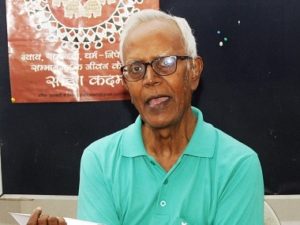
Held by NIA 83-yr-old priest worked for tribals, took on govt policies, and `even the Church´

Held by NIA 83-yr-old priest worked for tribals, took on govt policies, and `even the Church´


Ranchi, Oct 2020

The Indian Express / by Abhishek Angad

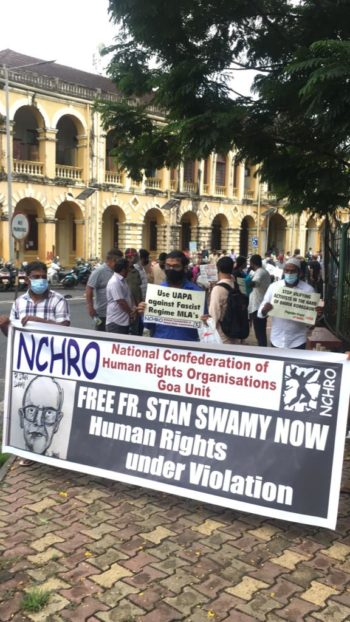
Swamy’s arrest has led to widespread protests in Jharkhand, where he has been based for over two decades. Various civil society groups and activists have criticised this arrest.
Two days before his arrest, Father Stan Swamy, 83, a Jharkhand-based Jesuit priest, human rights activist and writer who was arrested by NIA on Thursday in the Bhima Koregaon case, had in a video statement spoken about his work on displacement, land alienation, rights of gram sabhas and of Adivasis in jail, among other issues.
Read more

Who is Stan Swamy?

Who is Stan Swamy?

“Adivasis lost a great servant,” tribal rights activist Father Stan remembered

06/07/2021

TwoCircles.net / by Sami Ahmad

Stanislaus Lourduswamy, popularly known as Stan Swamy, was an Indian Roman Catholic priest, a member of the Jesuit order, and a tribal rights activist for several decades. Arrested in the Elgaar Parishad case in 2020, Father Stan Swamy breathed his last in a Mumbai hospital. Doctors at Holy Family Hospital, Bandra, informed the Bombay High Court (on 5th of July) that Swamy passed away around 1.30 p.m. In this obituary, Father Stan is remembered by those who knew and worked with him for decades.
Read more
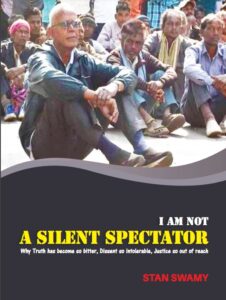

I am not a Silent Spectator – Why Truth has become so bitter, Dissent so intolarable, Justice so out of reach

An Autobiographical Fragment, Memory and Reflection

Indian Social Institute, Bangalore / by Stan Swamy

Edition: Aug 2021
Publisher: Indian Social Institute, Bangalore
Language: English
Paperback: 149 pages

Access a free PDF copy of the book here


Who is Stan Swamy?

By India Civil Watch

On the morning of August 28, 2018 Maharashtra police raided the one room home of Fr.Stan Swamy, who lives on the outskirts of Ranchi on Bagaicha campus, under suspicion of him being involved in the violence at Bhima Koregaon. The police confiscated his laptop, mobile phone and several CDs, and a recent press release on the Pathalgadi movement by Women against Sexual violence and State repression (WSS).

What does an 82 year old Jesuit priest has got to do with Bhima-Koregaon case? Everything, if he is a stalwart of people’s causes.

“When I decided to join the Jesuits, I sought to know where I will be needed more. I came to know about the Indigenous Adivasi people in central India and I lived in an interior Adivasi village for two years and came to appreciate their values … sense of equality, cooperation, sharing without counting, community-bond, consensus decision making, closeness to nature etc.  At the same time, I saw how these beautiful people were being exploited and oppressed by unscrupulous outsiders. I wanted to make something of my life that would make even a small difference in their search for dignity and self-respect. That’s what I am still trying to do during the last four decades.“ (Stan Swamy)

This life defining decision has put Stan Swamy in the forefront of struggles that ranged from the right to food to anti-displacement movements to protests against false imprisonments to land alienation.
Stan Swamy, who moved to the Chaibasa area of undivided Bihar in the 1970s, embarked on life of activism by associating with the 1996 campaign led by the Jharkhand Organisation Against Uranium Radiation (JOAR), a campaign against Uranium Corporation India Limited that successfully stopped the construction of a tailing dam in Chaibasa which, if constructed, would lead to the displacement of adivasis in Jadugoda’s Chatikocha area. After vociferously raising these issues, he moved to work with the displaced people of Bukaro, Santhal Parganas and Koderma and has continued to work for them. He has been a vocal critic of the government’s attempts to amend land laws and the land acquisition act in Jharkhand, termed as ‘Land Bank’, which he sees as the most recent plot to annihilate the Adivasi people and a strong advocate of the Forest Rights Act, Panchayat Extension to Scheduled Areas (PESA), Tribes Advisory Council (TAC), Samatha Judgement etc.
In 2010 Stan Swamy published a book titled, ‘Jail Mein Band Qaidiyon ka Sach’ exposing the arbitrary and unlawful arrests of tribal youths with alleged links to the Naxal Movement. In his book, he highlighted that the average monthly income of 97 percent of these tribal households was less than Rs 5,000, which meant they simply could not afford to hire lawyers to take up their cases. In 2015 when a report was published discussing the plight of the arrested youths, Stan Swamy came into the State machinery’s radar. According to the report 98% of the 3000 arrested were falsely implicated and had no links to the Naxal Movement. Some served years in jail without a trial. He has selfless contributed to pay for the youth’s bail bonds and approached lawyers to represent these cases in the court of law. As part of the Persecuted Prisoners Solidarity Committee, Stan Swamy along with Sudha Bhardwaj, has questioned the illegality with which some undertrials have been put in solitary confinement following the banning of Mazdoor Sangathan Samiti in December 2017.
Working tirelessly to have the PESA Act implement in the state’s scheduled areas, his efforts culminated in the Pathalgadi movement in 2017 in the districts of Khunti, Simdega, Seraikela and Gumla in Jharkhand.  The government’s response was to try and suppress the movement by booking around 20 leaders, including Father Swamy, under charges of sedition on 30 July 2018. It led to well-known intellectuals and activists like Vasvi Kido and Santosh Kido describing the government action as a witch hunt and an attempt to malign the image of the Church in Jharkand. It is hardly a secret that Chief Minister Raghubar Das and the BJP are keen to check the Church’s influence among the tribal community.
As testimony to his tireless endeavours to retain the secular fabric of the country, Stan Swamy has also been closely engaged in fostering communal harmony through secular platforms like Sajha Kadam.
He founded of Vistapan Virodhi Janvikash Andolan (VVJA), an all India platform for different movements that are campaigning against human rights violations caused by displacement of adivasi people, dalits, and farmers from their lands.
As a writer and with meticulous documentation skills he laid threadbare several of the government’s anti-people policies.

India Civil Watch
Facebook: https://www.facebook.com/indiacivilwatch/
Twitter: https://twitter.com/indiacivilwatch
E-mail: indiacivilwatch at gmail.com

By Jhakhand Janadhikar Mahasabha

Stan Swamy wrote at least 74 articles, notes and books in the last two decades on several questions including land rights, undertrials, Adivasi rights, fifth schedule and PESA, hunger and development model. Always vocal on peoples’ issues.
See list of Articles, notes and books written by Stand Swamy (1999-2020)

Decimation drive – The recent arrest of three Dalit rights activists

Decimation drive – The recent arrest of three Dalit rights activists

Frontline / by Anupama Katakam

The recent arrest of three Dalit rights activists in connection with the Elgar Parishad is seen as an attempt to stifle dissent.
MEMBERS of the Kabir Kala Manch (KKM), a Pune-based cultural activist group, knew it was only a matter of time before the National Investigation Agency (NIA) reached their doorstep. The NIA arrested 12 people in connection with the Elgar Parishad, and as one of the primary organisers of the meeting that hosted 250 Dalit organisations, the KKM was definitely on the radar.
Read more

Dubbed urban Naxal, Arun Ferreira a ‘victim’ of BJP govt’s sectarian, vendetta politics

Dubbed urban Naxal, Arun Ferreira a ‘victim’ of BJP govt’s sectarian, vendetta politics

Drawing by Arun Ferreira

Counterview / by Atul, Sandeep Pandey

Arun Ferreira is a civil rights activist and human rights lawyer. He has been behind bars since June 6, 2018, when he was arrested in connection to the Bhima Koregaon event held earlier that year. Like many other activists, he was slapped with Unlawful Activities Prevention Act, sedition and other anti-terror related offenses allegedly for inciting the ensuing violence that police claimed was calculated to disturb public peace.
Ferreira has spent years in jail on similar charges previously as well.
Read more

The Making of Varavara Rao: Parts Seven and Eight

The Making of Varavara Rao: Parts Seven and Eight


VV with wife Hemalatha and the author

Indian Cultural Forum / by N Venugopal Rao

I wouldn’t have been who I am without Varavara Rao, and it is true for the generation I come from and the one that followed. Today’s Telangana wouldn’t have been what it is without him. I have written and spoken about him and his poetry in the past, but now he is on the deathbed, in a faraway hospital, being subjected to retributive torture by the powers that be. Now, with a never-before urgency, I want to speak and write about him, through an interminable torrent of words.
Read more

UAPA – Governments Avoid Due Process by Declaring Groups as ‘Front Organisations’

UAPA – Governments Avoid Due Process by Declaring Groups as ‘Front Organisations’


Jharkhand, Sep 5, 2020

The Wire / by Sukanya Shantha

Legal experts say loopholes in UAPA allow enforcement agencies to misuse the law to target dissenters by branding them as ‘fronts’ for banned organisations.
KKM – a 20-year-old cultural troupe with an anti-caste legacy – was first named in a criminal case in 2011, when the Maharashtra Anti-Terrorism Squad (ATS) arrested several individuals for their alleged link with the banned Maoist group… In the nine years since KKM was first criminalised, neither the state government nor the Centre have made any efforts to notify the organisation as either a banned organisation or an unlawful association, a process laid down in the UAPA.
Read more

An activist poet challenges official narratives: A profile of Sudhir Dhawale

An activist poet challenges official narratives: A profile of Sudhir Dhawale

The Polis Project / by the Polis Project and maraa

Born to a Dalit family in the slums of Indora, an Ambedkarite hub in Nagpur, fifty-four-year-old Sudhir Dhawale is an activist, editor, and writer.
While the 2002 Gujarat riots led him to launch his radical bi-monthly magazine “Vidrohi”, in 2006 he started a cultural-political organization called “Ramabai Nagar-Khairlanji Hatyaakand Virodhi Sangarsh Samiti” following the murder of four persons from a family in Khairlanji in the Vidarbha region of Maharashtra… His magazine, though produced on a small scale, was potent enough to rouse the ire of the establishment. Dhawale was a key planner of the Elgaar Parishad.
Read more

Who are the three Kabir Kala Manch artistes arrested in the Bhima Koregaon case this week?

Who are the three Kabir Kala Manch artistes arrested in the Bhima Koregaon case this week?

The crushing power of street performances from the margins:
A profile of Kabir Kala Manch’s Sagar Gorkhe, Jyoti Jagtap and Ramesh Gaichor

02/09/2021

By The Polis Project and maraa

Kabir Kala Manch
Kabir Kala Manch (KKM) is an urban grass-roots performance group at the helm of a socio-political movement rooted in cultural struggles of the most marginalized communities in India. KKM was formed by working-class youth from low-income Dalit and Bahujan caste communities in Pune as a response to the 2002 pogrom in Gujarat. Drawing inspiration from India’s legacy of dissent – from Kabir and Sant Tukoba (Tukaram) to Dr Bhim Rao Ambedkar, Jyotiba and Savitri Phule, Bhagat Singh, Annubhai Sathe and contemporary cultural activists such as Sambhaji Bhagat and Vilas Goghre – KKM write and perform Marathi and Hindi songs and street plays in the language of India’s laboring people.
Read more


Who are the three Kabir Kala Manch artistes arrested in the Bhima Koregaon case this week?

12/09/2020

Scroll.in / by Aarefa Johari

The National Investigation Agency arrested Sagar Gorkhe, Ramesh Gaichor and Jyoti Jagtap from Pune on Monday and Tuesday.
In 2002, as a 19-year-old student in Pune’s Wadia College, Ramesh Gaichor was disturbed by the deadly communal violence in Gujarat that had claimed over 1,000 lives. Passionate about poetry and theatre, he soon found an outlet for expressing his anxieties: the Kabir Kala Manch, a cultural organisation founded by artiste Amarnath Chautaliya in response to the Gujarat riots.
Read more

NIA Arrests three Kabir Kala Manch Activists, Calls it ‘Maoist Front’ / What is Kabir Kala Manch?

NIA Arrests three Kabir Kala Manch Activists, Calls it ‘Maoist Front’ / What is Kabir Kala Manch?

Poets Branded Naxals by Both Cong & BJP: What is Kabir Kala Manch?

The Quint / by Asmita Nandy

What is Kabir Kala Manch and why are they repeatedly targeted by governments?
Kabir Kala Manch, a group of artists singing songs of Bahujans and Karl Marx, have been branded “naxals” by both Congress and BJP.
On Tuesday, 8 September, the National Investigation Agency (NIA), which is probing the Elgar Parishad case arrested three members of the group saying that they were in touch with senior leaders of CPI(Maoist), a banned organisation under the Unlawful Activities (Prevention) Act “so as to spread the ideology of Maoism/Naxalism and encourage unlawful activities”.
Read more


NIA Calls Kabir Kala Manch ‘Maoist Front’, Takes Activists into Custody

The Wire / by Sukanya Shantha

08/09/2020

Mumbai: The National Investigations Agency has accused the cultural group Kabir Kala Mancha (KKM) of being a frontal organisation of the banned terrorist Communist Party of India (Maoist) …
KKM is a Pune-based cultural troupe that was formed by youth belonging to the Bahujan community from across Maharashtra. Several working-class musicians and poets had come together after the 2002 communal riots in Gujarat and formed their own cultural group to sing songs of resistance and state repression. They have also been vocal against caste atrocities across the country.
Read more


Kabir Kala Manach cultural activist Jyoti Jagtap arrested / #StandWithBK15

08/09/2020

Kractivist / by Bhima Koregaon Shauryadin Prerana Abhiyan

Pune ATS has today arrested Jyoti Jagtap (Member of Bhima Koregaon Shauryadin Prerana Abhiyan and Kabir Kala Manch). She will be transfered to NIA for custody. Yesterday, on 7 September, Sagar Gorkhe and Ramesh Gaichor were arrested late evening and today Jyoti Jagtap has been arrested.
Read more


NIA Arrests Two Kabir Kala Manch Activists

07/09/2020

The Wire / by Sukanya Shantha

Mumbai: After questioning them over several days, the National Investigation Agency (NIA) arrested cultural activists Sagar Gorkhe and Ramesh Gaichor in the Elgar Parishad case. With their arrest, 14 persons – all academics, lawyers and activists – have been arrested in the 2018 Elgar Parishad case in total.
Read more

When contesting repressive laws makes you a dangerous citizen: a profile of Rona Wilson

When contesting repressive laws makes you a dangerous citizen: a profile of Rona Wilson

The Polis Project / by The Polis Project and maraa

Rona Wilson, a forty-seven-year-old activist from Kollam district in Kerala, has made Delhi his second home since the late 1990s. Having come to the capital during his post-graduation, Wilson almost immediately took to activism.
Rona Wilson is a member of the Committee for the Release of Political Prisoners (CRPP), which has campaigned against the UAPA and other repressive laws.
Read more