‘Maharashtra centre of Maoist urban network’: State defends Special Public Security Act in court
07/10/2026
The Indian Express / by Omkar Gokhale
Defending the law against Congress, CPI and AITUC pleas, the state says other Maoist-hit states already have similar laws that have withstood judicial scrutiny
Maharashtra, “because of its highest urban population has become center of Maoist urban network,” the state government has told the Bombay High Court, defending the Maharashtra Special Public Security (MSPS) Act. … Citing Elgaar Parishad and other cases, the affidavit claimed Maharashtra has the highest number of frontal organisations in the country, 64. It said Andhra Pradesh, Telangana, Chhattisgarh, Odisha and Jharkhand had banned such groups under similar laws that “withstood judicial scrutiny”, so Maharashtra was empowered to enact one for “local security environments”. Read more
Maharashtra Has Become ‘Centre’ Of Maoist Urban Network: State Defends Special Public Security Act Before Bombay High Court
07/10/2026
Live Law / by Narsi Benwal
The Maharashtra Government while defending its decision to enact the Maharashtra Special Public Security Act (MSPSA), on Tuesday (October 6) told the Bombay High Court that because of its highest urban population, the State has become a ‘centre’ for Maoist urban network and thus in absence of legal framework to ban such ‘left wing extremist’ organisations, it has come up with this law as done by states like Telangana, Andra Pradesh, Madhya Pradesh and Chhattisgarh. Read more
The TISS student’s arrest after commemorating the death anniversary of G.N. Saibaba raises fears that the machinery used to criminalise dissent, now armed with the label of “dimagi naxal”, could be ensnaring a new generation of students.
Abhirup Paul is a name that has little recall value. Note down his name, because he’s likely to be the next Surendra Gadling or the next Umar Khalid or the next Sharjeel Imam—the three men who have been languishing for years in prison and were unable to celebrate yet another Independence Day outside its forbidding walls. Like them, Paul also couldn’t celebrate, a protent that the fate of the three could also become his. Read more
Modi’s ‘Dimagi Naxal’ Remark Is an Attempt to Frame the Next Wave of Youth Dissent as Anti-National
22/08/2026
The Wire / by Anand Teltumbde
A government that has just witnessed a leaderless, meme-driven youth movement force it to yield has an obvious institutional incentive to narrow the boundaries of legitimate protest – and to have the vocabulary for doing so ready in advance.
…
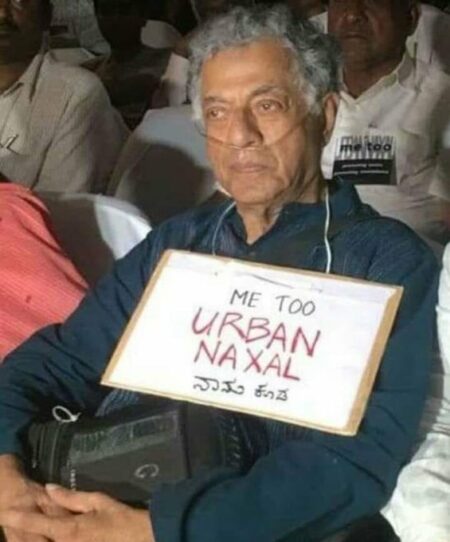
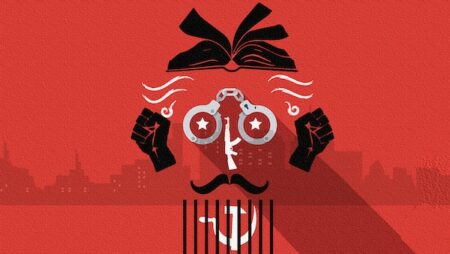
The phrase “dimagi Naxal” echoes the politically charged label “urban Naxal,” a term Modi and leaders of his Bharatiya Janata Party (BJP) have used for years for activists, academics and other critics of the government. It became the operative logic behind the 2018 Bhima Koregaon arrests, in which poets, lawyers, professors and human-rights defenders were arrested under the draconian Unlawful Activities (Prevention) Act (UAPA) on the theory that they had a link to a banned Maoist conspiracy.
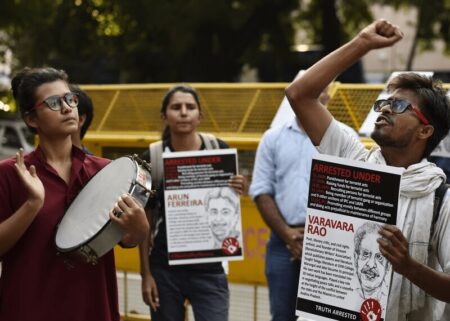
One of these 16 arrestees, Father Stan Swamy, 84 years old and suffering from Parkinson’s disease, died in judicial custody in 2021 without ever being convicted and Surendra Gadling, a human rights lawyer from Nagpur is still in jail in his ninth year. Read more
A Speech Sans Substance!
22/08/2026
Peoples Democracy / by M A Baby
On March 31, 2026, Union Home Minister Amit Shah declared that India has become free from Naxalism. In his Independence Day speech from the Red Fort on August 15, Prime Minister Narendra Modi proclaimed its return.
Quite a few things happened in the intervening four months. But three developments stand out – the wave of workers’ protests that briefly spread across the northern part of the country in April and May; the historic student-youth movement that forced the resignation of Union Education Minister Dharmendra Pradhan; and the Bankipur bye-election, which resulted in a mammoth defeat for the BJP in a seat it had dominated for over three decades and had only recently been vacated by its National President. These developments have no doubt forced the BJP onto the back foot.
Modi invoking the threat of “dimagi naxals” in his address must be seen in this context. A rattled leader bereft of ideas tends to fall back on rhetoric and tactics that have proven useful in the past. The “dimagi Naxal” jibe is thus a revival of the “tukde-tukde gang”, “urban Naxal”, “andolan jeevi” and similar labels used earlier. Read more
From ‘Tukde-Tukde Gang’ to ‘Dimagi Naxals’: When Labels Replace Answers
20/08/2026
Counterview.net / by Mohd Ziyaullah Khan
How the politics of insulting dissenters evolved — and why India’s Gen Z may be less willing to accept it. There is something revealing about the political vocabulary of the Narendra Modi era
When students protested, they were called the “Tukde-Tukde Gang.” When intellectuals, activists and academics challenged the government, some were branded “Urban Naxals.” Writers and artists who returned state awards became the “Award Wapsi Gang.” Farmers protesting the government’s policies were described using terms such as “Khalistanis,” “Maoists” and “anti-national.” Prime Minister Narendra Modi also coined “Andolanjeevi” for people he portrayed as professional protesters.
Now comes another expression: “Dimagi Naxals” — ideological or intellectual Naxals. Read more
Prime Minister’s ‘Dimagi Naxal’ Formulation Echoes the British Playbook Against Dissent
19/08/2026
The Leaflet / by S.N. Sahu
By branding dissenters as “Dimagi Naxals,” the Prime Minister revives the same colonial logic once used to silence Gandhi and threatens the constitutional freedoms India’s youth are fighting to defend.
Prime Minister Modi in his address to the nation from the ramparts of Red Fort on the occasion of 80th Independence Day stated that his government has succeeded in eliminating the armed Naxals in the jungles., While doing so he warned about “Dimagi Naxals” (intellectual Naxals) waiting for opportunities to unleash violence, unrest and create turmoil in society. And so, he underlined the necessity of identifying and isolating them. Read more
‘Dimagi Naxal’: When Mind Becomes Site of Suspicion
17/08/2026
NewsClick / by Shirin Akhter
After 79 years of Independence, a democracy should not be asking its citizens to fear the independent mind.
…
Naxalism has a specific political history. Its name derives from the 1967 uprising in Naxalbari in West Bengal and the Maoist political movements that subsequently emerged. For decades, the Naxalite was associated primarily with armed revolutionary politics.
Then came the term, “Urban Naxal”.
The expression acquired wider political currency particularly around 2018, when activists, lawyers and intellectuals were arrested in connection with the Bhima Koregaon case. The political category began travelling beyond those accused of participation in armed insurgency. Read more
Opposition says PM Modi’s ‘dimagi Naxals’ remark shows he is ‘rattled’
16/08/2026
Scroll.in / by Scroll Staff
Prime Minister Narendra Modi describing his opponents as “dimagi Naxals”, or persons with “Naxal mentality”, was a “sure sign of his desperation”, said the Congress on Saturday.
“It is a separate matter that he ends up doing whatever these so-called ‘urban Naxals’ or now ‘dimaagi Naxals’ are demanding or advocating,” said party leader Jairam Ramesh.
The term “urban Naxals” was first used by Union ministers and leaders of the Bharatiya Janata Party after several activists and academics were arrested in the Elgar Parishad case in 2018. Since then, the term has often been used to describe some dissidents of the Narendra Modi government. Read more
Digital rights groups warn that forcing an app onto every device could allow the government to spy on Indians and even control their devices.
… On social media, founder and editor of technology policy website Medianama, Nikhil Pahwa, illustrated just what this ability to control a user’s mobile phone would look like. “A government application can also be used to implant files on your device,” he said. “[It] has happened before, in the Bhima Koregaon case where documents were allegedly put on laptops and used to frame a conspiracy.” Read more
Netherlands-based digital forensics expert Robert Jan Mora found “malware, not identified as such in the (RFSL) report, on an external pen drive that was seized from Mr. [Rona] Wilson”.
In 2022, when Netherlands-based digital forensics expert Robert Jan Mora was reviewing screenshots of Pune Police reports on some of the accused in the Bhima Koregaon case, he found something strange.
The Bhima Koregaon case has garnered international infamy for the prolonged persecution of 16 human rights defenders under terrorism-related charges, with individuals and organisations from across the world calling for the release of all accused. Read more
PUCL condemns regressive and defamatory views of DU Vice Chancellor Prof. Yogesh Singh: At odds with Constitutional values
09/10/2025
Countercurrents.org / by People’s Union For Civil Liberties
People’s Union for Civil Liberties (PUCL) India, is shocked at the troubling views expressed by Dr Yogesh Singh, professor and Vice Chancellor Delhi University on 28th September, 2025 in a speech titled “Naxal Mukt Bharat: Ending Red Terror Under Modi’s Leadership, Why Campuses are Targets?’
…
In the over 20 minute speech, replete with unsubstantiated and defamatory statements about alleged “urban naxals” on campus, Prof Singh named Delhi university’s professors and student activists charged and imprisoned under the draconian Unlawful Activities (Prevention) Act, 1967, including members of the feminist student group Pinjar Tod (Devangana Kalita and Natasha Narwal), charged in the Delhi riots case and Prof Hany Babu and professors Dr Shoma Sen and Dr Anand Teltumbde (mispronounced by Prof Singh as Teltumbedke), charged in the Bhima Koregaon case. Read more
Delhi University V-C’s speech criticising ‘urban naxals’, Pinjra Tod movement draws ire
08/10/2025
The Indian Express / by Express News Service
Delhi University Vice-Chancellor Yogesh Singh’s speech alleging the presence of “Urban Naxals” in universities and criticising movements like ‘Pinjra Tod’ has triggered protests from students and faculty.
… Referring to the 2018 Bhima Koregaon case, Singh named DU professor Hany Babu and academics Rona Wilson and Anand Teltumbde, saying, “And these are not isolated cases.” Read more
Protests across Maharashtra denounce the Public Security Act as unconstitutional and anti-democratic [picture galleries]
10/09/2025
Sabrangindia / by Sabrangindia
Opposition, rights groups, and people’s movements unite to call it an “anti-people, anti-democratic law”
A wave of protests swept across Maharashtra today as opposition parties, civil society organizations, and grassroots groups came together to denounce the recently passed Maharashtra Public Security Bill, branding it a “Public Oppression Bill.” Demonstrations took place in Mumbai, Pune, Kolhapur, Solapur, Palghar, Beed, Hingoli, Dhule, Gadchiroli, Gondia, and several other districts, marking one of the largest coordinated state-wide agitations in recent years. Read more
PSA a bid to criminalise varied organisations: Sudha Bharadwaj
31/08/2025
Hindustan Times / by HT Correspondent
Bharadwaj was among the speakers at a webinar organised by All India Inquilabi Youth and Students Alliance (ALIYSA) and National Alliance of People’s Movements (NAPM) along with senior advocate Mihir Desai and activist Ulka Mahajan
Human rights lawyer Sudha Bharadwaj said on Saturday that it was a great thing that the civil society in Maharashtra had already begun protesting against the Maharashtra Special Public Security Act, passed by the state’s legislative assembly in its recently concluded monsoon session. Read more
Maharashtra Special Public Security Act, Pre-Emptive Criminalisation And Indefinite Surveillance
22/08/2025
Outlook / by Anand Teltumbde
The MSPSA gives the state-corporate nexus the legal means to suppress participatory democracy under the guise of public security.
On July 10, 2025, the Maharashtra Vidhan Sabha passed a revised version of the Maharashtra Special Public Security Act (MSPSA), exactly one year after the original draft was introduced on July 11, 2024, by the Shiv Sena-BJP coalition under Chief Minister Eknath Shinde. Initially framed as a response to the perceived threat of “urban Naxalism”, the Bill claimed to address the alleged infiltration of Maoist ideology into urban areas through affiliated organisations offering logistical support and shelter to underground cadres. Read more
The home minister’s accusation against vice-presidential candidate Justice Sudarshan Reddy should make us reflect deeply on how certain terms have been weaponised to invalidate the lifeworks of public intellectuals, and how the higher judiciary itself has enabled this.
… Who is a Naxal?: The attack on public intellectuals and the judiciary’s silent complicity
Of late, supporters of the ruling regime have weaponised the label of ‘Naxal’ and ‘urban Naxal’ to name-call public intellectuals who have opposed them. We saw similar allegations being deployed against intellectuals and social activists who have been imprisoned under the notorious Unlawful Lawful Activities (Prevention) Act (‘UAPA’) in the Bhima Koregaon case. Read more
The MSPSA gives the state-corporate nexus the legal means to suppress participatory democracy under the guise of public security.
On July 10, 2025, the Maharashtra Vidhan Sabha passed a revised version of the Maharashtra Special Public Security Act (MSPSA), exactly one year after the original draft was introduced on July 11, 2024, by the Shiv Sena-BJP coalition under Chief Minister Eknath Shinde. Initially framed as a response to the perceived threat of “urban Naxalism”, the Bill claimed to address the alleged infiltration of Maoist ideology into urban areas through affiliated organisations offering logistical support and shelter to underground cadres. Read more
New Maharashtra Security Law Open To Abuse, Threatens Rights; Say ‘No’ To It
18/08/2025
Deccan Chronicle / by Aakar Patel
The term “Urban Naxalism” has no legal definition in Indian law. With its vague language, discriminatory focus, absence of judicial oversight, and high potential for misuse, the bill risks criminalising of legitimate dissent in one of our largest states
We celebrated Independence Day earlier this month, to mark the culmination of our freedom struggle. Independence and freedom from what? From alien rule and from all oppressive laws — no matter who imposes them on us. The governor of Maharashtra is currently examining a law passed by the state Assembly called the “Maharashtra Special Public Security Bill”. Read more
Open letter: Withhold assent to the Maharashtra special public security bill
15/08/2025
Amnesty International / by Aakar Patel
Your Excellency Shri. Chandrapuram Ponnusamy Radhakrishnan, Governor of Maharashtra.
I write to you with grave concern regarding the recently passed Maharashtra Special Public Security Bill, which now awaits your assent. Though presented as a tool to combat “urban naxalism,” The Bill introduces vague, overboard, and ideologically biased provisions that pose an immediate threat to international and constitutionally protected rights and will criminalize dissent in the state.
The Honorable Chief Minister, Devendra Fadnavis, has asserted that the law will not be used to suppress government critics. However, the term “urban naxalism” has no legal definition in Indian law. It is a rhetorical and politically charged phrase – popularized in media and political discourse, not jurisprudence. Its vagueness allows it to be weaponized against civil society, often conflating peaceful dissent with sedition or terrorism. There is a troubling precedent. The Bhima Koregaon case, in which 16 activists were arrested under the Unlawful Activities (Prevention) Act UAPA, demonstrates how this label has been used to detain individuals for years without trial. Read more