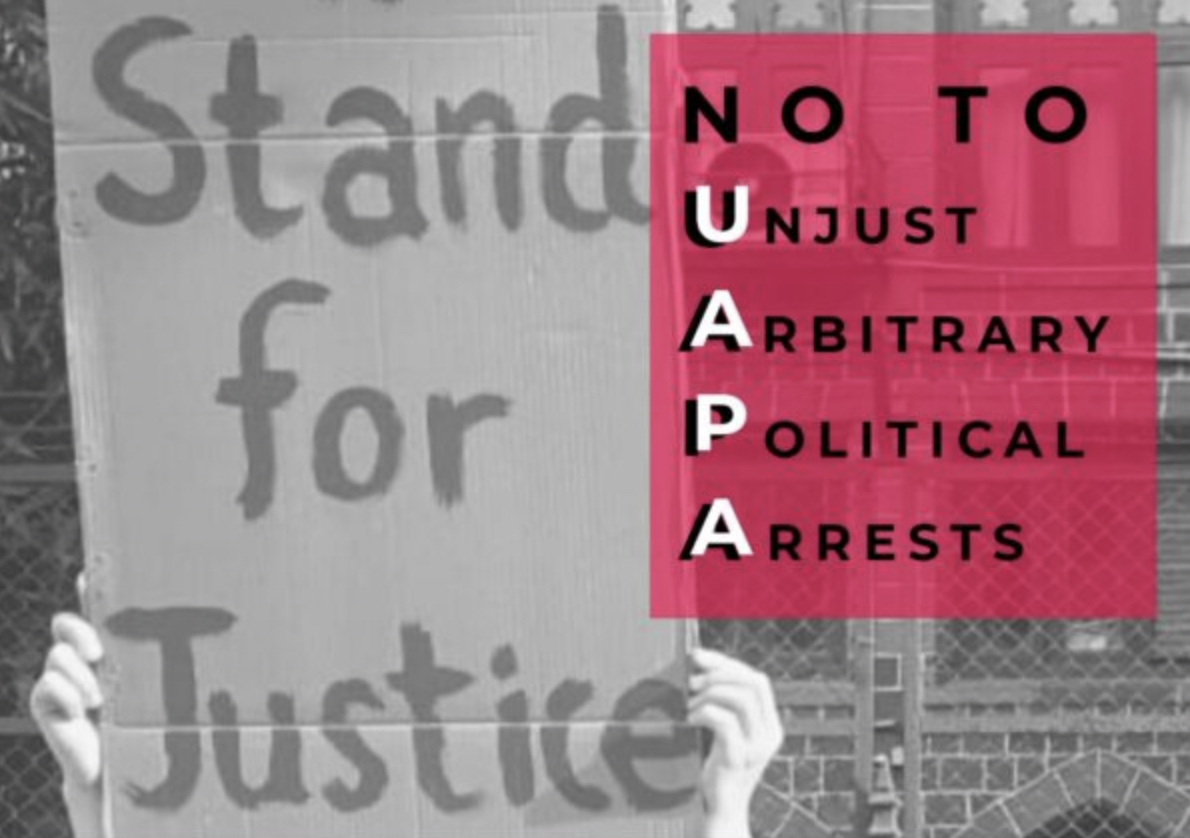
UAPA’s vague provisions, stringent bail conditions and inconsistent judicial interpretations have enabled the prolonged imprisonment of activists, scholars and journalists without trial; Prof. G.N. Saibaba’s experience shows the urgent need to reform a legal regime that undermines civil liberties, due process and rule of law
… The anniversary of Professor Saibaba’s death is an occasion to reflect on a legal regime that is designed to — quite literally — imprison dissent and deny justice. Over the years, the UAPA has been used to criminalise political opposition. Following the violence at the Bhima Koregaon commemoration event in 2018, UAPA charges were brought against 16 scholars and activists, all of whom were jailed. Eight years later, the trial has yet to begin, and the court has yet to frame charges against the accused. Read more
They voiced their concerns over alleged voter deletions, police action against dissenters and the independence of constitutional institutions, seeking the intervention of the Supreme Court.
… Advocate and legal activist Narasimhamurthy condemned alleged police atrocity against lawyers, students and journalists. … He also cited the imprisonment of activists, including GN Saibaba and Father Stan Swamy, and detentions in the Bhima Koregaon case as examples of the treatment of dissenting voices. Read more
Modi opens war on the people, and the Supreme Court looks on
10/10/2026
Frontline / by Anand Teltumbde
The government has used force to stop protests against Gyanesh Kumar and the SIR. The Supreme Court’s delays and refusal of interim relief have allowed the process to continue, prompting criticism that its caution favors the executive.
On October 10, Delhi was sealed before the protest began. Dozens of Metro stations were closed or restricted, trains cancelled, and mobile internet suspended in central Delhi. Jantar Mantar was ringed with barricades, cameras, water cannons, and security forces; buses waited to carry detainees away. …
In the Bhima-Koregaon case, civil-rights activists, lawyers, and scholars were arrested under the Unlawful Activities (Prevention) Act and held for years without trial. During the protests against the Citizenship Amendment Act (CAA), Muslim activists, including Umar Khalid, were prosecuted under the same law. Prolonged detention before trial makes process itself a punishment. It was meant to terrorise people into silence. Women wrestlers who protested alleged sexual abuse by a BJP MP were met with police force rather than an urgent reckoning with their allegations. Read more
Front Line Defenders / by Front Line Defenders & others
We, the undersigned, are regional and international human rights nongovernmental organizations as well as individuals expressing concerns over the developments at the National Human Rights Commission of India (NHRCI).
…
Over the past decade, the NHRCI has not intervened when Indian authorities have targeted students, activists, lawyers, journalists, and critics of the government under the abusive, counterterrorism law, the Unlawful Activities Prevention Act (UAPA). This includes 16 prominent activists who promoted the rights of persons from India’s most marginalized communities, accusing them of inciting violence that occurred during a Dalit meeting in January 2018 in Bhima Koregaon in Maharashtra state. The trial is yet to begin but 15 activists arrested in the case spent years in jail before they were granted bail, while 84-year-old Stan Swamy, a prominent tribal rights activist, died in custody, which a UN expert termed as “a stain on India’s human rights record.” According to reports by the US-based forensic firm Arsenal Consulting, malware was used to surveil and plant evidence on the computers of at least three accused in this case. Read more
‘A National Hero’: Jailed Activist Umar Khalid Wins International Award For Human Rights Defenders
09/10/2026
The Wire / by The Wire Staff
A special ceremony was held at the Trinity College in Dublin, to honour all the recipients. Khalid was represented by his father, Syed Qasim Rasool Ilyas.
Activist Umar Khalid who has been jailed since the last six years has won the 2026 Front Line Defenders Award for Human Rights Defenders at Risk.
“Umar Khalid is the 2026 Asia winner of the Front Line Defenders Award. To those who try to silence his work, he is seen as an “enemy of the state’’ and an “anti-national”, but to others, he is a national hero, a voice of the people, and a human rights defender. Read more
To mark Prisoners’ Day honestly is to notice this asymmetry, not just to honor the dead of 1929. It is to ask why a nation can revere its historical political prisoners while refusing that name to those living through an almost identical experience today
On 13th September 1929, Jatin Das died in Lahore Central Jail after sixty-three days without food. He had not committed a violent act. His crime, in the eyes of the colonial state, was conviction, the belief that India should govern itself. His body, wasting through week after week of hunger strike, became the only language of protest still available to a man the state had already decided to silence through confinement rather than trial. His death is why September 13th is observed as Prisoners’ Day.
… Sharjeel Imam has been in Jail without trial since 2020. Umar Khalid’s case has moved at a similar pace. The Bhima Koregaon accused, several of them elderly, some in visibly deteriorating health, have spent years as undertrials on charges that have yet to be substantively tested in court. Read more
Umar Khalid’s six years in Tihar expose how prolonged pretrial detention under UAPA has become a means of punishing dissent, with Muslims, Dalits and Adivasis bearing a disproportionate burden.
On September 13, 2026, Umar Khalid completed six years in Tihar Jail. Not one prosecution witness has been examined.
There is a particular kind of silence that settles over a case like Umar’s. This is the silence of a system that has learned to punish without verdict, to sentence without trial, and most importantly, to convert the process itself into the penalty.
… The Bhima-Koregaon case offers a parallel indictment of the same machinery. It has been eight years since the alleged incident. Even the trial has not begun. Read more
Who Will Police the Indian Police?
13/09/2026
The Wire / by Anand Teltumbde
Police reform will remain cosmetic unless policing is made strictly accountable to the law rather than to political power.
Police are the face of the state to ordinary Indians. And that face is often one of raw terror. People encounter the state through the policeman at the street corner, the police station, the barricade or the interrogation room. As veteran journalist Kuldip Nayar once observed, the ordinary person’s first encounter with the police often begins with abuse and the danda. Read more
Serving the Powerful, Failing the Powerless
13/09/2026
Peoples Democracy / by MA Baby
Justice Deepak Gupta, a former judge of the Supreme Court, marked the eightieth anniversary of Independence by asking in print what few in his position have dared to ask; how free are we, the citizens of India?
… The Bhima Koregaon prosecution is in its ninth year. Father Stan Swamy died in custody in July 2021. Surendra Gadling got bail in May 2026 after nearly eight years, only to stay in jail on a second case. Every surviving accused has now been granted bail; not one has faced trial, because charges have still not been framed, and forensic findings that the incriminating files were planted by malware have never been judicially examined. The process is the punishment, and the court’s refusal to intervene is what keeps the process alive. Read more
“The process has become the punishment”: Former SC judge Justice Deepak Gupta flags Umar Khalid’s incarceration, judicial majoritarianis
11/09/2026
Maktoob / by Maktoob
Former Supreme Court judge Justice Deepak Gupta criticised prolonged incarceration, judicial majoritarianism and courts’ failure to protect individual liberty, saying “the process has become the punishment” while citing the cases of Umar Khalid, Elgar Parishad and Sonam Wangchuk.
Former Supreme Court judge Justice Deepak Gupta criticised the judiciary’s failure to protect individual liberty, citing rights activist Umar Khalid’s prolonged incarceration and the Elgar Parishad case, and said “the process has become the punishment” as people are labelled “anti-nationals” and their lives ruined. Read more
The true meaning of freedom
06/09/2026
The Tribune / by Justice Deepak Gupta
No country can claim to be free unless it has an independent and fearless judiciary
After the marching has come to a halt, the drumrolls have fallen silent and the euphoria of India’s 80th Independence Day celebrations has lessened, I ponder, how free are we, the citizens of India?
… The accused in the Elgar Parishad case were kept behind bars for years; one died in jail. The allegations against them are said to be very serious. If so, why has the prosecution not shown the same seriousness to start the trial? Eight years have passed since the incident took place. The trial is yet to begin. Read more
Bail is the Rule, Jail is the Exception: The Promise of the Constitution and the Reality of State Repression
30/08/2026
Countercurrents / by Asish Gupta
Former Maoist leader Azad alias Dana Keshav Rao, had a total of 49 cases pending against him in Odisha and Andhra Pradesh after being arrested by the police in 2011. He spent more than 15 years and 2 months in prison as an undertrial prisoner. … Finally, in August 2026, he was acquitted in all 49 cases and released from prison. A lack of sufficient evidence was one of the key grounds for his acquittal.
…
Surendra Gadling’s situation underscores a broader dilemma. Even after securing bail in the Bhima-Koregaon case, he could not be released immediately because he faced a separate case related to the 2016 Surjagarh arson, in which his bail application was pending before the Supreme Court. Thus, while a person was granted bail in one case on the ground of prolonged undertrial detention, the doors of the prison remained closed due to another case.
This illustrates a structural loophole in the Indian bail system. Read more
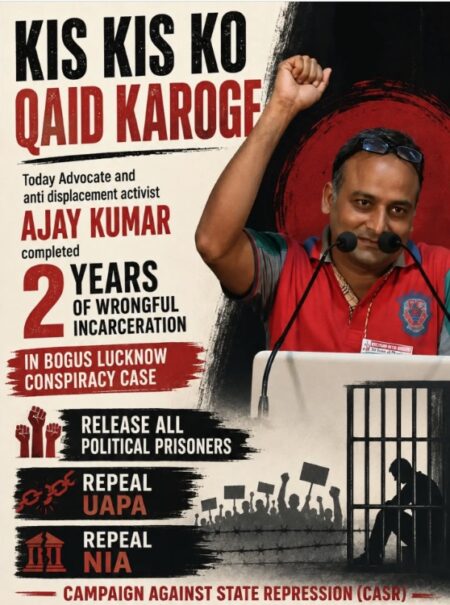
Who is Ajay Kumar? Why Has He Been Behind Bars for the Last Two Years?
30/08/2026
Campaign Against State Repression / by Campaign Against State Repression (CASR)
An activist, writer, lawyer, and intellectual, Ajay Kumar has dedicated nearly three decades of his life to the struggles of the toiling masses for liberation from oppression and exploitation.
… Ajay was actively involved in the Forum Against the War on People, which opposed attacks by state forces and the corporate-sponsored militia Salwa Judum on Adivasi communities in central India under Operation Green Hunt. He was also a founding member of the Vistapan Virodhi Jan Vikas Andolan (VVJVA), a coalition of more than 50 organisations from across the country working against the forcible displacement of peasants, particularly Adivasis, for corporate land acquisition and extractive projects.
VVJVA has campaigned against the forced displacement of peasant and Adivasi communities for the construction of big dams, industrial projects, mines, Special Economic Zones, highways, National Parks, and Smart City projects, among others.
… As a member of the Indian Association of Peoples Lawyers (IAPL), he has worked for the release of political prisoners, including those incarcerated in the Bhima Koregaon case. Read full statement
Click to enlarge
Civil Liberties Groups Seek Release of Political Prisoners
29/08/2026
Deccan Chronicle / by DC Correspondent
The Civil Liberties Committee (CLC) along with CPI and other activists demanded the release of political prisoners detained under UAPA cases.
“It is necessary that we strongly demand that the Telangana government release political prisoners. Governments of other states, including Andhra Pradesh, as well as the Centre, must release political prisoners,” Supreme Court advocate D. Suresh, CLC general secretary, said at a protest at Dharna Chowk on Saturday.
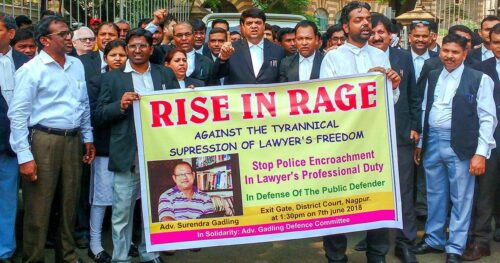
… Suresh said around 1,200 people in Chhattisgarh, 1,000 in Jharkhand and many others in Odisha, UP, Bengal, Kerala, Maharashtra and Delhi were jailed on allegations of being Maoists. He cited the case of lawyer Surendra Gadling who he said was “falsely implicated in the Bhima Koregaon case and has been unjustly languishing in jail for eight years without bail.” Read more
Ranchi, August 2026. Pic credits: Catholic Connect
Catholic Connect / by Fr. Praful Bara
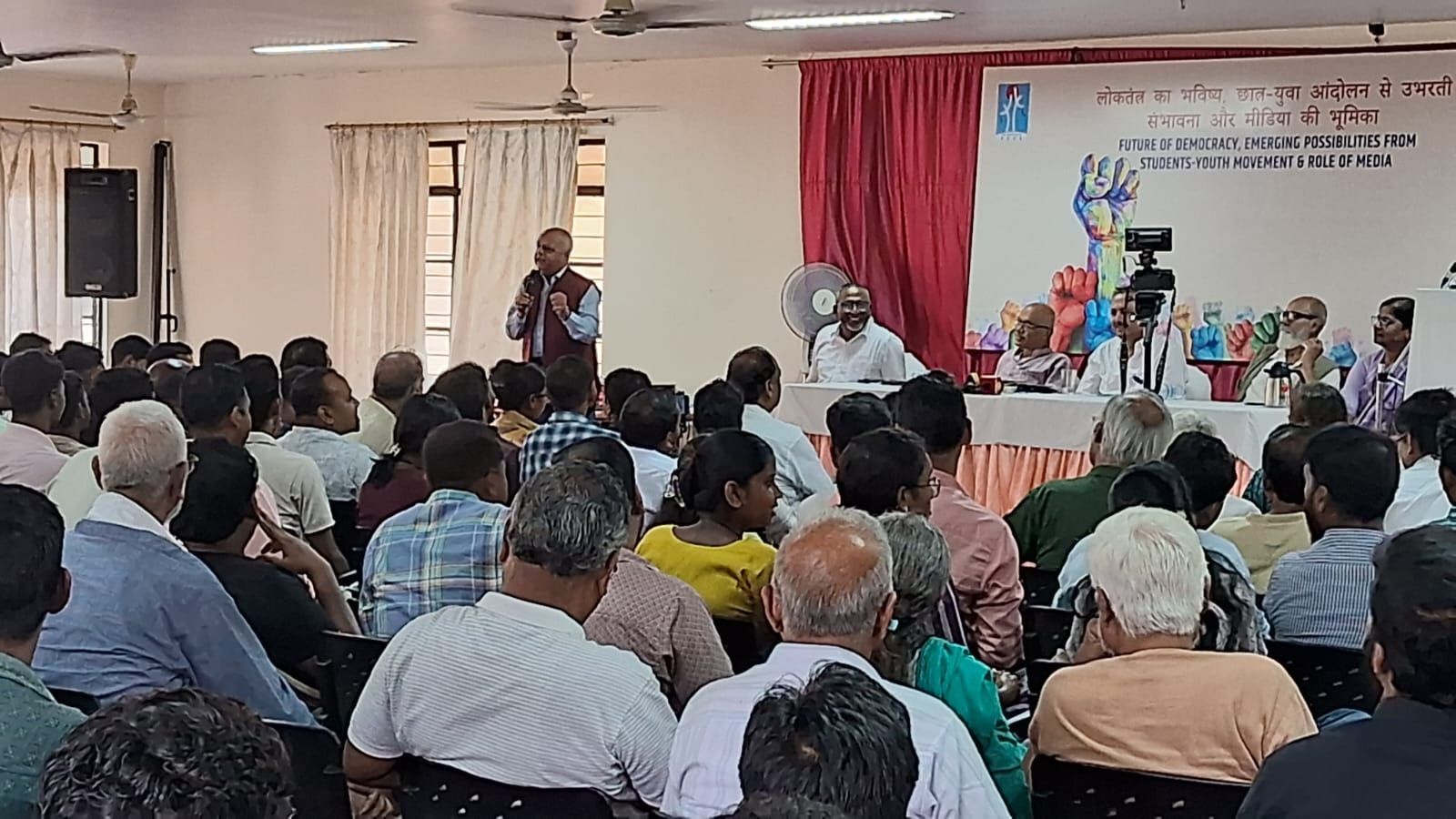
RANCHI, August 24, 2026: Stronger youth participation, media freedom and the protection of democratic values were the focus of the 5th Stan Memorial Lecture organised by the People’s Union for Civil Liberties (PUCL), Jharkhand, at SDC, Purulia Road, Ranchi, on August 23.
The lecture, titled “Future of Democracy: Emerging Possibilities from Youth Movements and the Role of Media,” examined the changing nature of democratic participation, the rise of youth movements and the challenges confronting independent media. The programme also recalled the life and work of Jesuit priest Stan Swamy and his advocacy for human rights and marginalised communities. Read more
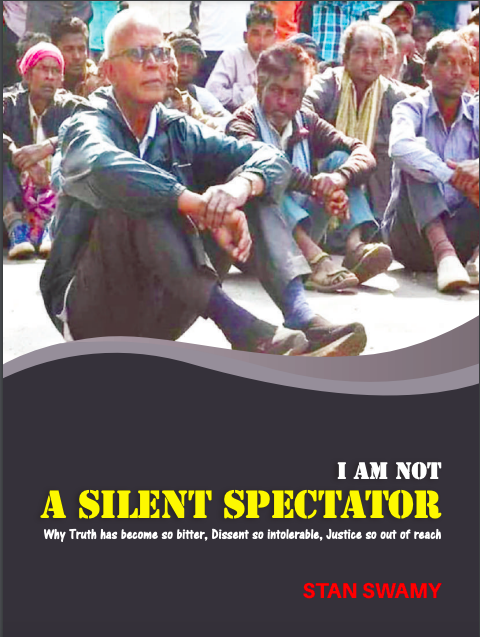
▪ I am not a Silent Spectator – Why Truth has become so bitter, Dissent so intolarable, Justice so out of reach – An Autobiographical Fragment, Memory and Reflection
Edition: Aug 2021
Publisher: Indian Social Institute, Bangalore
Language: English
Paperback: 149 pages
‘Why truth has become so bitter, dissent so intolerable, justice so out of reach?’ because truth has become very bitter to those in power and position, dissent, so unpalatable to the ruling elite, justice, so out of reach to the powerless, marginalised, deprived people. Yet, truth must be spoken, right to dissent must be upheld, and justice must reach the doorsteps of the poor. I am not a silent spectator. This booklet is not my autobiography. It is rather a collation of some glimpses/episodes from my life that somehow made a difference for me, and possibly for my confrères, colleagues and the people with whom I have shared my life.
Modi’s ‘Dimagi Naxal’ Remark Is an Attempt to Frame the Next Wave of Youth Dissent as Anti-National
22/08/2026
The Wire / by Anand Teltumbde
A government that has just witnessed a leaderless, meme-driven youth movement force it to yield has an obvious institutional incentive to narrow the boundaries of legitimate protest – and to have the vocabulary for doing so ready in advance.
…
The phrase “dimagi Naxal” echoes the politically charged label “urban Naxal,” a term Modi and leaders of his Bharatiya Janata Party (BJP) have used for years for activists, academics and other critics of the government. It became the operative logic behind the 2018 Bhima Koregaon arrests, in which poets, lawyers, professors and human-rights defenders were arrested under the draconian Unlawful Activities (Prevention) Act (UAPA) on the theory that they had a link to a banned Maoist conspiracy.
One of these 16 arrestees, Father Stan Swamy, 84 years old and suffering from Parkinson’s disease, died in judicial custody in 2021 without ever being convicted and Surendra Gadling, a human rights lawyer from Nagpur is still in jail in his ninth year. Read more
A Speech Sans Substance!
22/08/2026
Peoples Democracy / by M A Baby
On March 31, 2026, Union Home Minister Amit Shah declared that India has become free from Naxalism. In his Independence Day speech from the Red Fort on August 15, Prime Minister Narendra Modi proclaimed its return.
Quite a few things happened in the intervening four months. But three developments stand out – the wave of workers’ protests that briefly spread across the northern part of the country in April and May; the historic student-youth movement that forced the resignation of Union Education Minister Dharmendra Pradhan; and the Bankipur bye-election, which resulted in a mammoth defeat for the BJP in a seat it had dominated for over three decades and had only recently been vacated by its National President. These developments have no doubt forced the BJP onto the back foot.
Modi invoking the threat of “dimagi naxals” in his address must be seen in this context. A rattled leader bereft of ideas tends to fall back on rhetoric and tactics that have proven useful in the past. The “dimagi Naxal” jibe is thus a revival of the “tukde-tukde gang”, “urban Naxal”, “andolan jeevi” and similar labels used earlier. Read more
From ‘Tukde-Tukde Gang’ to ‘Dimagi Naxals’: When Labels Replace Answers
20/08/2026
Counterview.net / by Mohd Ziyaullah Khan
How the politics of insulting dissenters evolved — and why India’s Gen Z may be less willing to accept it. There is something revealing about the political vocabulary of the Narendra Modi era
When students protested, they were called the “Tukde-Tukde Gang.” When intellectuals, activists and academics challenged the government, some were branded “Urban Naxals.” Writers and artists who returned state awards became the “Award Wapsi Gang.” Farmers protesting the government’s policies were described using terms such as “Khalistanis,” “Maoists” and “anti-national.” Prime Minister Narendra Modi also coined “Andolanjeevi” for people he portrayed as professional protesters.
Now comes another expression: “Dimagi Naxals” — ideological or intellectual Naxals. Read more
Prime Minister’s ‘Dimagi Naxal’ Formulation Echoes the British Playbook Against Dissent
19/08/2026
The Leaflet / by S.N. Sahu
By branding dissenters as “Dimagi Naxals,” the Prime Minister revives the same colonial logic once used to silence Gandhi and threatens the constitutional freedoms India’s youth are fighting to defend.
Prime Minister Modi in his address to the nation from the ramparts of Red Fort on the occasion of 80th Independence Day stated that his government has succeeded in eliminating the armed Naxals in the jungles., While doing so he warned about “Dimagi Naxals” (intellectual Naxals) waiting for opportunities to unleash violence, unrest and create turmoil in society. And so, he underlined the necessity of identifying and isolating them. Read more
‘Dimagi Naxal’: When Mind Becomes Site of Suspicion
17/08/2026
NewsClick / by Shirin Akhter
After 79 years of Independence, a democracy should not be asking its citizens to fear the independent mind.
…
Naxalism has a specific political history. Its name derives from the 1967 uprising in Naxalbari in West Bengal and the Maoist political movements that subsequently emerged. For decades, the Naxalite was associated primarily with armed revolutionary politics.
Then came the term, “Urban Naxal”.
The expression acquired wider political currency particularly around 2018, when activists, lawyers and intellectuals were arrested in connection with the Bhima Koregaon case. The political category began travelling beyond those accused of participation in armed insurgency. Read more
Opposition says PM Modi’s ‘dimagi Naxals’ remark shows he is ‘rattled’
16/08/2026
Scroll.in / by Scroll Staff
Prime Minister Narendra Modi describing his opponents as “dimagi Naxals”, or persons with “Naxal mentality”, was a “sure sign of his desperation”, said the Congress on Saturday.
“It is a separate matter that he ends up doing whatever these so-called ‘urban Naxals’ or now ‘dimaagi Naxals’ are demanding or advocating,” said party leader Jairam Ramesh.
The term “urban Naxals” was first used by Union ministers and leaders of the Bharatiya Janata Party after several activists and academics were arrested in the Elgar Parishad case in 2018. Since then, the term has often been used to describe some dissidents of the Narendra Modi government. Read more
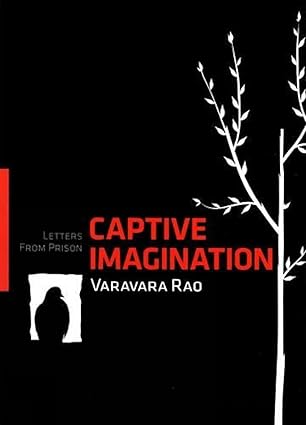
Varavara Rao’s searing remembrance of Bhumaiah and Kishta Goud is also a powerful critique of the state’s right to take lives. Synopsis: Through his account of the lives and deaths of Bhumaiah and Kishta Goud, Varavara Rao crafts his memorial to two men executed during the Emergency while also penning a passionate manifesto for the abolition of the death penalty. Stirring figures like Sri Sri and the author’s own vivid memories light up the narrative.
Death. All of us who live have to embrace it in the end.
But how should it arrive? Should the state and the law have the right to take a life? Is capital punishment a barbaric relic to which these institutions, meant to be hallowed, continue to cling? Read more
Poet, Marxist critic and activist, Varavara Rao (VV) has been continually persecuted by the state and intermittently imprisoned since 1973, but he never stopped writing during all these decades, even from within prison. When he was subjected to ‘one thousand days of solitary confinement’ during 1985-89 in Secunderabad Jail, a leading national daily invited him to write about his prison experiences.
hindi/en | 1:17:24 | 2026
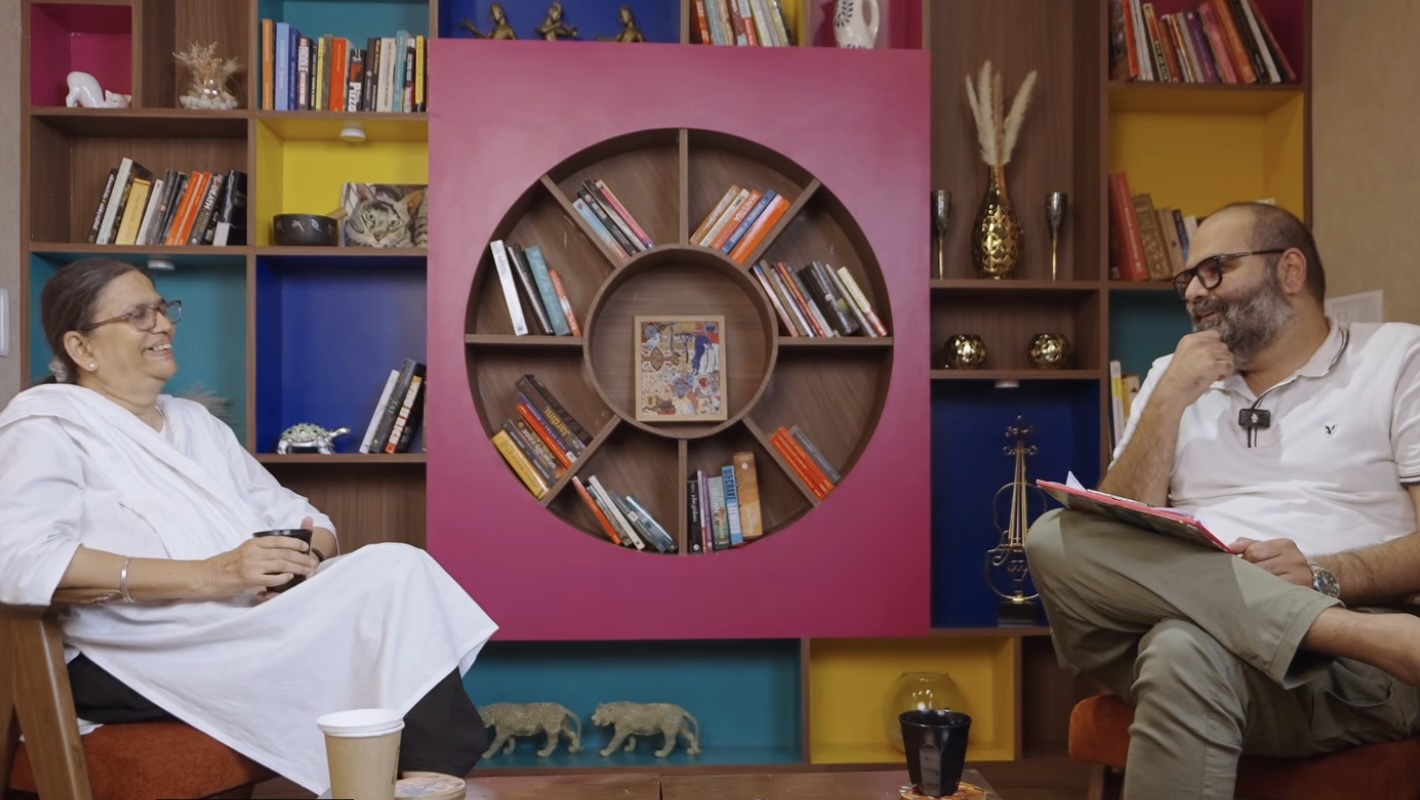
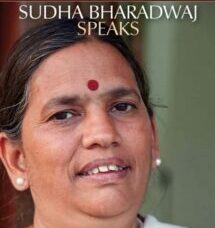
Sudha Bharadwaj is a lawyer, trade unionist, and human rights activist whose work has focused on labor rights, access to justice, and the rights of marginalized communities, particularly Adivasis and industrial workers. With decades of experience in public interest law and grassroots advocacy, she has been a prominent voice on issues of constitutional rights, civil liberties, and social justice in India. In this conversation, she reflects on her journey, the challenges of defending vulnerable communities, the legal system, democracy, and the evolving landscape of human rights. A thoughtful discussion on law, justice, and the pursuit of equality. Watch video