Browsed by
Tag: Stan Swamy

Disabled inmates must be allowed to self-identify: plea

Disabled inmates must be allowed to self-identify: plea

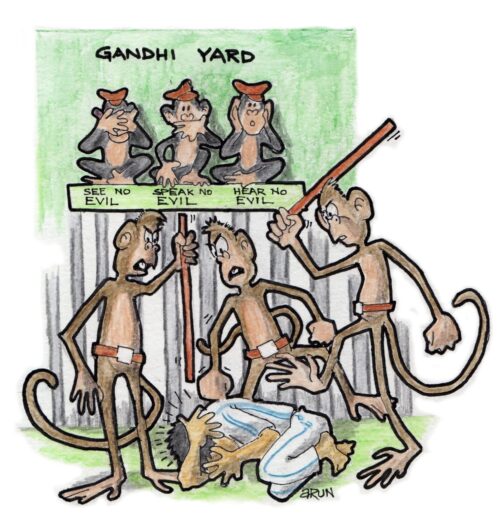
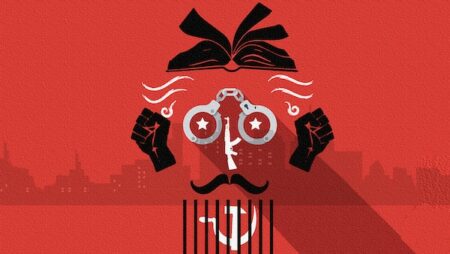
Credits: Drawing by Arun Ferreira / The Polis Project

The Hindu / by Krishnadas Rajagopal

The submissions recommend that prison records must identify every person with disability individually to make reasonable adjustments for them, while respecting their confidentiality.
A Kerala-based activist, whose petition highlighting the traumatic prison days of the late Professor G.N. Saibaba and Stan Swamy led the Supreme Court to form a high-powered committee to free Indian jails from the colonial yoke, suggested bringing in a mechanism to allow disabled prisoners/detainees to self-identify and declare their disabilities.
Read more


Also read/watch:
▪ Lives Lost: How Prolonged Incarceration Failed Pandu Narote, Kanchan Nanaware, Stan Swamy (Frontline / Jan 2026)
▪ Video | Sudhir Dhawale Spoke With Outlook About Mental Health Crisis in Indian Prisons (Outlook / Oct 2025)
▪ An Imprisoned Mind | Mental Health Challenges Among India’s Political Prisoners (Outlook / Sep 2025)
▪ I saw firsthand how callous prison officials and their negligence led to Stan Swamy’s death (Scroll.in | by Arun Ferreira | Jul 2025)
▪ BK-16 Prison Diaries: Sagar Gorkhe on his battle to survive Taloja jail’s brutality (The Polis Project | by Sagar Gorkhe | Feb 2025)
▪ Some personal reflections on prison medical care (The Leaflet | by Vernon Gonsalves | Apr 2024)
▪ ‘It Is Only by Chance That I Came Out of Prison Alive’: G.N. Saibaba (The Wire / March 2024)

Faces that haunt me – Stan Swamy and Sanjeev Bhatt

Faces that haunt me – Stan Swamy and Sanjeev Bhatt

Poster by #bakeryprasad

Matters India / by M.K.George

There are some faces that haunt me. They make me feel sad, angry, and, at times, I want to yell out. They confuse me. They fill me with despair. They prompt me to rebel. They make me feel so helpless. They make me pray. They cause me to reflect and speak up.
Two of them I want to present to you: Stan Swamy and Sanjeev Bhatt.
Read more


Also read/watch:

▪ I saw firsthand how callous prison officials and their negligence led to Stan Swamy’s death (Scroll.in | by Arun Ferreira | Jul 2025)

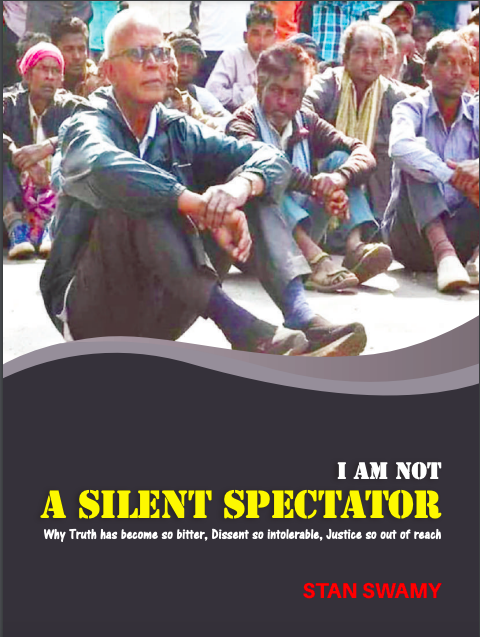
▪ I am not a Silent Spectator – Why Truth has become so bitter, Dissent so intolarable, Justice so out of reach – An Autobiographical Fragment, Memory and Reflection

Edition: Aug 2021
Publisher: Indian Social Institute, Bangalore
Language: English
Paperback: 149 pages

‘Why truth has become so bitter, dissent so intolerable, justice so out of reach?’ because truth has become very bitter to those in power and position, dissent, so unpalatable to the ruling elite, justice, so out of reach to the powerless, marginalised, deprived people. Yet, truth must be spoken, right to dissent must be upheld, and justice must reach the doorsteps of the poor. I am not a silent spectator. This booklet is not my autobiography. It is rather a collation of some glimpses/episodes from my life that somehow made a difference for me, and possibly for my confrères, colleagues and the people with whom I have shared my life.

Access a free PDF copy of the book here

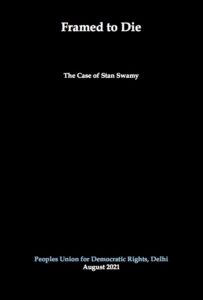
▪ Framed to Die – The Case of Stan Swamy


Edition: Aug 2021
Publisher: Peoples Union for Democratic Rights, Delhi
Language: English
Paperback: 45 pages

Stan Swamy, as this report documents, was framed, fettered, and finally forced towards a fatal illness under due process of law. The report argues that the naturalness of Stan’s death—a cardiac arrest driven by Covid complications—doesn’t exonerate the unnaturalness of the persecution that he suffered under the UAPA. Underlying Stan’s experiences of persecution lie the life-stories of many others, including the 15 accused in the Bhima Koregaon case. Beyond chronicling Stan’s persecution under law, the report documents why Comrade Stan was a dissenter and a true patriot and why the state feared and criminalized his dissent under the UAPA.

Access a free PDF copy of the book here
 

▪ Video: Testimony of Stan Swamy, two days before his arrest on 8 October 2020.


en | 7:48 min | Oct 6, 2020
Watch video

The ‘Natural Death’ Problem in Indian Jails / Our Criminal Justice System Overlooks Victims of Police Torture

The ‘Natural Death’ Problem in Indian Jails / Our Criminal Justice System Overlooks Victims of Police Torture

Credits: Drawing by Arun Ferreira / The Polis Project

The ‘Natural Death’ Problem in Indian Jails

26/06/2026

The Wire / by Sukanya Shantha

When prisoners die after allegedly being denied timely medical care, are those deaths truly natural? And is it fair that the very people who are accused of not providing timely medical care get to decide this?
… According to the latest NCRB data (for the year 2024), 1,960 persons died in Indian jails. Of these, 1,737 deaths were attributed to “natural causes”. When reading these figures, one must keep in mind cases like those of Basha and Khadar. Unless a judicial magistrate diligently inquires into their deaths, they too will be categorised as ‘natural deaths’ in upcoming NCRB reports.
Read more


Our Criminal Justice System Overlooks Victims of Police Torture

26/06/2026

The Wire / by Edgar Kaiser and Grace Anu

The Global Torture Index 2025 classifies India as a country with “high risk” of torture and ill treatment, and the signed UN Convention Against Torture is yet to be ratified.

Today, June 26 is observed as International Day in Support of Victims of Torture.

Particularly for human rights defenders, targeted reprisal killed the lives of Fr. Stan Swamy in Bhima Koregaon (BK-16), due to refusal of medical treatment, and Prof. Saibaba, a 90% disabled activist had to face the same fate as his health started deteriorating when he was confined to an ‘anda cell’. These figures are just the tip of the iceberg of a staggering number of survivors and victim families who are systemically denied medical, psychological and social assistance.
Read more


Also read:
▪ ‘No one dies in prison, They die on the way to hospital’ (Times of India / Jan 2026)
▪ Read India report: INDIA – COUNTRY FACTSHEET 2025 (World Organization Against Torture / Jun 2025)

▪ I saw firsthand how callous prison officials and their negligence led to Stan Swamy’s death (Scroll.in | by Arun Ferreira | Jul 2025)
▪ BK-16 Prison Diaries: Sagar Gorkhe on his battle to survive Taloja jail’s brutality (The Polis Project | by Sagar Gorkhe | Feb 2025)
▪ Some personal reflections on prison medical care (The Leaflet | by Vernon Gonsalves | Apr 2024)
▪ 4,484 People Died in Police Custody Since 2020: Govt Data (The Swaddle / Jul 2022)

Freedom, Education and Resistance: Revisiting Paulo Freire Through the Life of Stan Swamy

Freedom, Education and Resistance: Revisiting Paulo Freire Through the Life of Stan Swamy

Countercurrents / by Pon Chandran

By drawing together the life and ideas of Brazilian educator Paulo Freire and Indian human rights activist Stan Swamy, Pon. Chandran’s review of Cultural Action for Freedom revisits one of the most enduring questions in political education: can education become a tool of liberation rather than conformity?
… There is a striking similarity between Freire and Stan Swamy, whose work among Adivasi communities in Jharkhand reflected many principles of liberation pedagogy. Like Freire, Swamy viewed education as a means of empowering marginalised communities to understand and defend their rights. Through legal awareness and constitutional advocacy, he encouraged tribal communities to critically examine the structures responsible for displacement and land dispossession.
Read more


Also read/watch:

▪ I saw firsthand how callous prison officials and their negligence led to Stan Swamy’s death (Scroll.in | by Arun Ferreira | Jul 2025)

▪ I am not a Silent Spectator – Why Truth has become so bitter, Dissent so intolarable, Justice so out of reach – An Autobiographical Fragment, Memory and Reflection

Edition: Aug 2021
Publisher: Indian Social Institute, Bangalore
Language: English
Paperback: 149 pages

‘Why truth has become so bitter, dissent so intolerable, justice so out of reach?’ because truth has become very bitter to those in power and position, dissent, so unpalatable to the ruling elite, justice, so out of reach to the powerless, marginalised, deprived people. Yet, truth must be spoken, right to dissent must be upheld, and justice must reach the doorsteps of the poor. I am not a silent spectator. This booklet is not my autobiography. It is rather a collation of some glimpses/episodes from my life that somehow made a difference for me, and possibly for my confrères, colleagues and the people with whom I have shared my life.

Access a free PDF copy of the book here

▪ Framed to Die – The Case of Stan Swamy


Edition: Aug 2021
Publisher: Peoples Union for Democratic Rights, Delhi
Language: English
Paperback: 45 pages

Stan Swamy, as this report documents, was framed, fettered, and finally forced towards a fatal illness under due process of law. The report argues that the naturalness of Stan’s death—a cardiac arrest driven by Covid complications—doesn’t exonerate the unnaturalness of the persecution that he suffered under the UAPA. Underlying Stan’s experiences of persecution lie the life-stories of many others, including the 15 accused in the Bhima Koregaon case. Beyond chronicling Stan’s persecution under law, the report documents why Comrade Stan was a dissenter and a true patriot and why the state feared and criminalized his dissent under the UAPA.

Access a free PDF copy of the book here
 

▪ Video: Testimony of Stan Swamy, two days before his arrest on 8 October 2020.


en | 7:48 min | Oct 6, 2020
Watch video

Remembering Stan Swamy: Justice, Adivasi Rights, and the Politics of Criminalisation

Remembering Stan Swamy: Justice, Adivasi Rights, and the Politics of Criminalisation


pachaiyammal / @Shravs_Dalit (Apr 26):
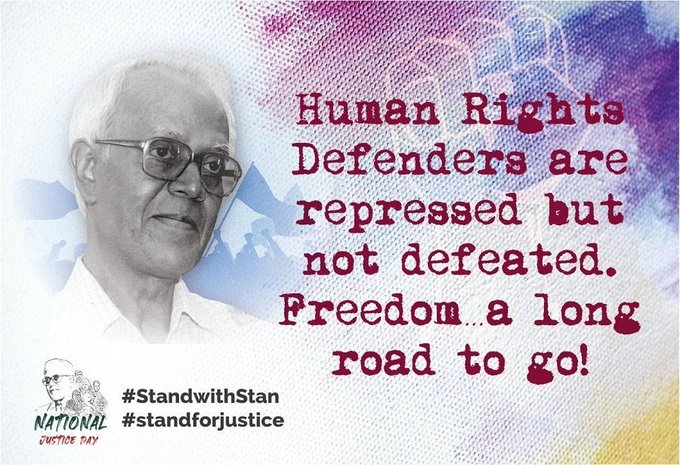
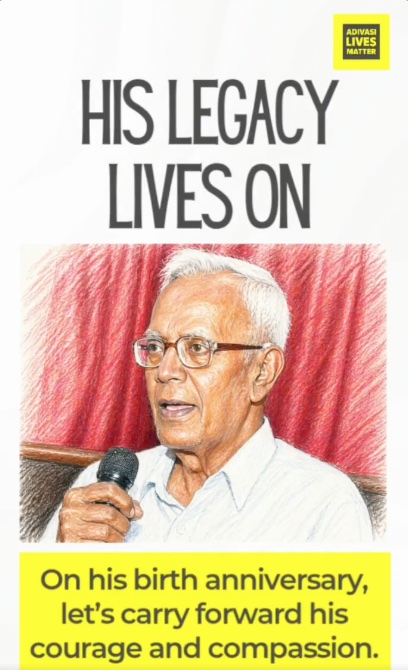
Remembering Father Stan Swamy on his Birth Anniversary


Remembering Stan Swamy: Justice, Adivasi Rights, and the Politics of Criminalisation

27/04/2026

Countercurrents.org / by Dr Suresh Khairnar

The special constitutional protections granted to Adivasis under the Fifth and Sixth Schedules are steadily being eroded. The death of Stan Swamy stands as a stark reminder of this trajectory, raising serious concerns about the treatment of those who defend these rights.
In the Bhima Koregaon case, in which the NIA arrested him in October 2020, Stan Swamy had never visited Bhima Koregaon. There is no credible basis for linking him to the Elgaar Parishad. The Parishad itself was a coalition of more than 200 social organisations from Maharashtra, formed solely to commemorate the 200th anniversary of the Bhima Koregaon Victory Day on 1 January 2018. I was personally associated with it as president of the Rashtra Seva Dal.
Read more


Shared by Parakala Prabhakar @parakala

Jharkhand Janadhikar Mahasabha / @JharkhandJanad1 (Apr 25):
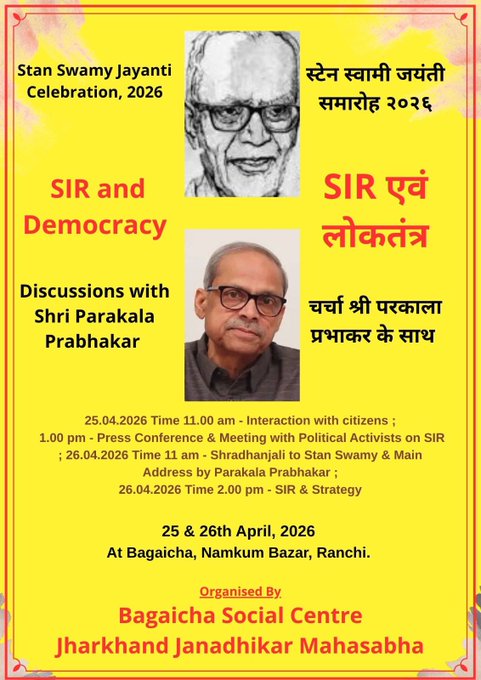
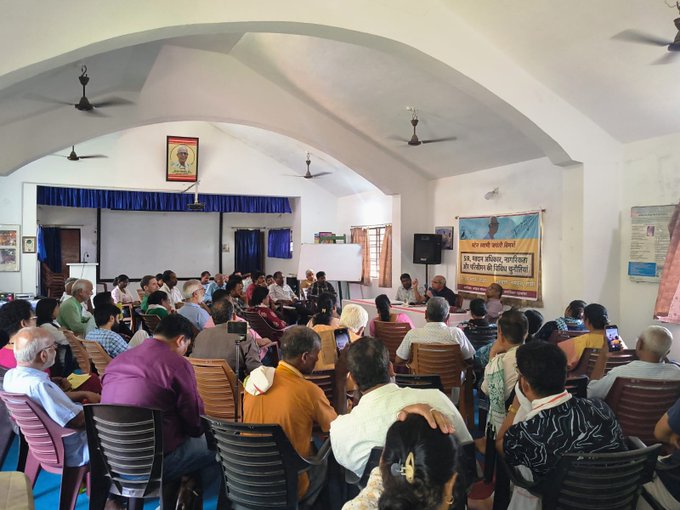
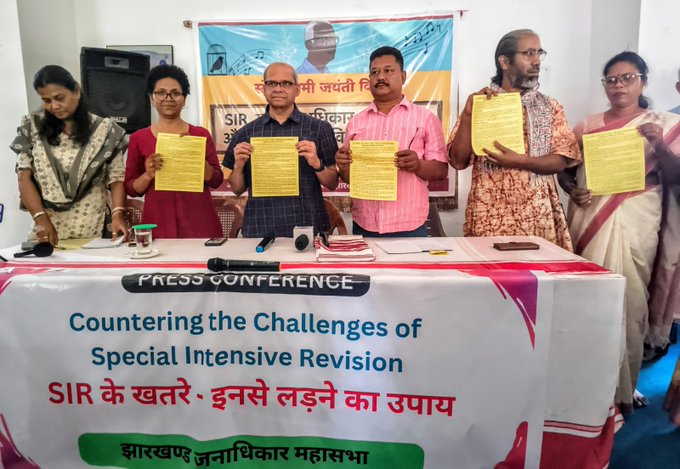
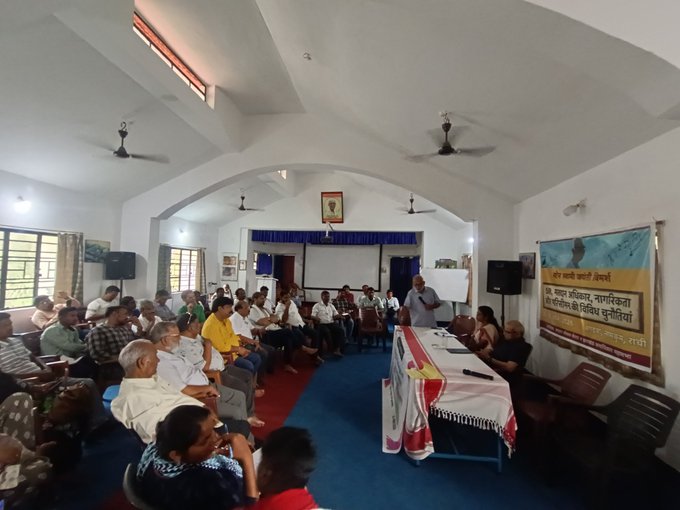
Today Mahasabha and Bagaicha, as part of two day Stan Swamy anniversary, organised discussions with activists and political reps and a press con on SIR and the worsening of electoral systems. @parakala was the main speaker. We also released a pamphlet for mass dissemination.


#AdivasiLivesMatter @AdivasisMatter (Apr 26):
Remembering Stan Swamy voice for Adivasis, justice & jal jangal zameen. Johar.
#StanSwamy #TribalRight


Also read:
▪ Jharkhand Special Intensive Revision: Economist Warns of ‘Bloodless Political Genocide Amidst Transparency Converns (Times of India / Apr 2026)
▪ Father Stan Swamy died of natural causes, Maharashtra government tells court (India Today / Oct 2025)
▪ NIA opposes plea to clear Stan Swamy’s name, says it would set wrong precedent (India Today / Sep 2025)
▪ I saw firsthand how callous prison officials and their negligence led to Stan Swamy’s death (Scroll.in | by Arun Ferreira | Jul 2025)
▪ Jharkhand police to probe into Maoist links with Stan Swamy’s ‘Bagaicha’, 63 other frontal organisations (The New Indian Express / Sep 2023)
▪ Hackers Planted Files to Frame an Indian Priest Who Died in Custody (Wired / Dec 2022)
▪ How the system broke Stan Swamy: A cell mate recalls the activist’s last days in prison (Scroll.in | by Arun Ferreira | Aug 2021)
▪ Rashtra Seva Dal’s Inquiry Report into Bhima-Koregaon Riots (SACW/Jan 2018)

▪ I am not a Silent Spectator – Why Truth has become so bitter, Dissent so intolarable, Justice so out of reach – An Autobiographical Fragment, Memory and Reflection (Indian Social Institute / Aug 2021)

Edition: Aug 2021
Publisher: Indian Social Institute, Bangalore
Language: English
Paperback: 149 pages

‘Why truth has become so bitter, dissent so intolerable, justice so out of reach?’ because truth has become very bitter to those in power and position, dissent, so unpalatable to the ruling elite, justice, so out of reach to the powerless, marginalised, deprived people. Yet, truth must be spoken, right to dissent must be upheld, and justice must reach the doorsteps of the poor. I am not a silent spectator. This booklet is not my autobiography. It is rather a collation of some glimpses/episodes from my life that somehow made a difference for me, and possibly for my confrères, colleagues and the people with whom I have shared my life.

Access a free PDF copy of the book here

The End of Naxalism, the End of Accountability

The End of Naxalism, the End of Accountability

Graphic credits: virasam.org

The Wire / by Nandini Sundar

As the government claims victory over the CPI (Maoist), a more consequential defeat is being obscured: the collapse of constitutional accountability and the normalisation of impunity.
…
Among the many ironies of this confused and legally directionless ‘end of Naxalism’, is the fate of those arrested on charges of being Maoist sympathisers. At one end, we have the human rights lawyer Surendra Gadling who has been in jail since 2018, along with the rest of the BK 16 who are out on bail but still suffer from a protracted trial despite ample proof that police ‘evidence’ was fabricated. At the other end, the youth leaders of the Moolvasi Bachao Manch in Bastar, like Raghu Midiyami, Suneeta Pottam and others, have been jailed for over two years under UAPA, along with some other 40 activists at different times. Even simple rights like an operation to fix Raghu Midiyami’s broken finger are being resisted by the NIA. The MBM waged an entirely constitutional struggle, invoking the 5th Schedule of the Constitution and PESA to defend their lands. Evidently a peaceful movement of locals, in the face of an intensified mining push, is now a greater threat to the national security state than even the Maoists.
Hundreds of other innocent Adivasis continue to languish in jail, going through the tortuous legal system. Stan Swamy was targeted because his PIL in the Jharkhand High Court, based on interviews with 102 undertrials, showed that 97% of those arrested on charges of being Maoist actually had no relation to them.
Read more


Also read:
▪ 7 yrs in jail, charges framed against Surendra Gadling in Surajgarh arson case. What Bombay HC told SC (The Print / Apr 2026)
▪ Voices From Prison | Half-Freedom For Adivasis Jailed On Maoist Allegations (Outlook / Jan 2026)
▪ Voices From Prison | From Forest To Prison, When Security Laws Criminalise Adivasi Resistance (Outlook / Jan 2026)
▪ Will anti-Naxal drive pave way for mining giants? (The New Indian Express / May 2025)
▪ Top intellectual targeted for role as anti-displacement activist, opponent of ‘corporate loot’ (Sep 2024)
▪ Who Is Suneeta Pottam, the Tribal Rights Activist Picked up for Unknown Cases Earlier This Month? (The Wire / Jun 2024)
▪ Encountering Resistance – State Policy for Development in Gadchiroli (PUDR / June 2018)
▪ Condemn the State Sponsored Massacre Scripted as ‘Encounter’ in Gadchiroli and Bijapur in Central India (wssnet.wordpress.com / May 2018)
▪ A study of Undertrials in Jharkhand (Sanhati / by Bagaicha Research Team / Feb 2016)

The death of the 84-year-old Catholic priest, Stan Swamy, marked the end of India’s secularism

The death of the 84-year-old Catholic priest, Stan Swamy, marked the end of India’s secularism

Illustration by #bakeryprasad

Christian Post / by Azeem Ibrahim 

On July 5, 2021, Father Stanislaus Lourduswamy — an 83-year-old Jesuit priest and tribal rights activist — died in pre-trial custody in Mumbai, India.
Frail from Parkinson’s disease and a COVID-19 infection, he had spent nine months behind bars under India’s anti-terror laws, denied bail despite his deteriorating health. His alleged crime was implausible: authorities accused him of sedition and links to Maoist insurgents — charges widely derided as baseless. To many, his imprisonment and death became a symbol of a constitutional democracy being quietly hollowed out.
Read more


Also read:
▪ The Siege of Faith: A year-long analysis of the persecution and otherisation of Christians in India (SabrangIndia / March 2026)
▪ Conversion laws and national identity: A Jesuit response response to the Hindutva narrative (Countercurrents / Feb 2026)
▪ Report 2025: Hate Speech Events in India (Center for the Study of Organized Hate / Jan 2026)
▪ Indian Jesuits to continue fight to clear Father Stan Swamy’s name (UCA News / Dec 2025)
▪ INDIA | USCIRF–RECOMMENDED FOR COUNTRIES OF PARTICULAR CONCERN (United States Commission on International Religious Freedom / 2025)
▪ Father Stan Swamy died of natural causes, Maharashtra government tells court (India Today / Oct 2025)
▪ Modi government’s actions against the Christian minority reveal a deep malaise within our society (Scroll.in / Mar 2022)

CASR Condemns NIA Notice to Anti-Displacement Activist Damodar Turi

CASR Condemns NIA Notice to Anti-Displacement Activist Damodar Turi

Poster campaign, 2019.

Countercurrents.org / by Campaign Against State Repression (CASR) 

The Campaign Against State Repression (CASR) strongly condemns the recent actions of the National Investigation Agency (NIA) in Hyderabad, which has issued a notice to Damodar Turi, a long-time anti-displacement activist, in connection with FIR RC-04/2025/HYDERABAD. This case, initiated two months ago, is yet another example of the state’s ongoing harassment of individuals who challenge the exploitation and marginalization of indigenous communities, particularly those resisting displacement due to mining and industrialization.
Damodar Turi, a dedicated activist for over three decades, has been at the forefront of movements against the forced displacement of Adivasis and indigenous communities in Jharkhand and across India. As a founding member of the Visthapan Virodhi Jan Vikas Andolan (VVJVA), a pan-India anti-displacement organization, Damodar Turi has worked alongside other prominent human rights advocates, including Stan Swamy and B.D. Sharma, to raise awareness about the systematic dispossession of tribal people from their land in the name of development.
Read full statement


Also read:
▪ Voices From Prison | Half-Freedom For Adivasis Jailed On Maoist Allegations (Outlook / Jan 2026)
▪ Voices From Prison | From Forest To Prison, When Security Laws Criminalise Adivasi Resistance (Outlook / Jan 2026)
▪ Will anti-Naxal drive pave way for mining giants? (The New Indian Express / May 2025)
▪ Top intellectual targeted for role as anti-displacement activist, opponent of ‘corporate loot’ (Sep 2024)
▪ Jharkhand police to probe into Maoist links with Stan Swamy’s ‘Bagaicha’, 63 other frontal organisations (The New Indian Express / Sep 2023)
▪ CASR: Release activists incarcerated in Bhima Koregaon Case (Countercurrents.org / June 2023)
▪ NIA Opposes Stan Swamy’s Bail; Calls PUCL, Visthapan Virodhi Jan Vikas Andolan ‘Maoist Fronts’ (The Wire / Jan 2021)

Conversion laws and national identity: A Jesuit response response to the Hindutva narrative

Conversion laws and national identity: A Jesuit response response to the Hindutva narrative

Countercurrents / by Rajiv Shah

A recent book, “Luminous Footprints: The Christian Impact on India”, authored by two Jesuit scholars, Dr. Lancy Lobo and Dr. Denzil Fernandes, seeks to counter the current dominant narrative on Indian Christians, which equates evangelisation with conversion, and education, health and the social services provided by Christians as meant to lure — even force — vulnerable sections into Christianity.
… the book cites the instance of Fr Stan Swamy, a Jharkhand-based civil rights leader, who was persecuted for actively advocating for tribal rights, especially the Pathalgadi movement, in which tribals “installed stone tablets in the village, inscribing the rights of tribals over their land and natural resources.”
Read more


Also read:
▪ Indian Jesuits to continue fight to clear Father Stan Swamy’s name (UCA News / Dec 2025)
▪ INDIA | USCIRF–RECOMMENDED FOR COUNTRIES OF PARTICULAR CONCERN (United States Commission on International Religious Freedom / 2025)
▪ Father Stan Swamy died of natural causes, Maharashtra government tells court (India Today / Oct 2025)
▪ Jesuit Missions repeats call to clear Indian priest’s name (Indcatholic News / Jul 2024)
▪ COUNTRY UPDATE: India | Increasing Abuses against Religious Minorities in India (United States Commission on International Religious Freedom / Oct 2024)
▪ Jharkhand police to probe into Maoist links with Stan Swamy’s ‘Bagaicha’, 63 other frontal organisations (The New Indian Express / Sep 2023)
▪ Modi government’s actions against the Christian minority reveal a deep malaise within our society (Scroll.in / Mar 2022)
▪ A study of Undertrials in Jharkhand (Sanhati / by Bagaicha Research Team / Feb 2016)

Incarceration As Politics: A Timeline Of Political Prisoners In Independent India

Incarceration As Politics: A Timeline Of Political Prisoners In Independent India

Pic credits: MR online

Incarceration As Politics: A Timeline Of Political Prisoners In Independent India

23/01/2026

Outlook / by Saher Hiba Khan

From the Anti-Hindi Agitations to UAPA arrests, India’s history shows how dissent is criminalised across decades and governments
Across countries and political systems, incarceration has always been used as a tool to control the masses. It has been justified through shifting legal terms such as national security, public order, and counter-terrorism.
While the laws change, the logic remains the same. It has time and again proved that dissent against any government will be treated as a threat. ​
Read more


Voices From Prison: Of Lives Stolen For Dissent

20/01/2026

Outlook / by Outlook News Desk

Outlook’s February 1 issue, Thou Shalt Not Dissent, shines a light on the lives of political prisoners who were slapped with anti-terrorism charges and continue to face long trials and curbing of rights.
…
In Outlook’s February 1 issue, Thou Shalt Not Dissent, first-person accounts of political activists who were slapped with anti-terrorism charges under different political regimes, explore life behind bars, the trauma, sights and sounds of a world bereft of freedom, normalcy and reason. Weaved with the accounts are stories of individuals who carry the burden of incarceration like a tumour on the face, afraid to cover it, so it doesn’t chafe, and hesitant to let it free, so it does not translate into their only identity.
Read more


Also read:
▪ Voices From Prison | A Legacy Of Detention: Weaponisation Of PDA, TADA, NSA And UAPA Laws Since Independence (Outlook / Jan 2026)