Browsed by
Tag: UAPA

In India, trial happens by extended detention
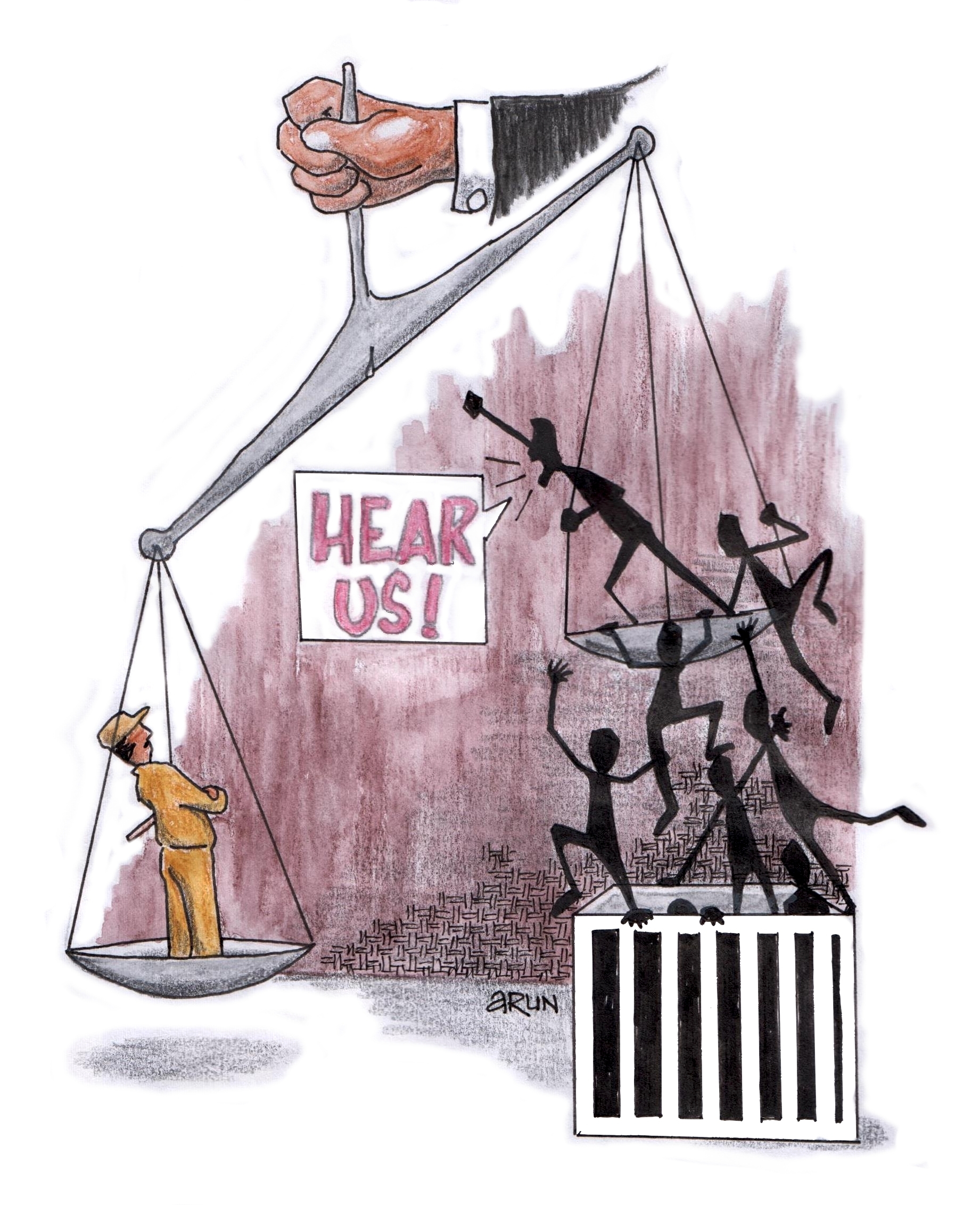
In India, trial happens by extended detention

Credits: Drawing by Arun Ferreira / The Polis Project

The Tribune / by Hammad Safraz

Those who question the government’s policies on rights and freedoms, find themselves in an endless chase for justice
The world’s largest democracy, or so the slogan goes, has perfected a quiet kind of cruelty against those who speak truth to power. For activists and journalists who question Narendra Modi’s Bharatiya Janata Party (BJP) government, the punishment is arbitrary detention without trial, stretched endlessly into a legal void where no charge is filed and no freedom is granted. …
The first big case, Ria Chakrabarty said, was actually that of anti-caste and tribal activists who rallied at Bhima Koregaon in Maharashtra and were later attacked by Hindu nationalist mobs. … Both the Supreme Court and the UN have judged that many of the detainees were held with no evidence of terrorism. “But this case is important to understand,” she said, “because then the Indian Home Ministry started using the same playbook against Muslim activists who would lead protests subjected to Hindu nationalist violence, and later, primarily Sikh farmers protesting farm laws.”
Read more


Also read:
▪ IAPL demands release of advocate Surendra Gadling from Maharashtra jail (The Sisat Daily / March 2026)
▪ Incarceration As Politics: A Timeline Of Political Prisoners In Independent India (Outlook / Jan 2026)
▪ Justice On Hold: How India’s Trial Courts Are Creating a New Class of Political Prisoners—Those Accused Of ‘Terrorism’ (article 14 / Dec 2025)
▪ Bail for Bhima Koregaon accused highlights extraordinary delay in trial (Scroll.in / Jan 2025)
▪ How Long is Too Long? – On the Maximum Period that an Undertrial Prisoner can be Detained (Constitutional Law and Philosophy | by Hany Babu and Surendra Gadling | Oct 2024)

The End of Naxalism, the End of Accountability

The End of Naxalism, the End of Accountability

Graphic credits: virasam.org

The Wire / by Nandini Sundar

As the government claims victory over the CPI (Maoist), a more consequential defeat is being obscured: the collapse of constitutional accountability and the normalisation of impunity.
…
Among the many ironies of this confused and legally directionless ‘end of Naxalism’, is the fate of those arrested on charges of being Maoist sympathisers. At one end, we have the human rights lawyer Surendra Gadling who has been in jail since 2018, along with the rest of the BK 16 who are out on bail but still suffer from a protracted trial despite ample proof that police ‘evidence’ was fabricated. At the other end, the youth leaders of the Moolvasi Bachao Manch in Bastar, like Raghu Midiyami, Suneeta Pottam and others, have been jailed for over two years under UAPA, along with some other 40 activists at different times. Even simple rights like an operation to fix Raghu Midiyami’s broken finger are being resisted by the NIA. The MBM waged an entirely constitutional struggle, invoking the 5th Schedule of the Constitution and PESA to defend their lands. Evidently a peaceful movement of locals, in the face of an intensified mining push, is now a greater threat to the national security state than even the Maoists.
Hundreds of other innocent Adivasis continue to languish in jail, going through the tortuous legal system. Stan Swamy was targeted because his PIL in the Jharkhand High Court, based on interviews with 102 undertrials, showed that 97% of those arrested on charges of being Maoist actually had no relation to them.
Read more


Also read:
▪ 7 yrs in jail, charges framed against Surendra Gadling in Surajgarh arson case. What Bombay HC told SC (The Print / Apr 2026)
▪ Voices From Prison | Half-Freedom For Adivasis Jailed On Maoist Allegations (Outlook / Jan 2026)
▪ Voices From Prison | From Forest To Prison, When Security Laws Criminalise Adivasi Resistance (Outlook / Jan 2026)
▪ Will anti-Naxal drive pave way for mining giants? (The New Indian Express / May 2025)
▪ Top intellectual targeted for role as anti-displacement activist, opponent of ‘corporate loot’ (Sep 2024)
▪ Who Is Suneeta Pottam, the Tribal Rights Activist Picked up for Unknown Cases Earlier This Month? (The Wire / Jun 2024)
▪ Encountering Resistance – State Policy for Development in Gadchiroli (PUDR / June 2018)
▪ Condemn the State Sponsored Massacre Scripted as ‘Encounter’ in Gadchiroli and Bijapur in Central India (wssnet.wordpress.com / May 2018)
▪ A study of Undertrials in Jharkhand (Sanhati / by Bagaicha Research Team / Feb 2016)

Convention in Ludhiana raises concerns over detentions, rights issues

Convention in Ludhiana raises concerns over detentions, rights issues

Pic credits: Counterview

Countercurrents / by Harsh Thakor

A convention organised by the Democratic Front Against Green Hunt, Punjab, was held to mark April 8 as a day opposing what participants described as “draconian laws” and to commemorate the legacy of Bhagat Singh, Sukhdev and Rajguru. …
Resolutions presented by Jaswinder Phagwara were adopted at the convention. … Additional demands included the release of activists and intellectuals in cases such as Bhima Koregaon, the Lucknow conspiracy case and the Delhi violence cases, the release of undertrials and convicts who have completed their sentences, protection of the right to organise and protest, and an end to alleged fake police encounters in Punjab.
Read more


Also read:
▪ 7 yrs in jail, charges framed against Surendra Gadling in Surajgarh arson case. What Bombay HC told SC (The Print / Apr 2026)
▪ Artists, Educators, Publishers Speak Out Against ‘Rising Attempts’ to Stifle Their Voices (The Wire / March 2026)
▪ Voices From Prison | A Legacy Of Detention: Weaponisation Of PDA, TADA, NSA And UAPA Laws Since Independence (Outlook / Jan 2026)
▪ ‘Provincial Convention against Repression’ in Barnala, Punjab (Countercurrents / Jan 2025)

Case overload? 71% of NIA investigations rely on anti-terror law UAPA

Case overload? 71% of NIA investigations rely on anti-terror law UAPA

Business Standard / by Jayant Pankaj

As the agency faces a mounting judicial bottleneck, its heavy reliance on the controversial law is fuelling concerns
When P Chidambaram was India’s Home Minister, he met with Robert Mueller, director of America’s Federal Bureau of Investigation, in March 2009 in New Delhi. It was three months after the 26/11 Mumbai terror attacks, and Chidambaram described the newly formed National Investigation Agency (NIA) as crucial to the country’s security.
…
In the headline-making Bhima Koregaon case, the NIA charged 16 people in January 2020 with participating in anti-national activities as defined by various UAPA sections. According to the latest data on the NIA’s official website, the case remains “under investigation”.
Read more


Also read:
▪ Unlawful: Editorial on the Bhima Koregaon case and denial of liberty under UAPA (The Telegraph / Feb 2026)
▪ Inside the NIA’s ‘Perfect’ Conviction Record: How Coercive Detentions Are Driving Guilty Pleas (The Wire / Dec 2025)
▪ Justice On Hold: How India’s Trial Courts Are Creating a New Class of Political Prisoners—Those Accused Of ‘Terrorism’ (article 14 / Dec 2025)
▪ UAPA – CRIMINALISING DISSENT AND STATE TERROR – Study of UAPA Abuse in India, 2009-2022 (PUCL / Sep 2022). Download report

The death of the 84-year-old Catholic priest, Stan Swamy, marked the end of India’s secularism

The death of the 84-year-old Catholic priest, Stan Swamy, marked the end of India’s secularism

Illustration by #bakeryprasad

Christian Post / by Azeem Ibrahim 

On July 5, 2021, Father Stanislaus Lourduswamy — an 83-year-old Jesuit priest and tribal rights activist — died in pre-trial custody in Mumbai, India.
Frail from Parkinson’s disease and a COVID-19 infection, he had spent nine months behind bars under India’s anti-terror laws, denied bail despite his deteriorating health. His alleged crime was implausible: authorities accused him of sedition and links to Maoist insurgents — charges widely derided as baseless. To many, his imprisonment and death became a symbol of a constitutional democracy being quietly hollowed out.
Read more


Also read:
▪ The Siege of Faith: A year-long analysis of the persecution and otherisation of Christians in India (SabrangIndia / March 2026)
▪ Conversion laws and national identity: A Jesuit response response to the Hindutva narrative (Countercurrents / Feb 2026)
▪ Report 2025: Hate Speech Events in India (Center for the Study of Organized Hate / Jan 2026)
▪ Indian Jesuits to continue fight to clear Father Stan Swamy’s name (UCA News / Dec 2025)
▪ INDIA | USCIRF–RECOMMENDED FOR COUNTRIES OF PARTICULAR CONCERN (United States Commission on International Religious Freedom / 2025)
▪ Father Stan Swamy died of natural causes, Maharashtra government tells court (India Today / Oct 2025)
▪ Modi government’s actions against the Christian minority reveal a deep malaise within our society (Scroll.in / Mar 2022)

7 yrs in jail, charges framed against Surendra Gadling in Surajgarh arson case. What Bombay HC told SC

7 yrs in jail, charges framed against Surendra Gadling in Surajgarh arson case. What Bombay HC told SC

Surendra Gadling

The Print / by Ruchi Bhattar

The arson case has been linked to the Bhima-Koregaon case. 12-page common order effectively rejects discharge pleas of accused, sets stage for trial to commence.
Charges were framed last month against advocate Surendra Gadling in the Gadchiroli-Surajgarh arson case which has long been stalled and linked with the Bhima Koregaon case, the Supreme Court was told Thursday.
In an affidavit filed before the apex court, the Registrar General of the Bombay High Court (Nagpur Bench) submitted details of the exact steps taken by the High Court to ensure video conferencing for Surendra Gadling. It said the trial court framed charges in the case on 18 March this year.
Read more


Also read:
▪ Justice Chandurkar Recuses From Hearing Surendra Gadling’s Bail Plea In Gadchiroli Arson Case (Live Law / Apr 2026)
▪ IAPL demands release of advocate Surendra Gadling from Maharashtra jail (The Sisat Daily / March 2026)
▪ 6 yrs, no charges framed—Bhima-Koregaon accused stuck in trial limbo in 2016 Surajgarh arson case (The Print / Sep 2025)
▪ Encountering Resistance – State Policy for Development in Gadchiroli (PUDR / June 2018)
▪ DISINHERITING ADIVASIS – THE GADCHIROLI GAME PLAN (KAFILA / June 2018)

Iftar gathers families of political prisoners, calls for sustained solidarity

Iftar gathers families of political prisoners, calls for sustained solidarity

Iftar and Solidarity Meet for Political Prisoners Held in Kurla

02/03/2026

Muslim Mirror / by Muslim Mirror

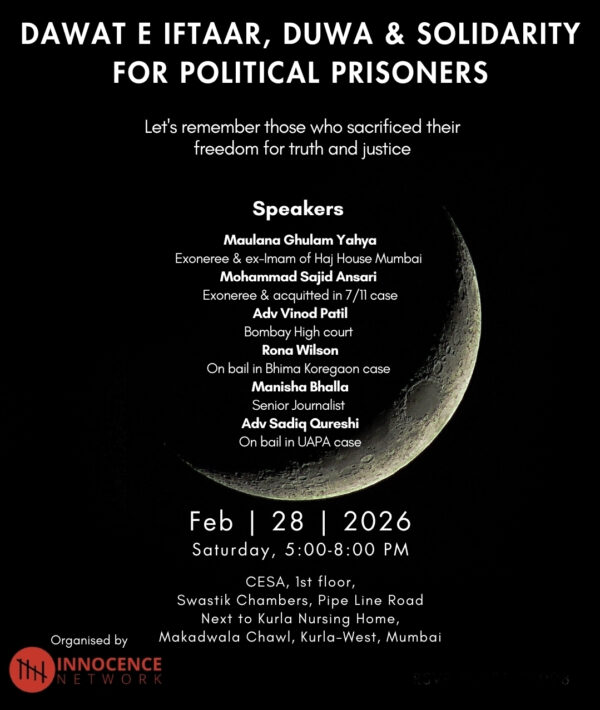
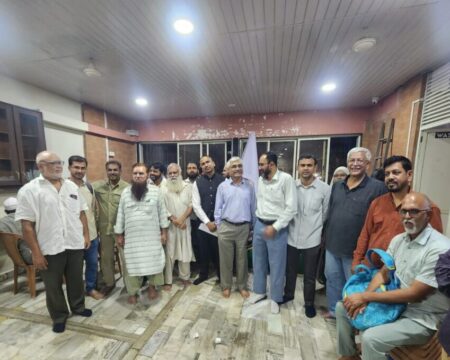
An iftar, dua and public meeting in solidarity with political prisoners was held at CESA, Kurla (West), on February 28, organised by Innocence Network India. Now in its eighth year, the annual gathering drew former prisoners and their families which nearly made 80% of the audiences.
…
A message from Rona Wilson, an accused in the Bhima Koregaon case who was unable to attend, was read out at the venue. In it, he said that when large numbers of people are subjected to incarceration and prolonged legal battles, such gatherings were necessary to renew solidarity and sustain the pursuit of justice.
Read more


Iftar gathers families of political prisoners, calls for sustained solidarity

02/03/2026

Maktoobmedia / by Maktoob Staff

An iftar, dua and public meeting in solidarity with political prisoners was held at the Centre for Study of Society and Secularism (CESA) in Kurla (West) on February 28. Organised by Innocence Network India, the annual gathering, now in its eighth year, drew former prisoners and their families, who organisers said made up nearly 80 per cent of the audience.
Read more


Also read:
▪ Voices From Prison | A Legacy Of Detention: Weaponisation Of PDA, TADA, NSA And UAPA Laws Since Independence (Outlook / Jan 2026)
▪ Incarceration As Politics: A Timeline Of Political Prisoners In Independent India (Outlook / Jan 2026)
▪ Who Is a ‘Political Prisoner’? Rona Wilson Says Caste and Religion Are Key to the Answer (The Wire / Feb 2025)
▪ Justice On Hold: How India’s Trial Courts Are Creating a New Class of Political Prisoners—Those Accused Of ‘Terrorism’ (article 14 / Dec 2025)
▪ How The Indian Prison System Denies Basic Freedoms, Rights And Dignity To Political Prisoners (The Polis Project / Jun 2024)

Surendra Gadling and the justice that must be seen to be denied

Surendra Gadling and the justice that must be seen to be denied

Frontline / by Ajaz Ashraf

The human rights lawyer is the only one of the Bhima Koregaon-16 still in jail. Seven years on, charges have not even been framed against him in a case built on a surrendered Maoist’s statement.
From 1998, the year in which Minal married Nagpur-based lawyer Surendra Gadling, she would urge him to lodge a complaint every time he told her about the police issuing threats to him. Gadling had incurred their wrath because of fighting cases, often pro bono, of poor Adivasis jailed for being Maoist. His triumphs suggested that either the police were guilty of shoddy investigations or, worse, guilty of foisting false cases on them.
Read more


Also read:
▪ Explained: The 2016 Surjagarh arson case, the Elgaar link, and why the Supreme Court is intervening now (The Indian Express / Jan 2026)
▪ In Surendra Gadling’s case, adjournment becomes the verdict (Frontline / Aug 2025)
▪ Bhima Koregaon: Challenging Caste. Brahminism’s wrath against dreamers of equality

Author: Ajaz Ashraf  
Publisher: AuthorsUpFront
Publishing Date: June 2024
Pages: 496
Challenging Caste reads the violence at Bhima Koregaon as a clash between two worldviews – one striving to flatten the social hierarchy, the other justifying and perpetuating it. This book rips apart the Maoist conspiracy theory and the Urban Naxal narrative.
Read more/order

▪ Surendra Gadling’s Computer Was Attacked, Incriminating Documents Planted: Arsenal Consulting (The Wire / July 2021)

Unlawful: Editorial on the Bhima Koregaon case and denial of liberty under UAPA

Unlawful: Editorial on the Bhima Koregaon case and denial of liberty under UAPA

Poster by #bakeryprasad

The Telegraph / by The Editorial Board

After eight years, no charges have been framed. This is a shocking failure of the operations of justice that brings up disturbing questions about the commitment to the Constitution
The Unlawful Activities (Prevention) Act makes bail difficult for those charged under it. It seems, however, that clapping UAPA on persons by accusing them of Maoist links, of plots to incite violence and conspiracy against the State, gives authorities a free hand to curtail the freedom of the accused even after bail is granted. Of the 16 people arrested under the UAPA for the Bhima-Koregaon violence in 2018, 14 were granted bail after an average of five years or more.
Read more


Also read:
▪ Inside the NIA’s ‘Perfect’ Conviction Record: How Coercive Detentions Are Driving Guilty Pleas (The Wire / Dec 2025)
▪ Elgaar Parishad-Bhima Koregaon case: 16 accused, 1 dead, 1 in custody, 14 out on bail. The bail diaries (The Indian Express / Feb 2026)
▪ Bail for Sagar Gorkhe and Ramesh Gaichor, five years and five months after arrest (SabrangIndia / Jan 2026)
▪ In Surendra Gadling’s case, adjournment becomes the verdict (Frontline / Aug 2025)
▪ UAPA – CRIMINALISING DISSENT AND STATE TERROR – Study of UAPA Abuse in India, 2009-2022 (PUCL / Sep 2022). Download report

New anthology stands in solidarity with Umar Khalid / Lecture on Umar Khalid Highlights UAPA’s Chilling Effect

New anthology stands in solidarity with Umar Khalid / Lecture on Umar Khalid Highlights UAPA’s Chilling Effect

“Widen the circle”: New anthology stands in solidarity with incarcerated activist Umar Khalid

19/02/2026

Maktoob / by Fida Fahima

Released on Tuesday at the Press Club of India in New Delhi, the book “Umar Khalid and His World: An Anthology” seeks to “widen the circle of companionship” around anti-CAA activist Umar Khalid and serve as a tribute to those jailed or targeted for speaking out against injustice, the organisers said.
… The book further accuses the regime of responding to dissent with a “brazen witch-hunt,” referencing cases such as Bhima Koregaon and the Delhi riots, and alleging that misinformation and media trials were deployed to incarcerate what it terms “foot soldiers of the Constitution.”
Read more


Mumbai Lecture on Umar Khalid, Sharjeel Imam Bail Denial Highlights UAPA’s Chilling Effect

15/02/2026

The Wire / by Nishtha Sood

Speakers at the ninth Shahid Azmi Memorial Lecture said the Supreme Court’s refusal to grant bail to Umar Khalid and Sharjeel Imam under UAPA threatens the right to protest and deepens fears of institutional failure.
… Arun Ferreira, Vernon Gonsalves and Sudha Bharadwaj were among those in attendance.
Read more


When The Personal Became Political At Shahid Azmi Memorial Lecture

11/02/2026

Outlook India / by Pritha Vashisth

Organised by Innocence Network India, the Shahid Azmi Memorial Lecture focused this year on the prolonged denial of bail to Umar Khalid and Sharjeel Imam.
… Among those present were individuals out on bail in the Bhima Koregaon case, often referred to as the BK 16, including Sudha Bharadwaj, Vernon Gonsalves, and Hany Babu. There were also people who had faced incarceration in cases such as the 7/11 Mumbai train blasts before eventually being acquitted. Some sat quietly taking notes. Others listened with folded arms. A few wiped away tears.
Read more


Also read:
▪ Incarceration As Politics: A Timeline Of Political Prisoners In Independent India (Outlook / Jan 2026)
▪ Voices From Prison Series: Of Lives Stolen For Dissent (Outlook / Jan 2026)
▪ Shadows of Judicial Indiscipline: On the Supreme Court’s bail denial to Umar Khalid and Sharjeel Imam (The Leaflet / Jan 2026)