Browsed by
Category: Context

Will anti-Naxal drive pave way for mining giants?

Will anti-Naxal drive pave way for mining giants?

The New Indian Express / by Gurbir Singh

Is the government campaign aimed at ‘finishing off’ the extremists, or are the larger goals to open up central India’s mineral and natural resources for exploitation? Or both?
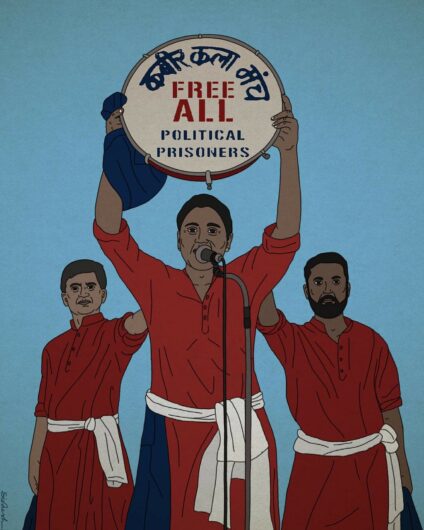
… Over the years, Maoists, NGOs and even priests like Stan Swamy have mobilized these tribal communities to resist corporate expansion. The state forces, on the other hand, have intervened to crush the protests.
Read more


Also read:
Three years after Stan Swamy’s death in custody, activists recall his contributions to Adivasi cause (Scroll.in / Jul 2024)
Jharkhand police to probe into Maoist links with Stan Swamy’s ‘Bagaicha’, 63 other frontal organisations (The New Indian Express / Sep 2023)
Statement against the drone bomb attacks in Chhattisgarh, India (India Matters / April 2023)
DISINHERITING ADIVASIS – THE GADCHIROLI GAME PLAN (KAFILA / June 2018)
The legal face of corporate land grab in Chhattisgarh (India Environmental Portal | by Sudha Bharadwaj | Feb 2018)
Mining In Gadchiroli – Building A Castle Of Injustices (Countercurrents | by Neema Pathak Broome and Mahesh Raut | June 2017)

When The Personal Became Political At Shahid Azmi Memorial Lecture

When The Personal Became Political At Shahid Azmi Memorial Lecture

Outlook India / by Pritha Vashisth

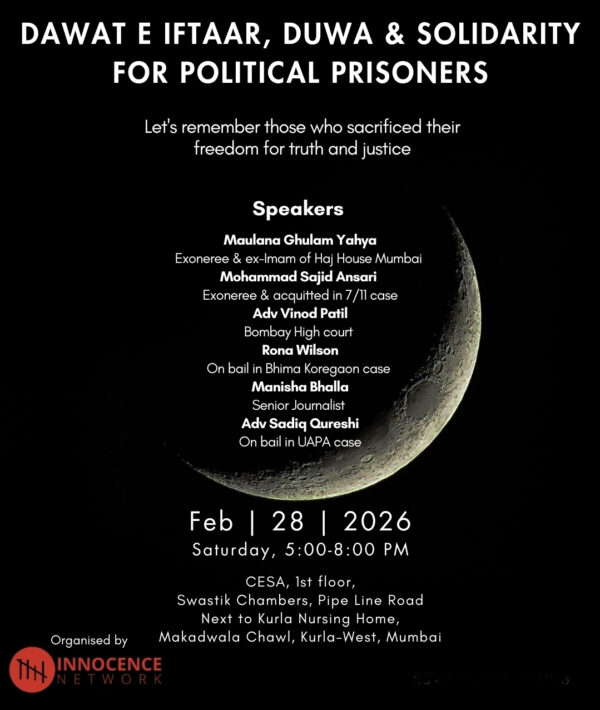
Organised by Innocence Network India, the Shahid Azmi Memorial Lecture focused this year on the prolonged denial of bail to Umar Khalid and Sharjeel Imam.
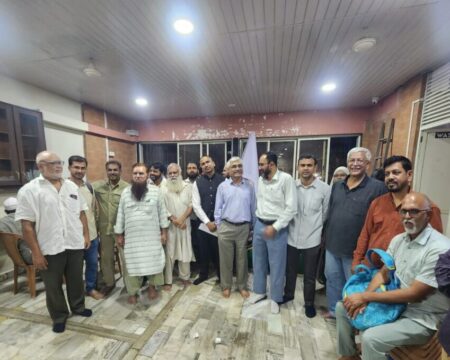
… Among those present were individuals out on bail in the Bhima Koregaon case, often referred to as the BK 16, including Sudha Bharadwaj, Vernon Gonsalves, and Hany Babu. There were also people who had faced incarceration in cases such as the 7/11 Mumbai train blasts before eventually being acquitted. Some sat quietly taking notes. Others listened with folded arms. A few wiped away tears.
Read more


Also read:
Incarceration As Politics: A Timeline Of Political Prisoners In Independent India (Outlook / Jan 2026)
Voices From Prison Series: Of Lives Stolen For Dissent (Outlook / Jan 2026)
Shadows of Judicial Indiscipline: On the Supreme Court’s bail denial to Umar Khalid and Sharjeel Imam (The Leaflet / Jan 2026)

How Not To Defend Umar Khalid / Shadows of Judicial Indiscipline / From Protest to Persecution

How Not To Defend Umar Khalid / Shadows of Judicial Indiscipline / From Protest to Persecution

An Injustice Strengthened by Political Silence

18/01/2026

Peoples Democracy / by Brinda Karat

The Supreme Court’s refusal to grant bail to Umar Khalid and Sharjeel Imam, while accepting the bail pleas of five other accused in the same case, is not merely a judicial order affecting two individuals. It marks a deeply troubling moment for constitutional democracy in India.

Silence transforms injustice, more so when it has a communal colour, into routine governance. When there is hesitation to challenge unjust court orders, to oppose political persecution carried out through lawless laws like UAPA, whether in the Delhi violence cases, the Bhima Koregaon prosecutions or the NewsClick case, the ruling regime faces no real political cost for its repression, all under the pretext of “national security.” In such a political climate, even the custodial death of a Stan Swamy — caused by the sheer cruelty of denying bail and even basic facilities despite his serious health conditions — becomes normalised.
Read more


How Not To Defend Umar Khalid

16/01/2026

The Wire / by Ajay Gudvarthy

The problem with Umar for the current regime is his refusal to be constrained within a Muslim body and identity. Very much similar to a Dalit like Anand Teltumbde who is not Dalit enough because he speaks of right to education and corporate Hindutva.
Umar Khalid is arrested not because he is a Muslim. He is under detention because he does not wear his Muslim identity on his sleeves. He remains incarcerated not because he protested against the Citizenship Amendment Act (CAA) but because he was agitated about what is happening to the tribals in central India and was resisting the damage being done to the economy that was emaciating the working poor.
Read more


Shadows of Judicial Indiscipline: On the Supreme Court’s bail denial to Umar Khalid and Sharjeel Imam

07/01/2026

The Leaflet / by Indira Jaising

In both the Bhima Koregaon and Delhi riots cases, a wrongful invoking of UAPA and obdurate refusal to follow precedent on delay in trial, raise legitimate questions on the independence of the judiciary.
At the heart of the controversy relating to the denial of bail to Sharjeel Imam and Umar Khalid is a simple question: what is the crime that they have committed? What if they have committed no crime at all under the Unlawful Activities (Prevention) Act, 1967? Would bail still have been denied to them?
Read more


From Protest to Persecution: The Supreme Court’s defining Moment in Delhi Riot Case

07/01/2026

PUDR / by PUDR

On 5 January 2026, the Supreme Court delivered its first substantive order in the so-called ‘Delhi riots conspiracy case’ of FIR 59/2020 under UAPA, to grant bail to five (Gulfisha Fatima, Shifa ur Rehman, Meeran Haider, Md Saleem Khan and Shadab Ahmad) and reject the bail of two (Umar Khalid and Sharjeel Imam).
… the Supreme Court walks back on its own precedent in Vernon Gonsalves, which held that in determining the existence of a prima facie case to deny bail under UAPA, courts are empowered to look into the probative value or patent inadmissibility of prosecutorial materials. In the order of 5 January 2026, the Supreme Court states: “the inquiry is one of statutory plausibility, not evidentiary sufficiency”.
Read full statement


When a Government Targets Its Citizens

07/01/2026

Countercurrents.org / by Hiren Gohain

Does anyone remember the Bhima Koregaon incident now? Certain well-known people active and well-regarded for their work in academic areas as well as in social action to bring justice to victims of state repression and social discrimination as well as human rights violations,had been detained following midnight arrests on hair-raising charges of conspiring to assassinate the Prime Minister and destroy the state. It had shaken the fragile world of the media, though not the workaday world.
Read more


Justice Delayed, Selectively Denied

05/01/2026

Youth Ki Awaaz / by Geetika Kaur

The denial of bail to Umar Khalid this week is not an isolated legal decision. It sits within a larger and deeply disturbing pattern in India’s criminal justice system, one where activists, students, lawyers, and environmentalists languish in jail for years without conviction, while those convicted of rape, murder, or mass violence repeatedly find the doors of prison opening for them.
… Stan Swamy died in custody after repeated denial of bail despite his age and illness. Sudha Bharadwaj spent years in jail before being granted bail, not because she was acquitted, but because prolonged incarceration without trial became legally indefensible. Gautam Navlakha remained under incarceration and house arrest for years on allegations that rested largely on contested digital evidence.
Read more


The spectacle of justice in the Delhi riots case is cover for polarisation and violence

06/01/2026

Scroll.in / by Akash Bhattacharya

In the six years since, a series of incidents in the national capital have intensified this schism while Umar Khalid and Sharjeel Imam remain incarcerated.
The capital of India, Delhi is no stranger to political violence. But the Delhi riots of 2020 set a new benchmark. The violence not only ended lives and livelihoods, it also transformed the city’s social and political landscape for the worse.
Read more


Also read:
How The Supreme Court’s Bail Order Against Umar, Sharjeel Enables Govt Efforts To Silence Muslim Voices (article 14 / Jan 2026)
After Five Years in Jail, Bail Still Barred for Two: Supreme Court denies bail to Umar Khalid and Sharjeel Imam in Delhi riots case (Sabrangindia / Jan 2026)
Umar Khalid, Sharjeel Imam, and The Moral Arc of the Universe (The Wire / Jan 2026)
In UAPA Bail Hearing, Defence Not To Be Considered; Only See If Prosecution Has Shown Prima Facie Case : Supreme Court (Live Law / Jan 2026)
Read judgment
Delhi Riots UAPA Case : Supreme Court’s Bail Conditions Bar Accused From Sharing Posts Digitally & Attending Gatherings (Live Law / Jan 2026)
Why SC denied bail to Umar Khalid, Sharjeel Imam but awarded it to five other anti-CAA activists (Scroll.in / Jan 2026)
Recovering the Basics: The Supreme Court’s Bail Order in Vernon Gonsalves’ Case (Constitutional Law and Philosophy / Jul 2023)
Amit Shah’s ‘Bhima Koregaon Model’ Used For Anti-CAA Protests (NDTV / May 2020)
Imperative for Understanding Evolution of Human Rights Paradigm: Whither Human Rights in India

Imperative for Understanding Evolution of Human Rights Paradigm: Whither Human Rights in India

Sabrang India / by Harsh Thakor

‘Whither Human Rights in India’ is a comprehensive exploration of how the devastation of human rights over the parts decade symbolise a crucial departure or rupture, manifesting a new fascist paradigm
‘Whither Human Rights in India,’ edited by  Anand Teltumbde, is a critical and outstanding collection of essays navigating  India’s human rights landscape, exploring diverse arenas Ike majoritarianism, state violence, systemic inequality (Dalits, Adivasis, Muslims), judicial issues, hate speech, and threats to vulnerable groups.
Resurrecting the outlook of Father Stan Swamy and Prof. G. N. Saibaba, Whither Human Rights in India is both a chronicle of resistance and a call to reshape the future of democracy and human dignity.
Read more

▪ Whither Human Rights in India


Critical Essays on Democracy, State Power, Civil Liberties & the Lived Realities of Dalits, Adivasis, Minorities & More

Whither Human Rights in India, edited by Anand Teltumbde, one of India’s prominent human rights activists, is a searing and indispensable anthology that brings together some of the most important thinkers, activists and human rights defenders of our time. The essays trace the historical and ideological roots of India’s human rights discourse—from colonial legacies and constitutional guarantees to the challenges posed by majoritarian politics, state violence and systemic inequality.

Editor: Anand Teltumbde
Publishing Date: Nov 2025
Publisher: Penguin Viking
Pages: 400
Read more/order

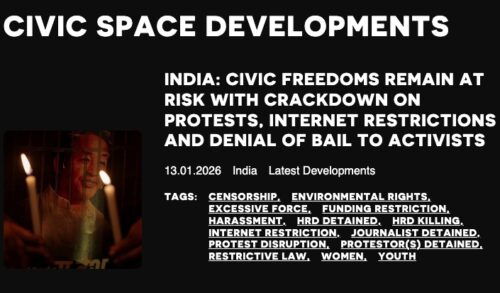
Civic freedoms remain at risk with crackdown on protests, internet restrictions and denial of bail to activists

Civic freedoms remain at risk with crackdown on protests, internet restrictions and denial of bail to activists

CIVICUS Monitor / by CIVICUS

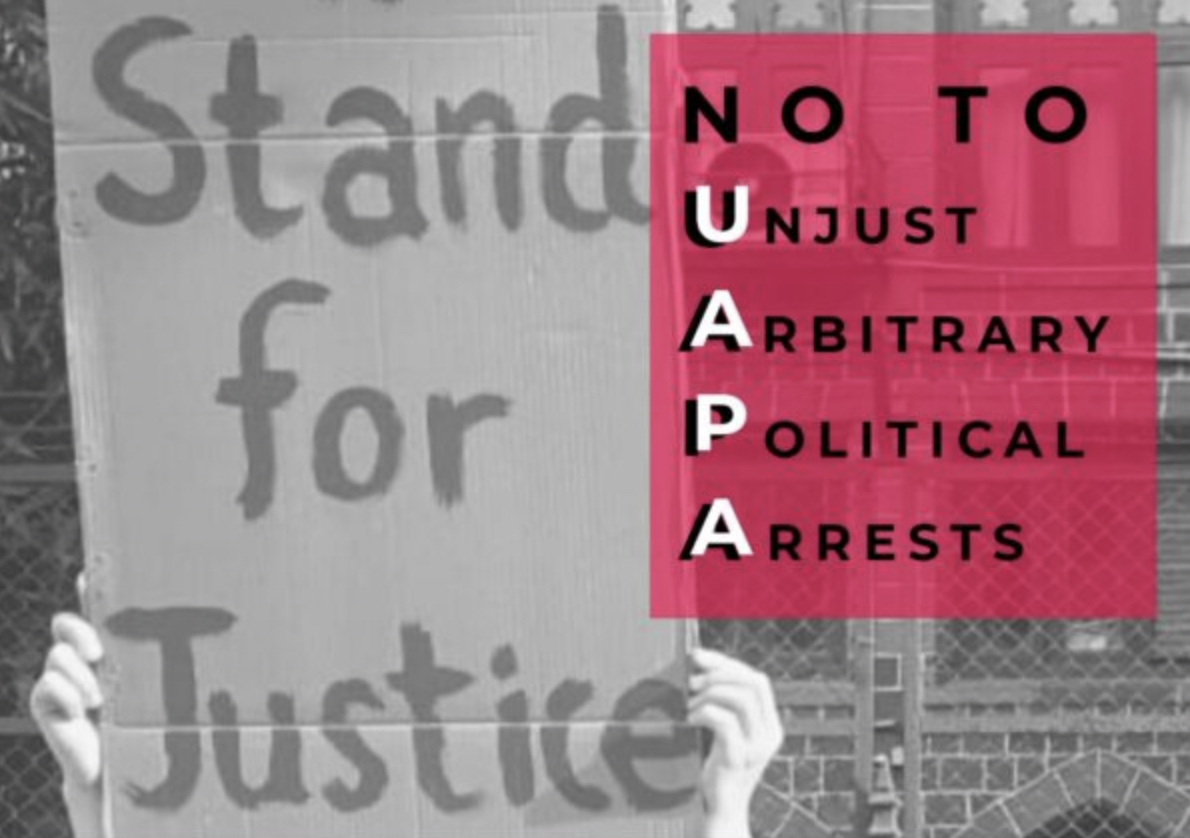
India’s civic space is still rated as ‘repressed’ by the CIVICUS Monitor. The authorities persist in targeting activists, journalists, students and civil society through the misuse of draconian laws, arbitrary detention, censorship and the criminalisation of dissent. Over the past year, the Unlawful Activities (Prevention) Act (UAPA), the Foreign Contribution (Regulation) Act (FCRA), counterterrorism provisions and public order regulations have been consistently deployed to silence government critics, restrict civil society, and deter peaceful protests.
Read more


Also read:
Ongoing detention of activists without bail, criminalisation of dissent and ban on books (CIVICUS / Sep S025)
Read India report: INDIA – COUNTRY FACTSHEET 2025 (World Organization Against Torture / Jun 2025)

India: Submission to the UN Human Rights Committee on the deterioration of civic space (CIVICUS /Jul 2024)
CIVIC FREEDOMS IN INDIA ‘REPRESSED’: GLOBAL MONITOR CIVICUS (The Wire / March 2023)
Read full report „People Power Under Attack 2022“ (CIVICUS)

‘It’s like Groundhog Day’: Waiting decades for justice in India’s overburdened court system

‘It’s like Groundhog Day’: Waiting decades for justice in India’s overburdened court system

CBC News / by Salimah Shivji

Backlog of cases in country’s courts would take several hundred years to clear, experts say
The frustration and weariness crept into Sanjay Goel’s voice as he stared at the giant stack of handwritten court documents in front of him.
He was on one of his countless visits from Vancouver to Mumbai, India, to fight for justice in the brutal killing of his mother and was struggling to describe the excruciating delays in criminal court proceedings.

Mumbai activist Sudhir Dhawale is familiar with the pain of waiting for a judgment. 
He sat in jail for 6½ years, two of which were in solitary confinement, waiting for bail. 
Read more


Also read:
A Key Conspiratorial Meeting May Be A Fabrication: Why Umar Khalid & Other Muslim Activists Should Get Bail (article 14 / Dec 2025)
Justice On Hold: How India’s Trial Courts Are Creating a New Class of Political Prisoners—Those Accused Of ‘Terrorism’(article 14 / Dec 2025)
In Surendra Gadling’s case, adjournment becomes the verdict (Frontline / Aug 2025)
Eternal adjournments, impractical riders mar precious Constitutional values (DT Next / Mar 2025)
Bail for Bhima Koregaon accused highlights extraordinary delay in trial (Scroll.in / Jan 2025)

Inside the NIA’s ‘Perfect’ Conviction Record: How Coercive Detentions Are Driving Guilty Pleas

Inside the NIA’s ‘Perfect’ Conviction Record: How Coercive Detentions Are Driving Guilty Pleas

Inside the NIA’s ‘Perfect’ Conviction Record: How Coercive Detentions Are Driving Guilty Pleas

10/12/2025

The Wire / by Sukanya Shantha

A year after the National Investigation Agency boasted of a 100% conviction rate, an investigation by The Wire finds that prolonged detention, near-automatic bail denials and pressure from investigators are pushing dozens of accused, mostly Muslims, to plead guilty before their trials have even begun.

After the NIA began registering cases in 2009, trials did not commence for the first six to seven years, except in a few cases. The restrictive bail clause, Section 43 D(5), introduced in the UAPA in 2008, making it virtually impossible for an accused person to be released on bail, ensured that those accused remained in jail during this time.
Read more


10,400 arrested under UAPA from 2019-2023, only 335 convicted

05/12/2025

Scroll.in / by Scroll Staff

Jammu and Kashmir had the highest number of arrests under the law, followed by Uttar Pradesh, data tabled in Parliament showed.
A total of 10,440 persons were arrested between 2019 and 2023 under the Unlawful Activities Prevention Act, the Union government has told Parliament. Of these, only 335 persons were convicted under the anti-terror law.
Read more


Also read:
Years Without Trial, Then Pushing Guilty Pleas: Understanding the NIA’s Playbook (The Wire / Dec 2025)
Judicial Backlog: 90 Thousand Cases Pending in SC, Almost 5 Crore In District Courts (Outlook / Dec 2025)
The Grammar of the Power to Arrest and Search under UAPA (Constitutional Law and Philosophy | by Hany Babu and Surendra Gadling | Jul 2025)
▪ UAPA – CRIMINALISING DISSENT AND STATE TERROR – Study of UAPA Abuse in India, 2009-2022 (PUCL / Sep 2022). Download report
Bhima-Koregaon case transferred to NIA to compromise independent probe: Front Line Defenders (SabrangIndia / Jan 2020)

‘A permanent surveillance backdoor’: Why Sanchar Saathi app order raises privacy fears

‘A permanent surveillance backdoor’: Why Sanchar Saathi app order raises privacy fears

Scroll.in / by Ratna Singh

Digital rights groups warn that forcing an app onto every device could allow the government to spy on Indians and even control their devices.
… On social media, founder and editor of technology policy website Medianama, Nikhil Pahwa, illustrated just what this ability to control a user’s mobile phone would look like. “A government application can also be used to implant files on your device,” he said. “[It] has happened before, in the Bhima Koregaon case where documents were allegedly put on laptops and used to frame a conspiracy.”
Read more


Poster by #bakeryprasad


Also read:
‘Malware Evidence in Their Own Reporting?’ Global Experts Reiterate Bhima Koregaon Reports, Seek End to Injustice (The Wire / Nov 2025)
How an unsophisticated malware attack became India’s biggest state-sponsored cybercrime (The Polis Project / Mar 2025)
Incriminating evidence planted in computers: The Trojan solved the Bhima Koregaon case! (Anchored Narratives / Jan 2023)
Hackers Planted Files to Frame an Indian Priest Who Died in Custody (Wired / Dec 2022)
Police Linked to Hacking Campaign to Frame Indian Activists (Wired.com / June 2022)
Leaked Data Shows Surveillance Net in Elgar Parishad Case May Have Crossed a Line (The Wire / July 2021)
They were Accused of plotting to overthrow the Modi government – The evidence was planted, a new report says (Washington Post / Feb 2021)

Counting the Caged: What India’s prison data refuses to see

Counting the Caged: What India’s prison data refuses to see

Sabrang / by CJP Team

Two years after NCRB’s Prison Statistics India 2023 report was published, the numbers still read less like history and more like prophecy
The NCRB Prison Statistics Report, 2023, detailed an already stressed carceral system, housing 5.82 lakh inmates in a system sanctioned for 4.25 lakh, with undertrial prisoners making up almost 78% of all prisoners. Other than numbers and statistics being added to the data, nothing changed substantively between the original numbers and now.
Read more


Also read:
Notes From Inside Taloja Prison (Outlook | by Mahesh Raut | Jun 2025)
Inside Taloja Prison: A Study | By Mahesh Raut (Outlook / May 2025)
Many Prisoners at Taloja Jail Not Produced Before Court For Years, Reveals Survey by Surendra Gadling and Sagar Gorkhe (The Wire / Feb 2025)
How Long is Too Long? – On the Maximum Period that an Undertrial Prisoner can be Detained (Constitutional Law and Philosophy | by Hany Babu and Surendra Gadling | Oct 2024)

Delhi University Vice Chancellor’s speech criticising ‘urban naxals’ draws ire

Delhi University Vice Chancellor’s speech criticising ‘urban naxals’ draws ire

Pic credits: MR online

PUCL condemns regressive and defamatory views of DU Vice Chancellor Prof. Yogesh Singh: At odds with Constitutional values

09/10/2025

Countercurrents.org / by  People’s Union For Civil Liberties

People’s Union for Civil Liberties (PUCL) India, is shocked at the troubling  views expressed by Dr Yogesh Singh, professor and Vice Chancellor Delhi University  on 28th September, 2025 in a  speech titled “Naxal Mukt Bharat: Ending Red Terror Under Modi’s Leadership, Why Campuses are Targets?’

In the over 20 minute speech, replete with unsubstantiated  and defamatory statements about alleged “urban naxals” on campus, Prof Singh named Delhi university’s professors and student activists charged and imprisoned under the draconian Unlawful Activities (Prevention) Act, 1967, including members of the feminist student group Pinjar Tod (Devangana Kalita and Natasha Narwal), charged in the Delhi riots case and Prof Hany Babu and professors Dr Shoma Sen and Dr Anand Teltumbde (mispronounced by Prof Singh as Teltumbedke), charged in the Bhima Koregaon case.
Read more


Delhi University V-C’s speech criticising ‘urban naxals’, Pinjra Tod movement draws ire

08/10/2025

The Indian Express / by Express News Service

Delhi University Vice-Chancellor Yogesh Singh’s speech alleging the presence of “Urban Naxals” in universities and criticising movements like ‘Pinjra Tod’ has triggered protests from students and faculty.
… Referring to the 2018 Bhima Koregaon case, Singh named DU professor Hany Babu and academics Rona Wilson and Anand Teltumbde, saying, “And these are not isolated cases.”
Read more


Also read:
As Maharashtra Govt Brings Bill Against ‘Urban Naxalism’, Activists Fear Criminalisation of Dissent (The Wire / Jul 2025)
Insecurity By Law: A Critique of the Maharashtra Special Public Security Bill in the Context of India’s Banning Regime (PUDR / Jul 2025)
McCarthyism in INDIA?: The Return of The Urban Naxal Bogey! (The Crossbill / Jul 2024)
From ‘tukde tukde gang’ to ‘urban Naxal’: How media trials enable the government to stifle dissent (Scroll.in / Sep 2018)

The radical Hindutva links of the men arrested for lynching a Muslim man in Maharashtra

The radical Hindutva links of the men arrested for lynching a Muslim man in Maharashtra

Scroll.in / by Tabassum Barnagarwala

Social media accounts of four of the accused reveal they are members of an organisation founded by the hardliner Sambhaji Bhide.
On August 11, Suleman Rahim Khan Pathan was sitting with a Hindu woman in a cafe in Maharashtra’s Jamner town when a group of men forced him to go along with them.
The 21-year-old was driven around in a van and brutally assaulted before finally being dropped off at a bus stand in his village. Khan died of his injuries.
… Scroll’s analysis of their social media accounts showed that the four were active members of Shri Shiv Pratishthan Hindustan, an organisation formed by the Hindutva hardliner Sambhaji Manohar Bhide, who was formerly associated with the Rashtriya Swayamsevak Sangh.
In December 2022, Dalit groups and political activists had accused Bhide of instigating violence in Bhima Koregaon village through provocative speeches.
Read more


Also read:
Why caste Hindutva, not an Elgar conspiracy, is at the root of the Bhima Koregaon violence (The Polis Project / Feb 2025)
Samabhji Bhide, Milind Ekbote instigated Bhima Koregaon riots: Accused event organiser tells Inquiry Commission (Bar & Bench / Sep 2021)
India’s Hindu Nationalist Project Relies on Brutal Repression (Jacobinmag / April 2021)
Bhima Koregaon violence: Dalit group demands action against Sambhaji Bhide (The Indian Express / Jan 2021)
Casting a Veil – What we miss by ignoring Maratha caste politics in the Bhima Koregaon case (The Caravan, Dec 2020)