Browsed by
Category: Profiles

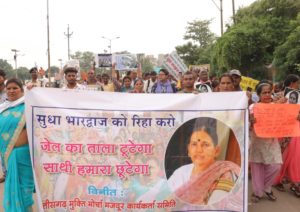
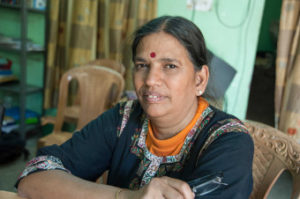
Who is Sudha Bharadwaj?

Who is Sudha Bharadwaj?

Sudha Bharadwaj

Nov 2019

By Mumbai Rises to Save Democracy

Maaysha, Sudha’s daughter: “If fighting for the rights of adivasis, fighting for workers and peasants, fighting against repression and exploitation and giving up one s whole life for them is being a naxalite then I guess naxalites are pretty good.”

“The 6th Annual Harvard Law International Women’s Day Portrait Exhibit showcases the astounding contributions of women around the world to the areas of law and policy. The honorees — each of whom were nominated by HLS students, faculty or staff — are powerful voices in their respective fields, whether they are sitting on a high court bench, standing in front of a classroom, or marching in the streets.”

Or whether they are sitting in jail.

Advocate Sudha Bharadwaj is a 2019 honoree of the Harvard Law International Women’s day exhibition and is sitting in a jail cell in Pune. How did these conflicting positions come about?

Sudha grew up to illustrious parents, and spent the first part of her life as an American citizen. In the next 30 years of her life, she worked tirelessly in Chhattisgarh Mukti Morcha (CMM) as a trade unionist and eventually as a lawyer after the CMM, hamstrung in their legal battles by unscrupulous lawyers, found in her the courage and integrity needed to challenge powerful opponents in the courtrooms.

She founded Janhit, giving rigorous legal aid to several industrial workers, villages fighting acquisition and mining, Adivasi communities fighting for forest rights, environmental cases and PIL litigation. Janhit led cases against powerful industrial houses such as Jindal, Vedanta, BALCO, Lafarge Holcim, D.B. Power, Vandana Vidyut, SECL, Bhilai Steel Plant, Monnet Steel, Adani, Hindalco, Grasim, Ultratech and others.

Sudha was instrumental in rebuilding the PUCL group after the arrest and incarceration of its then-President, Dr. Binayak Sen. During this time, she was appointed as the General Secretary of People’s Union for Civil Liberties (PUCL) and worked on issues of human trafficking and attacks on minorities. She also assisted families of victims of human rights violations looked upon as casualties in the conflict zone of Bastar and supported journalists and activists who dared raise their voices and pen against the State excesses in Bastar. She was elected recently as Vice President of the Indian Association of Peoples’ Lawyers (IAPL) and was active in campaigns against attacks on Dalit and human rights lawyers in Chhattisgarh and facilitated an IAPL fact-finding into it.

Sudha was arrested from her Faridabad home which she was sharing with her daughter, Maaysha. During this time, she was a Visiting Professor at the National Law University Delhi, taking Seminar Courses on tribal rights, land acquisition, and the Fifth and Sixth Schedules. This year she was to have taught “Law and Justice in a Globalising World”. Sadly, and ironically, she can’t teach the class as she is in jail. The loss, the students inform us, is all theirs.

Her daughter Maaysha, has in several letters candidly brought to fore Sudha’s tireless spirit and her commitment to her work, “If fighting for the rights of Adivasis, fighting for workers and peasants, fighting against repression and exploitation and giving up one’s whole life for them is being a Naxalite then I guess Naxalites are pretty good.”

Guneet Ahuja, Advocate, Delhi, in an open letter writes about Sudha, “On my first meeting with Sudha ji, I asked her about the competing narratives regarding the condition of indigenous communities in Bastar. Her reply left a deep impact on me: “For a pedestrian on a narrow lane, the car driver is causing the trouble. For the car driver, the pedestrian is the nuisance. Your perspectives change based on where you are placed.”

Sudha is the pedestrian along with all the people she fights for. She believes the road belongs to us. The State is the car who doesn’t want nuisance pedestrians in the way, believes the road belongs to it, and wants it lined with the businesses of its cronies. To the State, Sudha belongs in jail. To us, she is a defender of human rights.

“If you try to be safe and in the middle, you will never succeed.”
Sudha, The Wire


Sudha Bharadwaj Speaks – A Life in Law and Activism
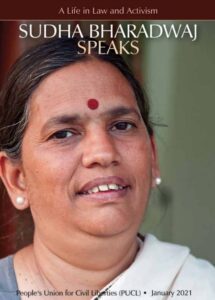

Publisher: Peoples Union for Civil Liberties (PUCL)
Edition: January 2021
Language: English
Sudha Bharadwaj’s interview by: Darshana Mitra and Santanu Chakraborty
Pictures credit: PUCL
Cover Design / Layout: Vinay Jain
Paperback: 316 pages

PDF copy: Sudha Bharadwaj speaks – A Life in Law and Activism (PUCL, Jan 2021)

Read More Read More

Who is Varavara Rao?

Who is Varavara Rao?

Varavara Rao

Nov 2019

By Mumbai Rises to Save Democracy

“When the victory drum started
beating
In the heart of the masses
You mistook it for a person and
trained your guns
Revolution echoed from all
horizons.”

Being thrown into jail is nothing new to the famous Telugu poet Varavara Rao. He has faced at least 25 cases in the last 45 years. His story can be understood through the history of these arrests and the power of his writings, his poetry, his teaching career and his political understandings and analysis of power and oppression, and the path to liberation.
Varavara Rao, or VV was born into a middle class family in Chinna Pendyala, Warangal District, Andhra Pradesh in 1940. He started publishing his poetry at age 17, in 1957, but got interested in revolutionary theory while working as a lecturer at Mahabubnagar. It was during this time that he founded a literature and poetry group called Sahithee Mithrulu and a non-political journal named Srujana to eventually join the Tirugubadu Kavulu (Rebel Poets), who were sympathetic to the armed struggle going on in Srikakulam.
During this time, VV founded the Virasam or Viplava Rachayitala Sangham (Revolutionary Writers’ Association), an association banned by the Andhra Pradesh government in August 2005. The ban was later struck down by the AP High Court in November 2005.
VV, now 74, has published 15 poetry collections of his own, besides having edited a number of anthologies. His poetry has been translated into almost all Indian languages and have appeared in Malayalam, Kannada, Hindi and Bengali. His thesis on ‘Telangana Liberation Struggle and Telugu Novel – A Study into Interconnection between Society and Literature’ published in 1983 is considered to be one of the finest works of Marxist critical studies done in Telugu. While in prison he translated Kenyan writer, Ngũgĩ wa Thiong’o’s prison diary ‘Detained’ and his novel ‘Devil on the Cross’ into Telugu. He also wrote his own prison diary Sahacharulu (1990), which was translated into English as Captive Imagination.
VV was first arrested under the infamous Maintenance of Internal Security Act (MISA) in Andhra Pradesh, in 1973. He was then arrested during Emergency and was re-arrested at the entrance of the jail and kept imprisoned for an additional week when the Emergency was lifted. He survived many attempts on his life post-Emergency.
He was among the 46 accused of conspiring to overthrow the Andhra Pradesh government in the Secunderabad conspiracy case, and was sent to jail once again in 1985. He was also an accused in the Ramnagar conspiracy case where he was accused to have attended a meeting where the plan to kill two Andhra Pradesh Police constables was hatched. He was finally acquitted of the charges after 17 years, in 2003.
He remains a staunch opposer of neo-liberal globalisation and specifically the globalisation policies adopted by Chandrababu Naidu’s government in the ’90s. He went as an emissary for the People’s War Group in the peace negotiations between the Andhra Pradesh government and Naxalites. After multiple rounds of the talks failed, Virasam was banned only to be reinstated later. Following the banning, Rao was arrested once again in 2005 and was released in 2006. He has been arrested four-times since the formation of the new Telangana state in 2014.
VV has faced at least nine cases under the Arms Act of 1959 and the Explosive Substances Act, 1908 over the last four decades. In perhaps the most ridiculous case, he was charged with distributing bombs to ensure the success of a strike against the custodial death of a Radical Students Union activist in 1985. In response, Varavara Rao wrote a memorable poem, titled :

Reflection
I did not supply the explosives
Nor ideas for that matter
It was you who trod with iron heels
Upon the anthill
And from the trampled earth
Sprouted the ideas of vengeance
It was you who struck the beehive
With your lathi
The sound of the scattering bees
Exploded in your shaken facade
Blotched red with fear
When the victory drum started
beating
In the heart of the masses
You mistook it for a person and
trained your guns
Revolution echoed
from all horizons …


WHO IS VARAVARA RAO?

By India Civil Watch

Varavara Rao (VV) was born in Warangal in 1940. He finished his MA in Telugu literature from Osmania University. He worked as a lecturer in several colleges and transformation towards revolutionary ideas started in Varavara Rao’s mind during his tenure in Mahabubnagar district.

Read More Read More

Who is Shoma Sen?

Who is Shoma Sen?

By Mumbai Rises To Save Democracy

In one of her letters to her daughter, Shoma writes, They can keep me locked inside, but my mind is completely free”

A reputed academician, a Dalit and Women’s Rights activist, a teacher and dissenter, Shoma Sen is all of the above and more. Born and raised in Mumbai, she moved to Nagpur with her partner and daughter with a strong resolve to protect and promote democratic rights of the most marginalised people in the society.

Shoma has been a respected academic for almost three decades. She has been actively involved with the Women’s Department of Wardha Vishwavidyalaya and taught in various colleges across Nagpur. During the time of her arrest she was the Head of the Department of English at Rashtrasant Tukadoji Maharaj Nagpur University. She has written extensively on post-colonialism and women’s studies for several decades.

Read More Read More

Letters from jail: Elgaar Parishad detainees pen thoughts and experiences

Letters from jail: Elgaar Parishad detainees pen thoughts and experiences

Paintings by Arun Ferreira

The Indian Express / by Seema Chishti

The letters, which The Indian Express has access to, reveal a slice of their lives behind bars. Some talk about when they can possibly see the gallows, some are abstract ruminations on life and freedom, while some dwell on the circumstances of their arrest and merits of the case.
Read more

Who is Hany Babu?

Who is Hany Babu?

Hany Babu: An epitome of intellectual activism

13/08/2020

MAKTOOB / by Farah Rafeeq

… Hany Babu, an anti-caste activist and an Associate Professor at the Department of English, at the University of Delhi, is a vocal advocate of Dalit rights and the Reservation Policy. He is the 12th person to be arrested in the Elgar Parishad violence. Hany had repeatedly denied any connection to the case.
Read more


Hany Babu: “If you are in a university and oppose state policy, you can be targeted”

29/11/2020

Caravan Magazine / by Shaheen Ahmed & Maya Palit

In the early hours of 10 September 2019, a team of police officials … turned up at the doorstep of Hany Babu MT … raided his apartment in Noida. The Caravan spoke to Babu about the raid at his house and its aftermath. They also discussed his participation in anti-caste movements and in a committee for the defence of the incarcerated professor GN Saibaba.
Read interview

‘Life not comfortable in jail, Shoma has lost 7 kgs´

‘Life not comfortable in jail, Shoma has lost 7 kgs´

The Times of India / by Shishir Arya

Nagpur: “It’s Independence Day and the second year of my unfreedom begins. Last year on 14th August, I was shifted into the separate cell, my compact little world,” reads a letter written from Yerawada Jail by Shoma Sen, one of the five accused in Bhima Koregaon violence case, to her husband, Tushar Kanti Bhattacharya in Nagpur on August 15 this year.
Read more

One year later: process has become punishment, say activists’ family members

One year later: process has become punishment, say activists’ family members

The Hindu / by Sonam Saigal

It has been a year since poet Varavara Rao, unionist and human rights lawyer Sudha Bharadwaj, and activists Vernon Gonsalves and Arun Ferreira have been arrested and charged under the Unlawful Activities Prevention Act (UAPA) for their alleged links with the CPI (Maoist) and for their alleged role in the Bhima-Koregaon violence.
Their family members, who spoke to The Hindu on Wednesday, said, “The process has become the punishment”, and it is extremely disheartening that it has become very difficult for them to even get bail.
Read more

Who is Arun Ferreira?

Who is Arun Ferreira?

By India Civil Watch

Arun Ferreira is a human rights lawyer from Mumbai, India. He is a member of the Committee for Protection of Democratic Rights (CPDR) and the Indian Association of People’s Lawyers (IAPL). He studied at Mumbai’s St. Xavier’s College where he developed a strong social conscience, and organised the institution’s canteen workers to demand better work conditions. After college, he worked with slum dwellers in Mumbai before becoming a community organiser in Vidarbha (rural Maharashtra state).

Read More Read More

Who is Vernon Gonsalves?

Who is Vernon Gonsalves?

By Mumbai Rises to Save Democracy

Characterised by a loose cotton half sleeve shirt, loose trousers, spectacles, a jhola and a hearty laughter, Vernon Gonsalves comes across as an effervescent wise man. Gonsalves gets along well with everyone from the age of six to sixty. His demeanour reflects an inner happiness. He started a band in college, but gave it up to be a part of people’s movements. His songs still hold the flavour of 70s rock.
Vernon’s pen is as sharp as his vision for an equitable, just society without distinctions of class, caste, race, with principles of gender equality and justice at its core. He is an acute political observer and makes nuanced arguments about complex sociopolitical-economic issues. Vernon has shown a keenness to understand the latest undercurrents in progressive politics.
He was born to a Mangalorean Catholic couple and grew up in a chawl in a modest locality in Byculla in Mumbai. Vernon was always good with academics and won a gold medal in Commerce from Mumbai University. Subsequently, he left his corporate job in Siemens to work with trade unions, workers, slum dwellers and the working class in Mumbai. During this period, he taught in prominent colleges in Mumbai including Ruparel College, HR College of Commerce and Economics, and Akbar Peerbhoy College of Commerce and Economics. Very few know that, in college he wanted to be a musician. Rumours say that he had also started a band but could not find meaning in it.
Around 1983, he moved to Chandrapur near Nagpur to work with unorganised sector workers including the coal-mine workers in the area. In 1984, he married fellow activist Susan Abraham. It was a union of two unique and fiercely independent minds. They worked in Chandrapur for a decade. After their son Sagar was born in 1994, they returned to Mumbai.
On 19 August 2007, the Maharashtra ATS arrested Vernon from his residence in Andheri, Mumbai. His arrest was falsely shown as from the residence of his co-accused S. Shridhar in Govandi. They were charged with being “top-level” Naxalites having explosives in their possession. For some months prior to this, Vernon had been working for the rights of tribal communities in the Maharashtra district of Chandrapur. 20 cases were filed against him. He spent nearly six years in jail while his trial dragged on as an undertrial. He was acquitted in 18 cases, convicted in one against which his appeal is pending in the Nagpur HC while the application for discharge in the last case in Gujarat is pending before the High Court.
During his years as an undertrial in jail, Vernon spent most of his time writing. He is now working on a collection of prison writings. He edited a set of short stories written while imprisoned, one of which, “Jailbird Jabbar” was written in a typical staccato Bambaiya patois style. He also translated stories by Annabhau Sathe from Marathi to English for Aleph Publication’s “A Clutch of Short Stories.” After his release he wrote articles on prevailing law, rights of Dalit and tribal communities, the condition of prisons in India, land grabbing by the nexus of Corporates and the Government, misuse of the criminal justice system by the governments against marginalised communities, and scrapping of UAPA. One of his last published articles titled “Harsher Punishments and Retributive Criminal Justice” is a landmark commentary on the trends of crime control vis-a-vis justice system in the country.
Vernon’s son Sagar sums what everyone close to him feels about him:
“Among the many things that I admire greatly about my father is his commitment to his beliefs and ideals.To stand up for what is right and help those whose rights are denied – he has always done that and will continue to do so. This did not deter him the last time and will not do it now as well. He has an unbreakable spirit and will always stay true to what he believes in.”


WHO IS VERNON GONSALVES?

By India Civil Watch

Vernon Gonsalves is trade unionist, activist, an academic (former professor of business management in a college in Mumbai) and a writer, who writes extensively on Dalit and adivasi rights, the conditions of prisons in India and the routine violation of rights of prisoners. Along with Arun Ferriera, he has authored a number of popular articles on the condition of Indian jails, the abuse of authority by Indian police, and draconian laws such as the Unlawful Activities (Prevention) Act (UAPA), a piece of ‘anti-terror’ legislation with a wide ambit and vague concepts, which allows its misuse against academics, lawyers and human rights defenders. Equally importantly, their writings expose the hypocrisy of democracy in India.

Read More Read More