Browsed by
Category: Profiles

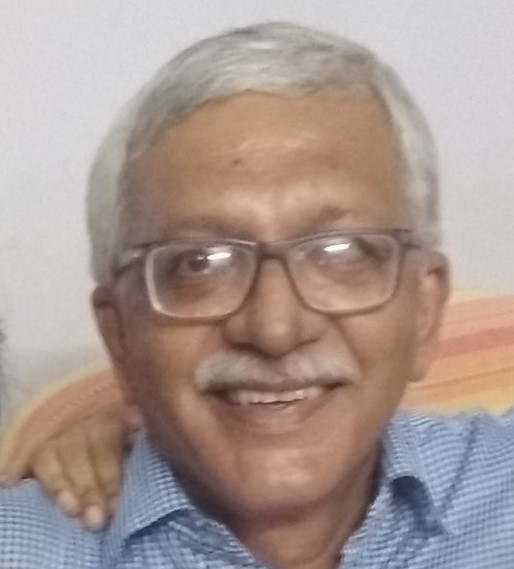
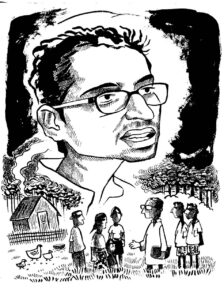
Who is Sudhir Dhawale?

Who is Sudhir Dhawale?

Sudhir Dhawale

Nov 2019

By Mumbai Rises to Save Democracy

Sudhir believes that every revolution has to be “unique”

Sudhir Dhawale’s rm commitment to activism is grounded in his belief in justice. Growing up in Indora , a centre of Ambedkarite politics in Nagpur, Sudhir has since his younger days, been actively involved in the struggles for human rights and dignity. He was part of people’s movement in Nagpur until 1994 then moved to Bombay in search of work opportunities.

From 1995, Sudhir Dhawale dedicated his life towards ghting against the atrocities on Dalits and other marginalized communities.. He was active in the streets and in the courts and has worked on incidents of Dalit atrocities such as the Ghatkopar Ramabai Nagar Dalit Hatyakand, in which 10 Dalits were gunned down by the Mumbai police for agitating against the desecration of a Dr. Ambedkar Statue in 1997. He was also involved in the Khairlanji agitation (against the massacre of a Dalit family in 2006), the Baban Misal murder in Ahmadnagar district in 2008, the ruthless murder of Sahebrao Jondhale in Marathwada in 2008, the Sadashiv Salve Guruji murder in Beed district in 2009, the Manorama Kamble gang rape and murder case in Nagpur in 2009, the Rohidas Tupe murder in Palgaon near Aurangabad in 2009, and many more cases of atrocities against Dalits in Maharashtra.

In 2002, following the Gujarat pogrom massacres, he started a Marathi magazine named Vidrohi. It started as a four-page magazine and soon doubled into eight pages. In a few years, it took the shape of a full- edged magazine which was published twice every month and spoke of pertinent issues concerning the country. It continues to play a pivotal role in bringing in the Dalit voice on human rights abuse of Dalits and other minorities across India, and also publishes fact- nding reports and valuable literature.

After the Khairlanji massacre took place in 2006, many Ambedkarite, left and other progressive organizations felt the need to form and drive a movement based on anti- caste politics with a concrete long-term program of caste annihilation. With this understanding, on December 6, 2007 at the Chaityabhoomi in Mumbai, the Republican Panthers Jaatiya Antachi Chalwal (Republican Panthers Caste Annihilation Movement) was formed. Sudhir, one of the founding members of this organisation, with years of experience and political intellect, evolved a new theoretical framework for the Republican Panthers situating the caste annihilation program at its centre. As a cultural group, Republican Panthers brought their revolutionary music and street theatre to the slums, trade unions, school and protests, to describe the atrocity that is the Hindu caste system.

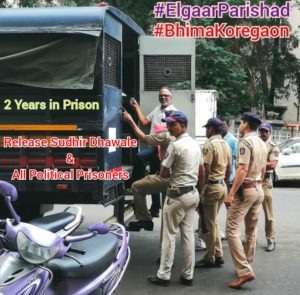
In 2011, the Maharashtra police arrested Dhawale on charges of sedition and of being a member of and providing support to a terrorist organisation. In May 2014, after Dhawale had spent 40 months in incarceration, RG Asmar—a judge presiding over a special UAPA court in Gondia, a district in Maharashtra— pronounced a judgment acquitting Dhawale and eight others of all charges. The judgment was strongly worded, and the court came down heavily against the state police for its investigation.

It is believed that it was the magazine Vidrohi that brought the ire of the establishment and became the reason for his arrest. Upon his release Sudhir did not only increase the reach of Vidrohi but also led many protests and marches on di erent social issues. He was actively leading several joint fronts formed against caste atrocities, like the Jatiya Atyachar Virodhi Kruti Samiti, the Joint Action Committee for Social justice, the Bhima Koregaon Shaurya Din Prearna Abhiyan and many more.
Incidentally, the lawyer who represented him in the 2011 case was Surendra Gadling, his co-accused in the current Bhima Koregaon case.

Sudhir also incorporated his political experiences and understanding on the paper. It was not only through the Vidrohi magazine, but also many books that he wrote and edited, on diverse socio-political issues. During his time in prison, he has written three books. His writings are sharpened through the assimilation of the pain and struggle of the masses.

Sudhir along with others, had called for the Elgar Parishad on December 31, 2017, bringing together Dalit, Maratha and Muslim leaders on one platform to commemorate the two- hundredth anniversary of the Bhima Koregaon battle and to discuss the State’s crackdown on the marginalised sections of the society.

As an organizer, writer, poet, playwright, freelance journalist and editor of Marathi magazine Vidrohi, Sudhir Dhawale has tried to bring the issues of injustice and atrocities against Dalits in the public domain to make democracy a substantive force and movement in the country.

Sudhir’s words are active, gritty, and capable of moving stones.
Sudhir explains that every revolution has to be “unique”.
To our own unique Revolution…

“What sort of a city is this?

What sort of people are you?

When injustice is done there should
be a revolt in the city.

And if there is no revolt,

It were better that the city should
perish in fire before the night falls…”

Lines from The good Person of Szechwan
a play written by Brecht. The lines
in Marathi were quated in the fir for
`provoking´ the crowd present in Elgar Parishad.


Who is Sudhir Dhawale?

By India Civil Watch

After spending close to four years (2011-2014) in jail in India (where he was denied every kind of human right) on charges of being a ‘Naxalite’, Sudhir Dhawale was acquitted of all charges. Reflecting on his traumatic experience, Sudhir soberly identifies his private struggle as being part of a much larger public and collective struggle for democratic values. Sudhir:

Read More Read More

Who is Mahesh Raut?

Who is Mahesh Raut?

Mahesh Raut

Mahesh Raut

Nov 2019

By Mumbai Rises to Save Democracy

“Mahesh is highly loved and respected in all these villages and one with the people I visited. They treated him as if he were a member of their own house!”

Hailing from Maharashtra’s Gadchiroli district, Mahesh Raut is a young prominent activist working for the rights of Adivasi communities in his district. Born in Lakhapur, a small village in Maharashtra, Mahesh completed his schooling from Gadchiroli and moved to Nagpur for graduation. He later went on to pursue higher education from the Tata Institute of Social Sciences, Mumbai. On completing his education he worked as Prime Minister Rural Development Fellow (PMRDF) in Gadchiroli. He has tirelessly advocated for laws like The Provisions of the Panchayats (Extension to Scheduled Areas) Act and Forest Rights Act which protect the democratic rights of indigenous communities against unlawful land grabbing by large corporations. Mahesh has consistently worked to protect and promote the rights of the marginalised within a Constitutional framework. On completion of his fellowship, Mahesh decided to continue working with the Adivasi communities in the State.

Mahesh organised and participated in mass movements to abet the cause of social welfare. He was the co-convenor of Visthapan Vidrohi Jan Vikas Andolan (VVJVA) which ghts against the forced displacement of Adivasis and other marginalised people. As a member of VVJVA, Mahesh organised the Tendu leaves workers from Adivasi communities of the region to sell them directly in the market without the involvement of middlemen.

Along with campaigning for the Adivasis of the region, he also joined the Bharat Jan Andolan (BJA), an organisation started by late BD Sharma. Through his work with BJA, Mahesh has been instrumental in organising people for participative decision making in regions a ected by mining projects, including the Surajgarh mining project.

His work against the atrocities of Police and several State authorities led to several cases being led against him. According to a letter drafted by his PMRDF fellows, the State’s crackdown on Mahesh started from 2013 citing his consistent political engagement as one of the reasons for his harassment. His friend and fellow activist Sohini Shoaib, working in Bihar writes about her visit to Gadchiroli, “Mahesh was highly loved and respected in all these villages and one with the people I visited. They treated him as if he were a member of their own house! Some of them even tried to get me to convince him to get married: they thought he worked too hard and did not take care of his health enough. They hoped that nding a partner would help him feel less lonely, help him balance other aspects of life!”

In 2018, Mahesh was picked up by the Pune Police for his alleged involvement in organising the Elgar Parishad and his alleged Maoist links. He was booked under sections of the UAPA and arrested from his residence in Nagpur. Neither was he involved in organising the Elgar Parishad nor did he attend the 31st December events. His arrest is a clear crackdown of the State on Human Rights defenders who are struggling against the State and Corporation nexus. His contributions to promote and uphold Constitutional rights of the marginalised identities have led him to persecution and consequent imprisonment. His incarceration is a standing testament of the State’s repression of Rights’ activists who protect the values of the Constitution which the same State is trampling upon.


Mahesh Raut (left) and Lalsu Narote. Foto credit: Javed Iqbal/ The Wire

Who is Mahesh Raut?

By India Civil Watch

Lalsu Nogoti, an elected district council member from Bhamragad in Maharashtra is speaking about the work of Mahesh Raut:
“He first came to us as a part of the PMRD [Prime Minister’s Rural Development] fellowship in 2013. He would visit every village with other government officials and meticulously note down grievances and parallelly also research on several village and state-level policies that could come to our rescue. His work in the formative years helped us build our struggles in the coming days.”

Read More Read More

Who is Rona Wilson?

Who is Rona Wilson?

By India Civil Watch

Rona Wilson is the 47-year old Public Relations Secretary of the Committee for the Release of Political Prisoners (CRPP). He was arrested under the UAPA on June 6, 2018, in Delhi, at the same time as Shoma Sen, Surendra Gadling, and Mahesh Raut in Nagpur and Sudhir Dhawale in Mumbai, and accused of channeling Maoist funds for the Elgar Parishad and fomenting violence in Bhima Koregaon.

Read More Read More

Who is Stan Swamy?

Who is Stan Swamy?

By India Civil Watch

On the morning of August 28, 2018 Maharashtra police raided the one room home of Fr.Stan Swamy, who lives on the outskirts of Ranchi on Bagaicha campus, under suspicion of him being involved in the violence at Bhima Koregaon. The police confiscated his laptop, mobile phone and several CDs, and a recent press release on the Pathalgadi movement by Women against Sexual violence and State repression (WSS).
What does an 82 year old Jesuit priest has got to do with Bhima-Koregaon case? Everything, if he is a stalwart of people’s causes.
Read more

Who is Gautam Navlakha?

Who is Gautam Navlakha?

By India Civil Watch

Gautam Navlakha is a Delhi-based veteran journalist, author, civil liberties, human rights and peace activist best known for his fierce and sustained critique of the Indian state’s militarism against its own citizenry in three broad zones – the northeastern states, Kashmir valley, and the central Indian forested zone in Chhattisgarh. He has been actively involved with the People’s Union for Democratic Rights (PUDR) – one of India’s leading civil liberties and democratic rights defence organizations- working to protect, extend and help implement fundamental rights as guaranteed in the Indian constitution.
Read more

Still in Jail, Inspite of Bail: The Case of Reliance Workers

Still in Jail, Inspite of Bail: The Case of Reliance Workers

Thozhilalar Koodam / By Thozhilalar Koodam

In January 2018, 5 electricity workers from Bombay were arrested on fabricated charges under Unlawful Activities Prevention Act (UAPA). After the police failed two deadlines for filing a chargesheet against them, and the prosecution did not even notify them of the extensions to their imprisonment, the High Court of Maharashtra ordered the sessions court to grant them bail on procedural reasons. This order was served in December 2018, 11 months after their arrests. But the sessions court has imposed conditions on bail that the workers have been unable to meet, thus leaving them in Jail for over two months since the bail was granted.
Read more

Who’s afraid of Anand Teltumbde?

Who’s afraid of Anand Teltumbde?

The Wire / by N. Balmurli

Teltumbde’s writing has exposed the hypocrisy of the votaries of neo-liberal capitalism, caste deniers and Hindutva triumphalists. It is they who seek to silence him today.
Teltumbde is one of India’s most well-respected public intellectuals – taking public positions on public issues in intellectually defensible ways through his long-standing regular column with the Economic and Political Weekly, or his frequent op-eds in Indian newspapers, or his scholarly writings in journals and books, or his fact-finding reports on atrocities around the country.
Read more