Browsed by
Category: Background

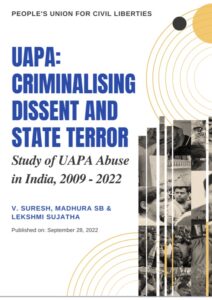
PUCL Report: UAPA – CRIMINALISING DISSENT AND STATE TERROR (#RepealUAPA campaign)
PUCL Report: UAPA – CRIMINALISING DISSENT AND STATE TERROR (#RepealUAPA campaign)

PUCL Report: UAPA – CRIMINALISING DISSENT AND STATE TERROR (#RepealUAPA campaign)

28/09/2022

By V. Suresh, Madhura SB and Lekshmi Sujatha (PUCL)

Study of UAPA Abuse in India, 2009 – 2022
Published: Sep 28, 2022
41 pages
PUCL’s study on the use and abuse of UAPA covering the period between 2009 and 2022, with special emphasis on the NIA. A first in the series of a larger collaborative work as part of #RepealUAPA campaign.
Download report


PUCL report alleges abuse of Unlawful Activities (Prevention) Act

02/10/2022

The Hindu / by The Hindu Bureau

Report by the People’s Union for Civil Liberties says ‘suo motu power’ by Centre to transfer investigation from the State police was a ‘serious threat to federalism’
The People’s Union for Civil Liberties (PUCL) has released a report titled ‘UAPA: Criminalising Dissent and State Terror’ on the alleged abuse of the legislation during 2009-22, and demanding the law be repealed.
Read more


97.2% of UAPA accused jailed for long periods and eventually acquitted, study finds

02/10/2022

The News Minute / by Jahnavi Reddy

The PUCL study found that 8,371 persons were arrested under the Unlawful Activities Prevention Act between 2015 and 2020, while only 235 were convicted under the draconian anti-terror law in the same period.
A total of 8,371 persons were arrested in 5,924 cases under the draconian Unlawful Activities Prevention Act (UAPA) across India between 2015 and 2020, according to a report by the People’s Union for Civil Liberties (PUCL), which sheds light on the Union government’s alleged abuse of the anti-terror law and calls to repeal it. In the same period, however, only 235 persons were convicted under the UAPA.
Read more
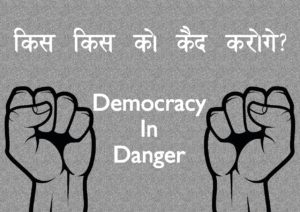
NCHRO calls for solidarity to Lawyers and Human Rights Defenders who are arbitrarily detained

NCHRO calls for solidarity to Lawyers and Human Rights Defenders who are arbitrarily detained

Poster campaign, 2020

By National Confederation of Human Rights Organizations (NCHRO)

27/09/2022

This letter elaborates our concerns about the unlawful detention of lawyers and other human rights defenders who were arrested on September 22nd, 2022 in an early morning raid along with over 100 others across the country by the National Investigation Agency (NIA), the principal counter-terrorist task force of India and Enforcement Directorate. The activists have been arbitrary detained under repressive laws including the Unlawful Activities (Prevention) Act (UAPA). Such detentions have become a regular practice of the present government…

The Bhima Koregaon case is just one emblematic example of the Indian authorities’ increasing use of anti-terror legislation, particularly the Unlawful Activities (Prevention) Act (UAPA) to punish those who ask questions about the illegitimate anti-minority and anti-poor stances.
Read full statement


The National Confederation of Human Rights Organisations (NCHRO) halts its work in the country

28/09/2022

By National Confederation of Human Rights Organizations (NCHRO)

The National Confederation of Human Rights Organisations (NCHRO) halted its work in the country as the news came that the Ministry of Home Affairs (MHA) had banned the organisation. This is a reprisal for the organization’s human rights work. The NCHRO is very proud of the vital human rights work carried out by the confederation.
As a result, we are suspending all our activities. Effective immediately, NCHRO halted all its programmes and we are not engaged and responsible for any posts on social media.
We will pursue legal remedies against this injustice.

Sincerely,
Prof A Marx

Prisoners of Conscience Under Modi Regime

Prisoners of Conscience Under Modi Regime

By Communist Party of India (Marxist-Leninist) Liberation

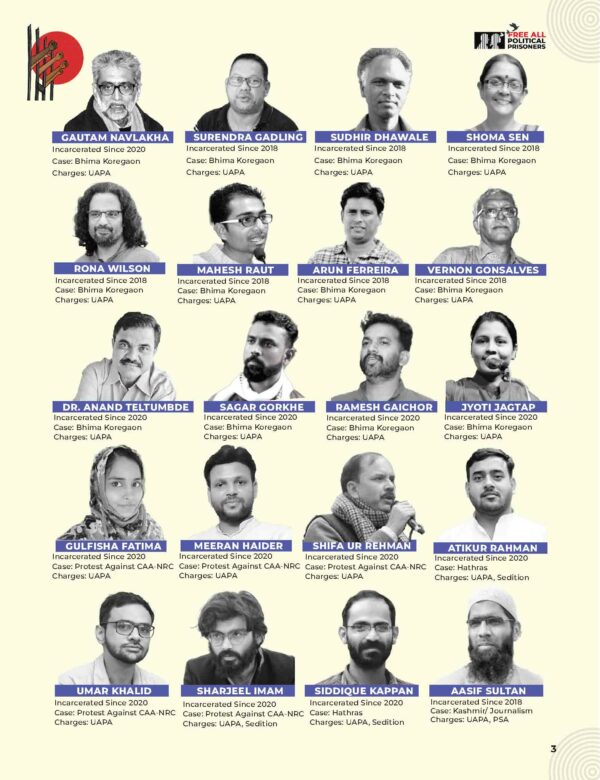
Since the BJP’s rise to power in 2014, the list of people -ranging from human rights activists to lawyers, and journalists to students – being persecuted for their identity and their fidelity to fighting for democratic and progressive rights, has grown rapidly. Starting from the arrests related to Bhima Koregaon in 2018 and protests against CAA in 2020 to the recent arrests of activist  Teesta Setalvad and journalist Mohammad Zubair, the current regime is bent on imprisoning any person who speaks uncomfortable truths and exposes their lies.
Read full statemnt

Click to enlarge

Also visit:

Prisoners of Conscience in India. The Prisoners of Conscience in India (PoCI) documents and highlights the cases of people who have been imprisoned in India because of their peaceful expression of political, religious, or other conscientiously held beliefs.

Political Prisoners Unite the British Raj and ‘New India’

Political Prisoners Unite the British Raj and ‘New India’

The Wire / by Partho Sarothi Ray

Just as the British rulers used to refer to political prisoners during their rule as ‘terrorists,’ the rulers of today also call people imprisoned for opposing them ‘terrorists’.

Today, September 13, is Political Prisoners Day.

“Ora Bhagat Singher bhai, ora Khudiramer bhai,
Samasta rajbandider mukti chai, mukti chai”
(‘They are the brothers of Bhagat Singh, they are the brothers of Khudiram,
We want the freedom of all political prisoners’)
– Popular Bengali song by Bipul Chakraborty

On September 13, 1929, Jatin Das, the 24-year-old revolutionary freedom fighter, died in Lahore Jail after a 63-day long hunger strike, demanding humane treatment of political prisoners under the British Raj…
The current government has similarly instituted cases like the Bhima Koregaon-Elgar Parishad case and the Delhi riots case to allege ‘conspiracies’ and thereby imprison a large number of activists and critics and demonise them as ‘anti-nationals’ and ‘terrorists’.
Read more


Video: Custodial Violence, Judicial Negligence and State Apathy

12/09/2022

en │ 52min │2022

By The Polis Project

On 5 October 2020, Atikur Rahman, journalist Siddique Kappan, student Masood Ahmad, and taxi driver Mohammad Alam were arrested in Mathura, in Uttar Pradesh in, India They were on their way to meet the family of a Dalit woman who was raped and murdered by a group of men from the dominant caste in Hathras…
The denial of medical treatment and bail must be seen as a part of a larger pattern of abuse of power directed toward dissenters and political prisoners in India. On 5 July 2021, 84-year-old Jesuit priest and human rights defender Father Stan Swamy died in judicial custody at the Holy Family Hospital in Mumbai, India.
Watch video

“Was Stan Swamy a Maoist?” By A Fellow Traveller

“Was Stan Swamy a Maoist?” By A Fellow Traveller

Stan Swamy

Academicfreedomindia.com / by a Fellow Walker

In this post, a fellow traveller of Stan’s in prison shares his reflections about the Jesuit priest who became one India’s foremost human rights defenders: the background to Stan’s own awakening and then participation in the continuing resistance movements among the most marginalised of Indian citizens, its indigenous peoples, the Adivasis: 

People call him Father Stan Swamy. This way of addressing is different from the Maoist usage. He opted for the Christian way of life in the Jesuit order when he was an adolescent. He migrated from Tiruchirappalli in Madras State to Jamshedpur which was, at that time, part of the undivided Bihar State. Jamshedpur is the habitat of tribal people. The people who work in the coal reserves and steel factories, and the people who live in the nearby forests are all tribals. Being idealistic from a very young age, Stan was influenced by the preaching and practice of Jesus Christ.
Read more

Address reprisals against activists in India: International Human Rights groups to EU

Address reprisals against activists in India: International Human Rights groups to EU

Address reprisals against activists in India: International Human Rights groups to EU

28/07/2022

Sabrangindia / by Sabrangindia

The groups named Fr. Stan Swamy, Teesta Setalvad and Khurram Parvez, in a joint statement urging EU to look into how activists are being targeted in India.
Five international human rights groups have issued a joint statement urging the European Union to address reprisals against human rights defenders and systematic attacks on civil society actors in India.
Read more


Joint statement: Address reprisals against human rights defenders in India

27/07/2022

www.fidh.org / by INTERNATIONAL FEDERATION FOR HUMAN RIGHTS

The joint European Union (EU)-India press release, which provides a summary of the topics discussed during the 10th EU-India human rights dialogue which took place on 15 July 2022 in New Delhi, fails to adequately address pressing issues of security and reprisals faced by human rights defenders in India, five human rights organizations said today.
… Indian rights defenders need immediate support and an end to systematic attacks, threats and arbitrary arrests. Of the 16 defenders arrested in relation to the Bhima Koregaon case, 13 remain in jail. On 5 July 2021, 84-year-old Stan Swamy died in custody due to the lack of medical treatment. There has been no public acknowledgment of the State’s complicity in his incarceration and death.
Read more

India’s President Droupadi Murmu and ‘an Unbroken History of Broken Promises’ – by Suhda Bharadwaj

India’s President Droupadi Murmu and ‘an Unbroken History of Broken Promises’ – by Suhda Bharadwaj

Sudha Bharadwaj

The Quint / by Sudha Bharadwaj

Draupadi Murmu has difficult tasks cut out for her if she is to protect rights and ensure justice to the Adivasis.
The reference in the headline is to the passionate essay by the late Dr BD Sharma of the same title. The continuing criminalisation of the Adivasi peoples is seen even in the 75th year of our Independence.
In the past couple of weeks, several very important events have taken place that will deeply affect the Adivasi people of our country.
Read more


Also read:
● Now that an Adivasi is president, will Big Media finally report on Adivasi issues? (Newslaundry / July 2022)
● Jailed Or Punished, With Or Without Trial: How The State Misuses The Law Against India’s Inconvenient Citizens (article 14 / July 2022)
● Narendra Modi’s Government Is Using False Charges of Terrorism to Repress Its Opponents (Jacobin.com / April 2022)
● Organisation In Jharkhand Is Holding The State Accountable (YKA / April 2022)
● Gadchiroli’s 300 Gram Sabhas Pass Resolution in Support of Activist Mahesh Raut (The Wire / Oct 2018)
● Press Release Of The Joint Fact Finding in Gadchiroli by CDRO, IAPL And WSS (WSS / May 2018)

Chidambaram: ‘Process is the Punishment’ / A former SC judge on the decay in the criminal justice system

Chidambaram: ‘Process is the Punishment’ / A former SC judge on the decay in the criminal justice system

P Chidambaram writes: ‘Process is the Punishment’

24/07/2022

The Indian Express / by P Chidambaram

P Chidambaram writes: Why are the accused denied bail? Pre-charge evidence, framing of charges, trial and arguments will — not may, it is will — take many years. Should the accused be in jail until the trial is over? Is pre-trial incarceration a substitute for trial, proof, conviction and punishment?
… In current times, there is no story more shocking than the story of the 16 accused in what is known as the Bhima Koregaon case.
Read more


Liberty is too precious to be lost: A former SC judge on the decay in the criminal justice system

22/07/2022

Scroll.in / by Madan B Lokur

A starting point can be making some trial judges realise that they need to stop acting as a rubber stamp of the police in matters of arrest.
“What’s going on?” a young lady asks quizzically in a television advertisement. The same question must be asked of criminal justice and India’s prisons.
Bail, not jail has been reduced to a mere slogan to be whispered once in a while. The reality is jail, not bail. Another reality is that innocent until proven guilty has been transformed to guilty until proven innocent.
Read more

Will Murmu Remain Help Unseen Adivasis Be Seen at Last? / Defending India’s Human Rights Defenders

Will Murmu Remain Help Unseen Adivasis Be Seen at Last? / Defending India’s Human Rights Defenders

Will Droupadi Murmu Remain a BJP Electoral Ploy or Help Unseen Adivasis Be Seen at Last?

21/07/2022

The Wire / by Ajoy Ashirwad Mahaprashasta

BJP is sure to celebrate its own decision to get an Adivasi President elected more than Murmu’s own achievements as a loyal political worker. It remains to be seen if they will let her have her own voice.
… Those who have been working for Adivasis’ causes point out that while BJP may congratulate itself in nominating Droupadi Murmu, their governments have mostly struck down or dismissed autonomous movements led by Adivasis. People like Father Stan Swamy (who passed away due to alleged medical negligence while in jail), Sudha Bharadwaj, or Surendra Gadling, all of whom have devoted their lives to improve the conditions of Adivasis, have been arrested under charges of terrorism in the Elgar Parishad case.
Read more


Defending India’s Human Rights Defenders

21/07/2022

South Asian Voices / by Ria Chakrabarty

On July 5, 2021, Jesuit Priest and human rights defender Father Stan died in Indian custody at the age of 84. He was the oldest person to be arrested by the Indian government for terrorism. Father Stan’s incarceration led to a global outcry against the Indian government’s brutal treatment of Indian human rights defenders.
Father Stan is one of a mushrooming group of prisoners of conscience whom the Indian government has jailed over the past few years.
Read more


Also read:
● ‘Religious Freedom Worsened’: US Body Names India as ‘Country of Particular Concern’ (The Wire / April 2022)
● 2022 ANNUAL REPORT (U.S. Commission on International Religious Freedom (USCIRF) / April 2022)

Jailed Or Punished, With Or Without Trial: How The State Misuses The Law Against India’s Inconvenient Citizens

Jailed Or Punished, With Or Without Trial: How The State Misuses The Law Against India’s Inconvenient Citizens

Article14 / by Mani Chander

The arrests and continued incarceration of fact-checker Mohammad Zubair, political activist Javed Mohammed and the exoneration of 121 Adivasis accused of terrorism are the latest evidence of how the State adopts extra legal methods of dealing with ‘inconvenient citizens’- including journalists, dissidents, activists or the poorest Indians – to push official narratives of conspiracy and terrorism. The common threads: manipulation or egregious misinterpretation of laws, changing accusations, unknown or untraceable complainants and the abandonment of due process by police and courts.
Read more